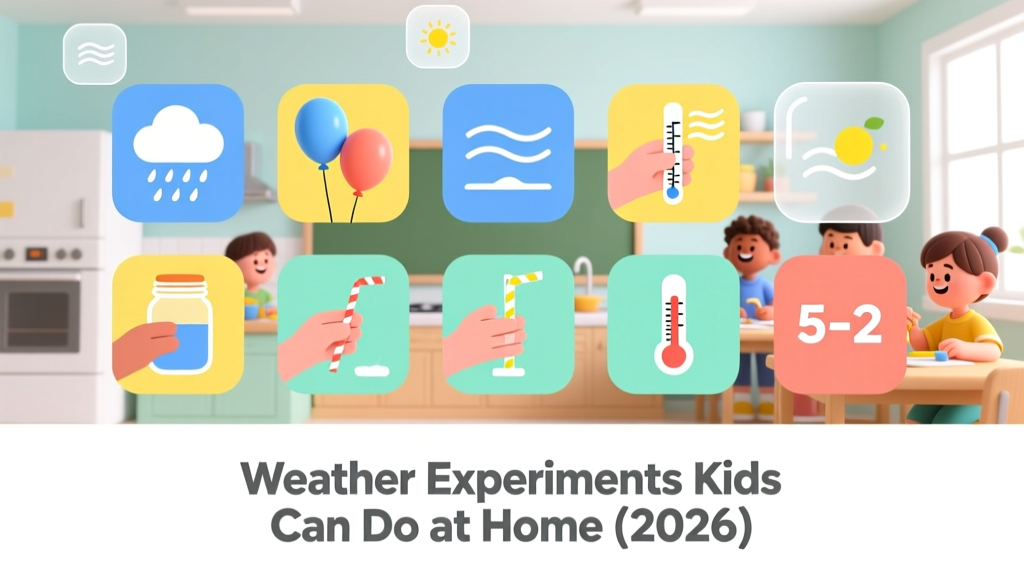
Weather Experiments Kids Can Do at Home (2026)
12 Weather Experiments
1. Cloud in a Jar
Ages 4+ Fill a jar with warm water (1/3 full). Light a match, blow it out, and drop the smoky match in. Quickly put the lid on and squeeze a cold wet cloth on top. A cloud forms inside! The smoke particles act as condensation nuclei — just like real clouds.
2. DIY Barometer
Ages 7+ Stretch a balloon over a jar opening. Tape a straw to the balloon as a pointer. Mark the straw's position daily. When air pressure drops (storm coming), the balloon sinks and the straw points down.
3. Rain Cycle in a Bag
Ages 3+ Draw the water cycle on a ziplock bag. Add a little water. Tape it to a sunny window. Watch evaporation, condensation, and "rain" inside the bag over days.
4. Tornado in a Bottle
Ages 5+ Fill a bottle 3/4 with water. Add a drop of dish soap and glitter. Spin the bottle in a circle. A vortex forms — same physics as real tornadoes.
5. Wind Vane
Ages 6+ Cut an arrow and tail from cardboard. Attach to a straw with a pin through an eraser on a pencil. It spins to show wind direction. Track daily patterns.
6. Rainbow Maker
Ages 4+ Fill a glass with water. Hold it near a window so sunlight passes through. A rainbow appears on the wall. The water acts as a prism, splitting white light into colors.
7. Thermometer from a Bottle
Ages 8+ Fill a bottle with colored water and water mixture. Insert a clear straw sealed with clay. As temperature rises, the liquid expands up the straw. Calibrate against a real thermometer.
8. Rain Gauge
Ages 5+ Cut the top off a plastic bottle. Invert the top as a funnel. Mark measurements on the side. Leave outside and record daily rainfall. Compare to weather reports.
9. Static Lightning
Ages 6+ Rub a balloon on hair. Bring it near a small piece of aluminum foil. A tiny spark jumps — this is the same principle as lightning, just much smaller.
10. Dew Point Demo
Ages 8+ Fill a metal can with ice water. Watch the outside fog up. That's dew forming — the can cooled the air below its dew point. Measure the temperature when dew first appears.
11. Wind Speed Anemometer
Ages 9+ Attach 4 paper cups to a cross of straws with a pin through the center. One cup gets a mark. Count rotations per minute to estimate wind speed.
12. Greenhouse Effect Model
Ages 8+ Two thermometers in sunlight. Cover one with a clear jar. The covered one gets warmer — the glass traps heat like greenhouse gases trap heat in the atmosphere.
Weather Journal Template
Encourage kids to keep a daily weather log:
| Observation | How to Measure |
|---|---|
| Temperature | Thermometer (°F and °C) |
| Cloud type | Cumulus, stratus, cirrus — draw them |
| Wind direction | Wind vane or wet finger test |
| Rainfall | Rain gauge (inches or mm) |
| Humidity feel | Sticky, comfortable, or dry |
More Articles
 MIT Admission Secrets: What Really Matters in 2026
 LEGO Engineering Challenges for Kids (2026)
 Math Games That Make Numbers Fun for Kids
 What Is 67 for Kids? Building Place Value Confidence
 Science Fair Projects: 2026 Winner Ideas
 Are You Smarter Than a 5th Grader? STEM Truth (2026)
 What Is a Hypothesis for Kids? (2026)
 Arts & Crafts Tools Educators Actually Use
 STEM Learning Essentials for Educators
 Teaching Kids How to Use a Compass (2026)