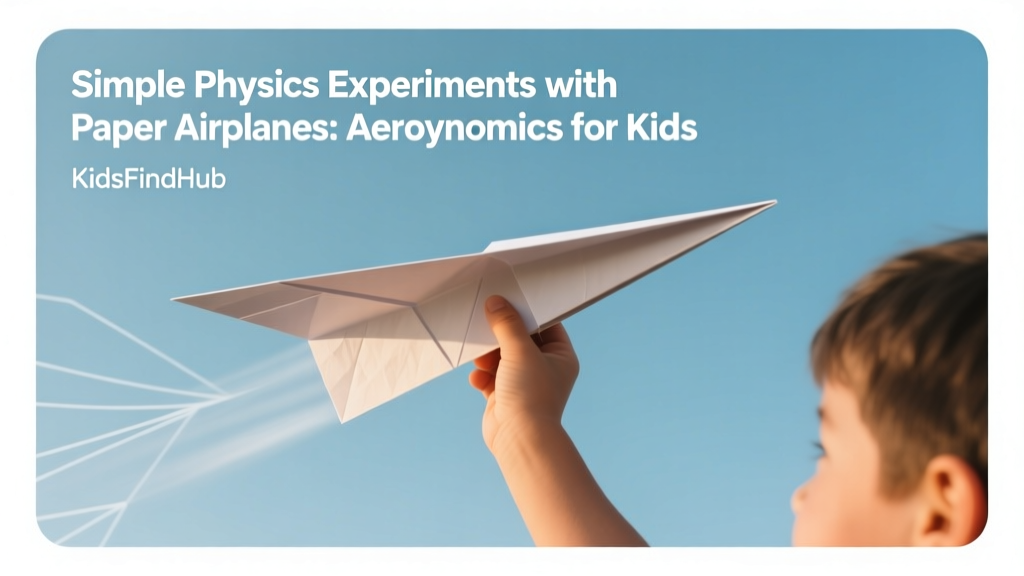
Paper Airplane Physics Experiments for Kids
Simple Physics Experiments with Paper Airplanes: Aerodynamics for Kids
A paper airplane is the most accessible physics laboratory in existence. For the cost of a sheet of paper, children can explore the same aerodynamic principles that aerospace engineers use to design real aircraft. This guide transforms paper airplane play into structured scientific inquiry.
The Four Forces of Flight
Every flying object — from a paper airplane to a Boeing 747 — is subject to the same four forces. Understanding these is the foundation of aerodynamics:
- Lift: The upward force created by air flowing over wings
- Gravity: The downward pull toward Earth
- Thrust: The forward force (your arm, in this case)
- Drag: Air resistance that slows the plane down
Experiment Framework
| Component | What to Do | Learning Goal |
|---|---|---|
| Hypothesis | Predict what will happen | Scientific thinking |
| Variable | Change one thing at a time | Experimental control |
| Measurement | Record distance/time | Data collection |
| Analysis | Compare results | Pattern recognition |
| Conclusion | What did you learn? | Scientific communication |
12 Experiments
1. Wing Shape vs. Distance (Ages 5+)
Build 3 planes with different wing shapes: wide, narrow, and delta. Throw each 5 times and measure distance. Which goes farthest? Why? Teaches: lift, wing loading, surface area.
2. Weight Distribution (Ages 7+)
Add a paper clip to the nose, then the tail, then each wing. How does each position affect flight? Teaches: center of gravity, stability, pitch.
3. Launch Angle Experiments (Ages 6+)
Throw the same plane at 0°, 15°, 30°, and 45° angles. Measure distance for each. What's the optimal angle? Teaches: projectile motion, trajectory optimization.
4. Paper Weight Comparison (Ages 8+)
Build identical designs from printer paper, cardstock, and newspaper. How does weight affect flight? Teaches: mass, air resistance, structural integrity.
Data Collection Sheet Template
Create a simple data table for each experiment:
- Column 1: Plane design or modification
- Column 2-6: Distance of throws 1-5
- Column 7: Average distance
- Column 8: Observations (nosedived, spiraled, glided)
Frequently Asked Questions
What's the best paper airplane design for distance?
The Suzanne design (named after John Collins' wife) holds the world record at 226 feet. However, the classic dart design is best for teaching — it's simple enough for young kids to fold and responds clearly to modifications.
How do I make this appropriate for different age groups?
Ages 4-6: Focus on throwing and observing. Ages 7-9: Add measurement and comparison. Ages 10+: Include data analysis, graphs, and scientific explanations.
Final Thoughts
Physics doesn't have to be abstract or intimidating. When a child tweaks a paper airplane and watches it fly farther, they're doing real science. The key is asking why? after every throw and treating each modification as an experiment. Before you know it, your kids will be explaining Bernoulli's principle at the dinner table.
More Articles
 Best Microscope for Kids + 25 Things to See
Best Robotics Kits for Elementary Students 2026
Best Microscope for Kids + 25 Things to See
Best Robotics Kits for Elementary Students 2026
 Evidence-Based Learning Strategies for Skill Acquisition
 Nuclear Energy for Kids: Simple, Safe & STEM-Ready
 Baking Soda & Vinegar Volcano Experiment
 Weather Experiments for Kids: Rain Cloud in a Jar
 Map Literacy for Kids: Build Spatial Skills (2026)
 Build a Homemade Weather Station with Kids
 Simple Machines: Hands-On Projects for Kids