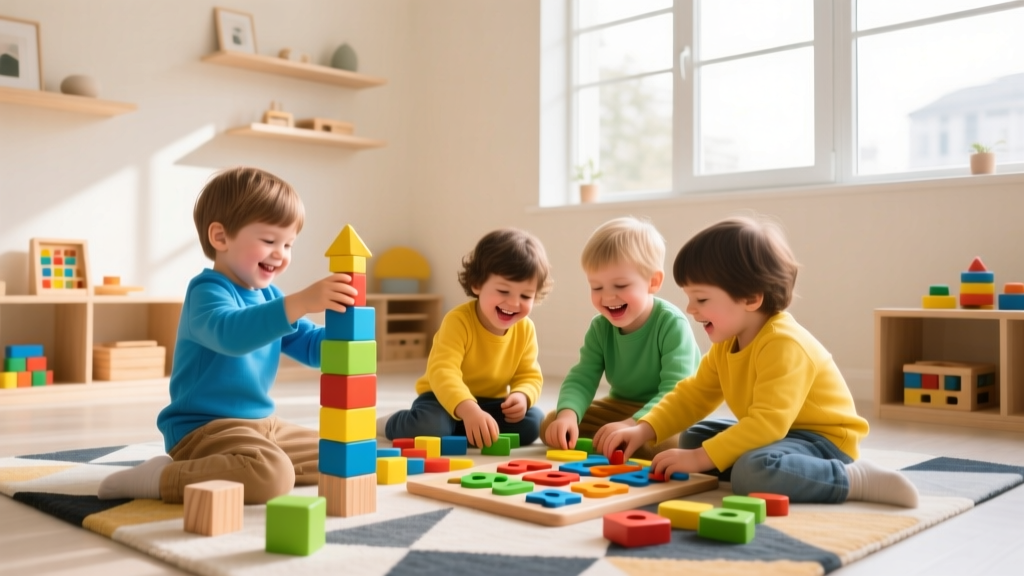
10 Easy Physics Experiments with Household Items
Why Physics Belongs in Your Living Room
Physics isn’t just for whiteboards and textbooks—it’s the science of why balloons stick to walls, why cereal jumps toward a magnet, and how a cardboard tube can launch a ping-pong ball across the room. In 2026, hands-on STEM learning is more vital than ever: research from the National Science Teaching Association shows children who engage in early, playful physics exploration develop stronger problem-solving skills and lasting curiosity. Best of all? You don’t need a lab—just common household items and 15 minutes of shared wonder.
These experiments are designed for real families: low-cost, low-mess (most clean up in under 2 minutes), and scalable by age. A toddler can feel air pressure pushing a straw through clay, while a 12-year-old can calculate acceleration using a smartphone timer and a ramp made from a book and baking sheet.
5 Quick & Safe Experiments for Ages 2–6
For preschoolers and early elementary kids, focus on sensory discovery, cause-and-effect, and vocabulary building (push, pull, float, sink, spin, bounce). Always supervise closely—especially around water, small parts, or stairs.
- Straw Rocket Launch: Cut a 2-inch piece from a plastic drinking straw. Slide it over the eraser end of a pencil. Place a small piece of modeling clay at the pencil tip (to seal it). Blow hard into the straw—watch the pencil zoom! Science takeaway: Air pressure pushes the pencil forward (Newton’s Third Law).
- Dancing Raisins: Fill a clear glass halfway with club soda. Drop in 5–6 raisins. Watch them rise, sink, and dance for 2+ minutes! Why? Carbon dioxide bubbles cling to the rough raisin skin, lifting them up—then pop at the surface, sending them down again.
- Static Butterfly: Cut a simple butterfly shape from tissue paper. Rub an inflated balloon vigorously on hair or wool for 10 seconds. Hold it above the butterfly—the wings will lift and flutter! Tip: Try different fabrics (cotton vs. fleece) to compare static strength.
- Color Climbing Water: Line up 5 clear cups in a row. Fill cups 1, 3, and 5 with water. Add red food coloring to cup 1, yellow to cup 3, blue to cup 5. Fold 4 paper towels into strips; place one end in a colored cup and the other in the adjacent empty cup. By bedtime, colors will ‘walk’ and mix—creating orange and green in the middle cups!
- Magnet Treasure Hunt: Hide paper clips, plastic beads, aluminum foil bits, and wooden buttons in a shallow tray of rice. Let your child use a fridge magnet to find ‘treasures.’ Sort findings into ‘magnetic’ and ‘not magnetic’ piles—and discuss patterns (e.g., ‘All our magnetic things are made of metal’).
5 Engaging Experiments for Ages 7–12
School-age kids thrive on prediction, measurement, and iteration. These activities introduce core physics concepts—including force, energy transfer, density, and light refraction—with opportunities to record data, sketch diagrams, and ask ‘What if?’ questions.
- Cardboard Ramp Race (Forces & Friction): Build a ramp using a large book propped against a baking sheet. Test 3 ‘cars’: a toy car, a marble, and a LEGO brick wrapped in tape. Time each roll 3 times using a free stopwatch app. Record results. Then add sandpaper to the ramp—how does friction change speed? Discuss why mountain roads have switchbacks (reducing steep force).
- DIY Cartesian Diver (Pressure & Density): Fill a 2-liter plastic bottle to the brim with water. Drop in a condiment packet (ketchup or soy sauce—test first: it must float upright). Screw the cap on tight. Squeeze the bottle—watch the diver sink! Release—watch it rise. Challenge: Can your child adjust the packet’s weight (add tiny paperclip) to make it hover mid-bottle?
- Refraction Rainbow Glass: Place a clear glass on a white sheet of paper. Pour water until it’s ¾ full. Put a single drop of black ink on the bottom. Shine a flashlight horizontally across the glass near the water line. Observe the rainbow spectrum projected on the paper. Real-world link: This mimics how rainbows form when sunlight bends through raindrops.
- Balloon-Powered Car: Tape a blown-up balloon to a plastic bottle cap (use hot glue or strong tape). Attach the cap to the top of a toy car (or build a chassis from cardboard and bottle caps for wheels). Let go—the balloon deflates and propels the car forward. Measure distance traveled with a measuring tape. Try different balloon sizes or wheel surfaces (smooth vs. rubber-banded) to test variables.
- Egg Drop Challenge (Energy Transfer): Give your child 1 raw egg, 10 straws, 1 foot of tape, and 2 sheets of paper. Their goal: design a container that protects the egg when dropped from a step stool (2 ft) and then a chair (3 ft). After each drop, inspect the egg and revise the design. Debrief question: ‘Where did the falling energy go? (Answer: absorbed by crumpling materials—like real car airbags!)’
Pro Tips for Stress-Free Physics Play
Turn kitchen-table science into joyful, meaningful moments—not another chore on your to-do list.
- Embrace the ‘Oops!’ Spilled water? That’s a chance to talk about surface tension and cohesion. A collapsed ramp? Perfect moment to explore structural stability and iterative design. In 2026, educators emphasize process over perfection—and so should you.
- Keep a ‘Science Journal’—even for non-readers. Use sticky notes, voice memos, or quick sketches. One parent in Austin keeps a ‘Discovery Jar’: her 5-year-old drops in a photo + a dictated sentence (“The balloon stuck to my shirt!”) after each experiment.
- Connect to Real Life Daily: While washing dishes, ask: ‘Why does the sponge float but the spoon sinks?’ On a rainy day: ‘How do puddles disappear? (Evaporation!)’ These micro-moments reinforce physics as part of their world—not just a school subject.
- Safety First, Always: Avoid latex balloons for kids under 3 (choking hazard); use Mylar instead. Skip glass containers for under-8s—opt for sturdy plastic. Never heat sealed containers or mix cleaners (e.g., vinegar + bleach = toxic gas). When in doubt, check the U.S. Consumer Product Safety Commission guidelines.
- When Curiosity Peaks, Go Deeper: If your child asks, ‘Why does the balloon stick *only* after rubbing?,’ pull up a 90-second video on electron transfer (try SciShow Kids on YouTube). Or visit your local library’s ‘STEM in a Box’ kit—many U.S. libraries offer free loaner kits with magnifiers, prisms, and circuit sets through 2026’s National STEM Library Initiative.
Physics isn’t about memorizing formulas—it’s about noticing, wondering, testing, and sharing that ‘Aha!’ moment over breakfast cereal. With these 10 experiments, you’re not just teaching science—you’re nurturing resilience, creativity, and the quiet confidence that comes from knowing: I can figure this out. Grab a balloon, a spoon, and some water—and let the living room become your favorite lab.
More Articles
 Euphrates River Facts for Kids: Geography & Activity Ideas
 Cheap vs Premium Skills: What Employers Pay For
 Fossil-Making for Kids: 5 Science-Backed Methods
 Build Simple Machines with Everyday Objects
 Start STEM Learning: Age-Appropriate Roadmap
 Parenting vs. DIY Kits: Better Early STEM Learning
 Simple Machines for Kids: Hands-On Guide
 Best Educational Toys: Science-Backed Picks Ages 1-12
 Best Screen-Free Coding Toys for Ages 4–8
 Kids' Chemistry Experiments: 12 Safe Kitchen-Lab Projects