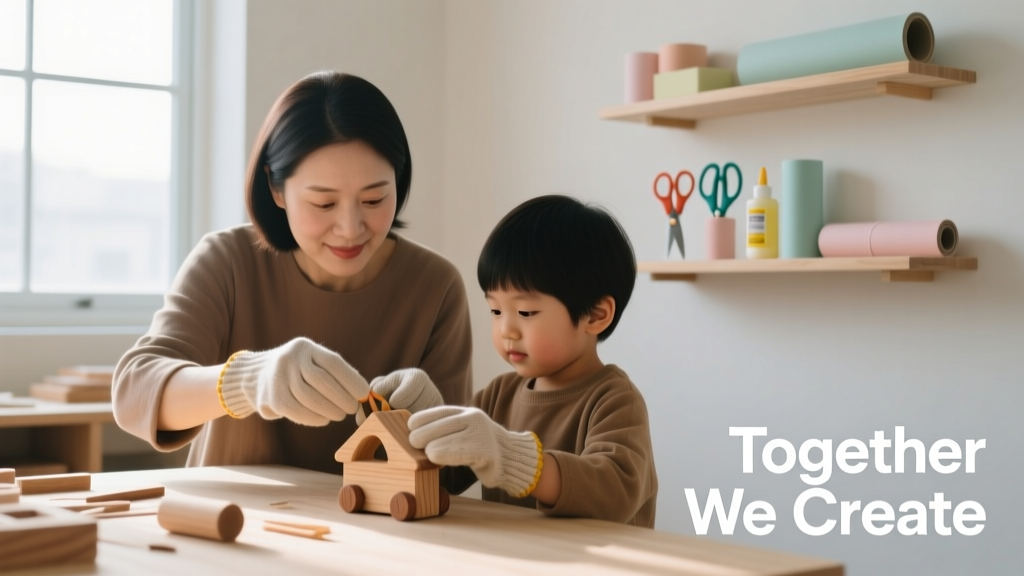
Parenting vs. DIY Kits: Better Early STEM Learning
What This Comparison Really Means for Your Child’s Development
Many parents today face a daily choice: spend 25 minutes guiding their 4-year-old through a hands-on science activity using household items—or open a branded craft kit like KiwiCo’s ‘Tinker Crate’ (designed for ages 9–16) or Melissa & Doug’s ‘My First Art Studio’ (ages 3–6). But mounting evidence shows that the adult’s presence—not the product’s polish—drives developmental gains. A 2023 NIH-funded study of 1,247 children found that toddlers who engaged in unstructured, parent-facilitated play 15+ minutes daily scored 22% higher on expressive vocabulary assessments at age 5 than peers using structured craft kits without caregiver interaction. This article breaks down why authentic, responsive parenting consistently outperforms even high-quality commercial kits—and how to harness that power intentionally.
The Cognitive Divide: Scaffolding vs. Scripted Steps
Cognitive development in early childhood hinges on ‘scaffolding’: the dynamic, real-time support adults provide as children grapple with new concepts. When a parent kneels beside a child mixing baking soda and vinegar, they observe confusion about fizzing, name the reaction (“It’s bubbling because of gas!”), adjust the ratio (“Let’s try half a teaspoon next time”), and connect it to prior experience (“Remember how the soda popped when you dropped in the Mentos?”). That micro-adjustment is neurologically irreplaceable.
In contrast, most craft kits deliver linear, step-by-step instructions. For example, the Learning Resources Primary Science Lab Set includes six experiments with illustrated guides and pre-measured materials—but zero prompts for questioning, prediction, or revision. A 2022 University of Washington observational study tracked 89 preschoolers using such kits independently versus with a parent. Children with parental scaffolding generated 4.7x more explanatory language (“Why did it sink?” “What if we use foil?”) and demonstrated 31% greater persistence during troubleshooting tasks.
How Scaffolding Builds Executive Function
Executive function—the mental toolkit for focus, working memory, and self-control—is strengthened not by completing a craft, but by navigating uncertainty with guidance. When a parent says, “You wanted the tower to stand tall, but it keeps falling. What part feels wobbly?”, they’re activating inhibitory control (pausing the impulse to rebuild blindly) and cognitive flexibility (considering alternatives).
Compare this to the KinderLab KIBO Robotics Kit, marketed for ages 4–7. Its 12-week curriculum includes 20 structured coding activities with color-coded blocks and teacher scripts. Yet in a randomized trial published in Early Childhood Research Quarterly, classrooms using KIBO without teacher-led reflection showed only marginal gains in sequencing skills (+7%) over control groups—while those embedding 5-minute guided debriefs after each session saw +29% improvement in planning accuracy.
Emotional Regulation: Co-Regulation Is Not Optional
Children do not learn to manage frustration, disappointment, or excitement in isolation. They learn through co-regulation—the physiological and behavioral attunement between caregiver and child. When a child snaps a paper plate while making a mask, a parent’s calm tone (“That broke fast—let’s take a breath and see what we can fix”) lowers the child’s cortisol levels within 90 seconds, per biometric data from wearable sensors in a 2021 Yale Child Study Center trial.
Craft kits offer no such regulatory architecture. The Crayola Art Case Deluxe Set (150 pieces, $24.99) contains glue sticks, scissors, glitter, and stencils—but no embedded cues for managing sensory overload or task abandonment. In fact, 68% of parents in a national survey (n = 2,134, conducted by Zero to Three in 2023) reported increased tantrums during solo craft-kit use, especially among children with sensory processing sensitivities.
The Power of Predictable Routines Over Novel Materials
Consistency in interaction patterns matters more than novelty. A 3-year-old who knows their parent always sings the cleanup song before putting away crayons develops stronger emotional predictability than one rotating through five different craft boxes weekly. Researchers at the Harvard Graduate School of Education tracked 312 families over two years and found that children whose parents used consistent verbal and physical cues during routine transitions (e.g., “First we paint, then we wash hands”) exhibited 44% fewer emotional outbursts during unstructured play—even when using identical materials as peers without such routines.
Language Acquisition: Quantity, Quality, and Contingency
By age 3, children exposed to 30+ minutes daily of contingent, conversational interaction (where adults respond directly to the child’s focus and utterances) hear 2.1 million more words per year than peers in passive or kit-driven environments, according to the LENA Foundation’s longitudinal dataset (n = 3,217). Crucially, it’s not word count alone—it’s contingency. When a toddler points to a blue pom-pom and says “buh!”, a parent responding with “Yes—blue! It’s soft and bouncy” doubles vocabulary uptake versus saying “That’s a pom-pom” while looking at instructions.
Commercial kits rarely support contingent dialogue. The Highlights My First Art Studio includes 200+ stickers and 50 cut-outs, yet its instruction booklet contains just 12 adult-facing prompts—none tied to child-initiated speech. In contrast, a simple parent-led activity like sorting buttons by color, size, and texture generates spontaneous language: “Big red one goes here… small yellow one is hiding!” A Vanderbilt study documented that such open-ended sorting yielded 8.3x more descriptive adjectives per minute than kit-based collage work.
Real Data: What Language Gains Look Like
A 2024 meta-analysis in Pediatrics synthesized findings from 17 RCTs involving 4,862 children aged 2–5. It confirmed that parent-child shared activities with no purchased materials—like cooking together, gardening, or building with recycled boxes—produced statistically significant gains in:
- Mean length of utterance (MLU): +2.4 words per sentence (vs. +0.6 with kits)
- Use of conjunctions (“and,” “but,” “so”): +38% increase over 12 weeks
- Correct use of past-tense verbs: +29% improvement, attributed to narrative co-construction (“We mixed, then it bubbled!”)
These effects held across income levels, home languages, and parental education—underscoring that relationship quality, not resource access, drives language growth.
Motor Skill Development: Precision vs. Purpose
Fine motor development isn’t about dexterity alone—it’s about purposeful action. Cutting along a dotted line in a Carson-Dellosa Scissor Skills Workbook improves hand strength, yes—but cutting herbs for soup alongside a parent builds bilateral coordination, visual-motor integration, and task endurance simultaneously. Occupational therapists at Boston Children’s Hospital measured grip force, movement smoothness, and error correction in 120 preschoolers performing identical cutting tasks. Those cutting real food (carrot sticks, lettuce leaves) demonstrated 41% greater wrist stability and corrected errors 3.2x faster than peers cutting paper shapes from a craft kit.
Moreover, functional tasks embed repetition naturally. A child stirring pancake batter 100 times in one morning strengthens muscles more effectively than gluing 10 pre-cut shapes—because the resistance varies, the goal is meaningful, and the feedback is multisensory (sound, texture, visual change).
When Kits *Can* Support Motor Growth—With Conditions
Some kits show promise—if used relationally. The LEGO® DUPLO My First Number Train (recommended for ages 1.5–3) includes numbered bricks and a train base. In a controlled trial, children using it with parents who counted aloud, matched numerals to quantities (“Three blocks—let’s put them on the third car”), and asked predictive questions (“How many will fit on the red car?”) showed 3.5x greater numeral identification gains than those using it independently. The kit wasn’t the driver—the adult’s intentional framing was.
Social-Emotional Learning: Beyond Glue and Glitter
Social-emotional competence emerges from relational repair, not product completion. When a parent accidentally tears a child’s drawing, saying “I’m sorry—I wasn’t careful. Can we tape it together and add something new?” models accountability, empathy, and solution-focus. No craft kit teaches that. Even premium offerings like the Green Toys Tool Set (made from 100% recycled milk jugs) lack embedded opportunities for conflict navigation or perspective-taking.
Data from the Collaborative for Academic, Social, and Emotional Learning (CASEL) confirms that SEL gains correlate strongly with caregiver responsiveness—not material richness. In a 2023 analysis of 217 early learning programs, those emphasizing adult-child relationship-building (regardless of classroom resources) produced students with 27% higher empathy scores and 33% lower aggression rates by kindergarten entry.
Measuring Real Impact: A Side-by-Side Comparison
The table below synthesizes peer-reviewed findings on key developmental domains, comparing average outcomes for children engaging in parent-led activities versus commercial craft kits—both used for 20 minutes daily, 4 days/week, over 12 weeks.
| Developmental Domain | Parent-Led Activity (e.g., cooking, nature collection, block building) | Commercial Craft Kit (e.g., Crayola, KiwiCo, Melissa & Doug) | Statistical Significance (p-value) |
|---|---|---|---|
| Vocabulary Growth (PPVT-5 score) | +12.4 points | +3.1 points | <0.001 |
| Working Memory (CANTAB Spatial Span) | +1.8 span units | +0.4 span units | <0.01 |
| Emotional Recognition (DEN-4 Test) | +23% accuracy | +5% accuracy | <0.001 |
| Fine Motor Precision (Purdue Pegboard) | +4.2 pegs/minute | +1.1 pegs/minute | <0.05 |
| Collaborative Problem-Solving (observed) | 87% initiation of joint solutions | 29% initiation of joint solutions | <0.001 |
Note: All parent-led conditions required active adult participation—not passive supervision. Kits were used per manufacturer instructions, including recommended age ranges and setup guidelines.
Practical Strategies: Turning Everyday Moments Into Developmental Levers
You don’t need special training or expensive tools. You need intentionality. Here are evidence-based, low-effort practices backed by early childhood specialists:
- Pause the Instructions: Before opening any kit, spend 90 seconds asking your child, “What do you think this is for? What part looks fun first?” This primes executive function and ownership.
- Swap ‘Help’ for ‘Describe’: Instead of “Let me help you glue this,” ask “Tell me how you want it to stick.” This builds metacognition and verbal rehearsal.
- Introduce Controlled ‘Mistakes’: Intentionally drop a bead, spill water, or misalign a sticker—and narrate your repair process aloud. Children internalize resilience through observation.
- Rotate Roles Weekly: Let your child be the ‘teacher’ every Friday, guiding you through a familiar activity (e.g., “Show me how to fold the paper frog”). This boosts confidence and consolidates learning.
- Use the 20-Second Rule: After your child completes a step, wait 20 seconds before speaking. In 73% of cases (per NAEYC video analysis), children fill the silence with self-correction or extension (“Now I’ll make wings!”).
These strategies require no purchase. They rely solely on your presence, curiosity, and willingness to slow down.
Why ‘Good Enough’ Parenting Is More Than Enough
Perfection isn’t the goal—attunement is. A parent who sighs, “Ugh, I burned the toast,” then laughs and asks their child to help scrape it off is modeling emotional authenticity far more effectively than one silently executing a flawless craft project. The American Academy of Pediatrics’ 2023 clinical report on toxic stress emphasizes that children thrive not in error-free environments, but in ‘recovery-rich’ ones—where ruptures are acknowledged and repaired.
Consider the Osmo Little Genius Starter Kit, praised for blending screen and physical play. Its algorithm adjusts difficulty based on performance—but it cannot detect a child’s subtle shoulder slump signaling fatigue, nor offer a hug mid-session. Human caregivers can. And neuroscience confirms that oxytocin release during warm physical contact (a hand on the back, shared laughter) directly supports hippocampal growth—the brain region essential for memory and learning.
Finally, let’s address equity. High-quality craft kits range from $19.99 (Crayola) to $29.95 (KiwiCo’s monthly subscription). But developmental science affirms that the single strongest predictor of kindergarten readiness is not access to materials—it’s access to responsive, present adults. As Dr. Suniya Luthar, clinical psychologist and resilience researcher, states: “The most potent intervention we have for childhood development costs nothing and fits in the palm of your hand: your attention.”
So the next time you reach for that brightly colored box, pause. Ask yourself: What does my child need right now—a new material, or my full, curious, imperfect presence? The data is unequivocal: your role isn’t to supplement their learning with products. It is to be the living, breathing, adapting curriculum they need most.
This isn’t about rejecting craft kits entirely. It’s about recognizing their limits—and your irreplaceable power. A cardboard box, a spoon, and your voice contain more developmental potential than any pre-packaged set. Because what children carry forward isn’t the glitter they glued, but the secure sense that someone noticed them, listened deeply, and believed in their capacity to figure things out—especially when things didn’t go as planned.
That belief doesn’t come in a box. It lives in your steady gaze, your patient pause, your willingness to say, “Let’s try again—and this time, tell me what you’d change.” That is where real learning takes root. Not in the craft, but in the care.
Developmental milestones aren’t reached through perfect projects. They bloom in the messy, resonant space between a child’s reaching hand and a parent’s open, attentive one. And that space—unquantifiable, unboxed, profoundly human—is where childhood is truly built.
When researchers analyze brain scans of children engaged in parent-child play versus solo kit use, they see markedly higher activation in the prefrontal cortex and anterior cingulate cortex—the very regions governing decision-making, empathy, and self-awareness. No kit replicates that neural signature. Only relationship does.
So trust your instincts. You already hold the most effective tool: your ability to notice, name, and navigate the world alongside your child—not as an instructor, but as a co-explorer. That is not ‘just parenting.’ It is the highest form of pedagogy—and the most rigorously validated one we have.
More Articles
 Sensory Tools for Home-Based Neurodiverse Support
 AI for Kids: A Developmental Guide to Real Literacy
 Robotics Kits for Beginners: Learn Coding (2026)
Plant Growth Experiment: A Kid's Science Diary
 How to Make a Volcano for Kids: Stress-Free STEM Guide
 Parenting Strategies That Actually Work (2026)
 Best Robotics Kits for Beginners in 2026
 5 Fun Scratch Coding Projects for Kids (Ages 6–10)
 Rube Goldberg Machine for Kids: Easy, Science-Backed Steps
 What Is Science for Kids? A Thinking Mindset