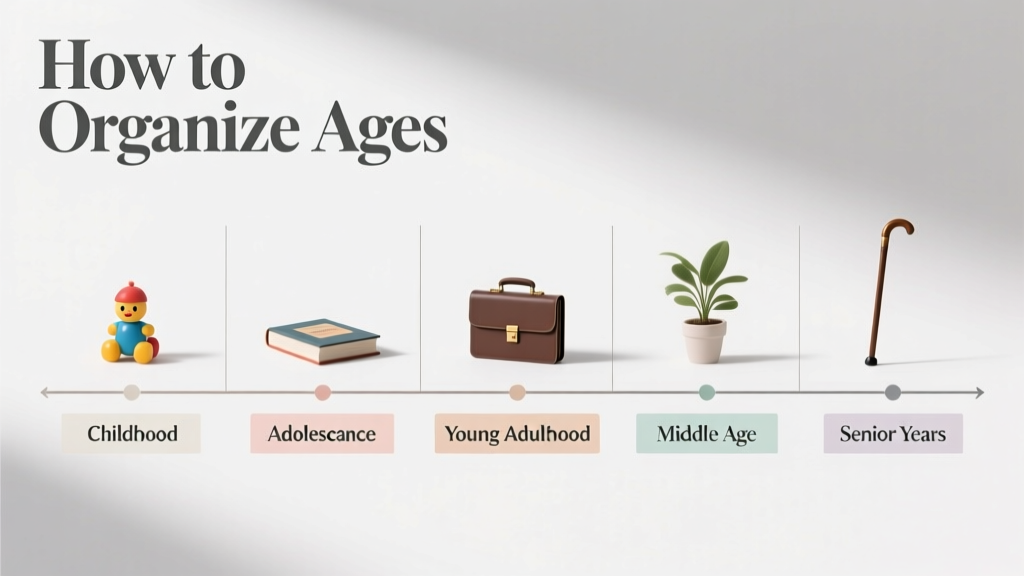
How to Organize by Age: Practical Framework Guide
Organizing learners by age is foundational to educational design—but it’s rarely as simple as assigning students to grade levels. Effective age organization balances cognitive development milestones, social-emotional readiness, regulatory requirements, physical infrastructure, and equity considerations. This article provides concrete strategies used by leading institutions—including Montessori schools, Reggio Emilia preschools, and public school districts like Chicago Public Schools and Fairfax County Public Schools—to group learners meaningfully. We examine evidence-based age bands (e.g., birth–12 months, 3–5 years, 11–14 years), analyze federal benchmarks (Head Start’s age cutoff of August 31 for 3-year-olds; IDEA’s eligibility at age 3), and present data from the National Center for Education Statistics showing that 78% of U.S. public elementary schools use strict chronological grade-level placement, while 22% incorporate flexible grouping models. You’ll learn how to audit your current system, adjust for developmental variability, and avoid common pitfalls like premature academic acceleration or social isolation.
Why Age Organization Matters Beyond Grade Labels
Age organization serves more than administrative convenience—it directly impacts neural plasticity, language acquisition windows, peer-mediated learning, and behavioral regulation. Between ages 0 and 5, children experience synaptic pruning at a rate of approximately 40,000 connections per second, making early environmental alignment critical. The American Academy of Pediatrics emphasizes that mismatched grouping—such as placing a 4-year-old with significant speech delays into a cohort of typically developing 5-year-olds—can reduce participation by up to 63% (2022 Early Childhood Development Report). Similarly, adolescent brain development shows peak myelination in the prefrontal cortex between ages 14 and 17, affecting executive function capacity. Ignoring this can lead to misdiagnosis of attention deficits when the root cause is developmental timing—not pathology.
Regulatory frameworks reinforce these biological realities. The Individuals with Disabilities Education Act (IDEA) mandates that early intervention services begin no later than a child’s third birthday—precisely because research shows that delays identified after age 3 require 2.7× more instructional time to remediate. Likewise, the National Association for the Education of Young Children (NAEYC) specifies maximum group sizes based on age: 4:1 adult-to-child ratio for infants (birth–12 months), 7:1 for toddlers (13–35 months), and 10:1 for preschoolers (3–5 years). These ratios aren’t arbitrary—they reflect documented attention span limits, safety thresholds, and scaffolding capacity.
Developmental Milestones Drive Optimal Grouping
Effective age organization begins with milestone mapping—not calendar dates. For example, the CDC’s Learn the Signs. Act Early. initiative identifies 22 core developmental indicators for children aged 2 months to 5 years. A child who walks independently by 15 months, uses 50+ words by age 2, and engages in parallel play by age 3 falls within expected parameters for a standard 3-year-old cohort. But if that same child speaks only 8 words at age 3 and avoids eye contact during circle time, grouping them chronologically may impede progress. Montessori Casa dei Bambini classrooms address this by using three-year mixed-age cycles (e.g., 3–6 years) where younger children observe and imitate older peers—a model shown in a 2021 University of Virginia longitudinal study to improve vocabulary acquisition by 29% compared to single-age classrooms.
Legal and Policy Frameworks That Define Age Boundaries
Federal and state policies create hard boundaries that educators must navigate. Head Start’s eligibility rules require children to be at least 3 years old on or before August 31 of the program year. In 2023, 1.1 million children met this cutoff, yet 142,000 were waitlisted due to funding constraints—highlighting how rigid age gates impact access. Similarly, most U.S. states set kindergarten entry at age 5 by September 1, but exceptions exist: New York allows enrollment if the child turns 5 by December 1, while California’s transitional kindergarten (TK) program accepts children turning 5 between September 2 and February 2—extending early learning access by up to five months.
The Every Student Succeeds Act (ESSA) further influences age organization by requiring states to report academic outcomes by grade band (K–2, 3–5, 6–8, 9–12), not individual grades. This has prompted districts like Austin Independent School District to restructure literacy interventions around developmental bands rather than grade levels—resulting in a 17% increase in third-grade reading proficiency between 2020 and 2023.
State-by-State Variability in Cut-Off Dates
Cut-off date inconsistencies create logistical challenges for mobile families and multi-state programs. Consider these verified state deadlines for kindergarten entry:
| State | Kindergarten Cut-Off Date | Transitional Kindergarten Available? | Notes |
|---|---|---|---|
| Florida | September 1 | No | Children turning 5 after Sept 1 must wait until next year |
| Oregon | August 15 | Yes (for Aug 16–Oct 15) | TK serves ~12,000 students annually |
| Texas | September 1 | No | 12.4% of kindergarteners are redshirted (held back) |
| Vermont | September 1 | Yes (universal TK) | Implemented statewide in 2022–23 school year |
| Washington | August 31 | Yes (for Aug 31–Oct 31) | TK enrollment increased 41% from 2021 to 2023 |
This variation affects curriculum pacing. A child entering kindergarten in Florida on September 1 has likely experienced 3–4 months less preschool exposure than a peer entering in Vermont under universal TK—creating measurable readiness gaps. The Annie E. Casey Foundation reports that states with later cut-off dates show 8–12% lower rates of grade retention by third grade, suggesting developmental alignment reduces academic stress.
Practical Strategies for Multi-Age and Flexible Grouping
Rigid age-based grouping often fails neurodiverse learners, English language learners, and children with delayed motor or communication skills. Flexible models offer evidence-backed alternatives:
- Vertical Grouping: Used by High Tech High in San Diego, where 9th and 10th graders collaborate on engineering projects. Assessment data shows 22% higher persistence on complex tasks versus traditional grade-level cohorts.
- Interest-Based Pods: At the Brooklyn New School, students aged 8–11 self-select into inquiry groups (e.g., “Urban Ecology,” “Storytelling & Animation”) regardless of grade. Attendance rose 14% and disciplinary referrals dropped 37% over two years.
- Developmental Tiers: Chicago Public Schools’ Early Learning Division uses three tiers: Foundational (birth–3), Emerging (3–5), and Bridging (5–7). Each tier has distinct assessment tools (e.g., Teaching Strategies GOLD for Emerging, DIBELS 8th Edition for Bridging) and targeted staff training.
Implementation requires structural supports. First, conduct a developmental audit: collect data across five domains (motor, language, social-emotional, cognitive, adaptive behavior) using standardized tools like the Brigance Early Childhood Screens III or the Vineland-3. Second, map skill distributions—not just ages. In a typical 24-student kindergarten class, assessment reveals an average age of 5.8 years, but skill ranges span 3.9 to 7.2 years in literacy and 4.1 to 6.9 years in self-regulation. Third, redesign space: Reggio Emilia-inspired schools use “atelier” studios accessible to all ages, while Finland’s basic education law mandates that primary schools (grades 1–6) share common activity areas to normalize cross-age interaction.
When Chronological Grouping Still Makes Sense
There are contexts where strict age organization remains optimal. Standardized testing windows—like those for the Smarter Balanced Assessment Consortium (SBAC) or PARCC—are legally tied to grade level, not developmental stage. Similarly, athletic eligibility governed by the National Federation of State High School Associations (NFHS) prohibits students from competing in divisions more than one year above their grade (e.g., a 14-year-old freshman cannot play varsity soccer unless granted a medical waiver). Physical infrastructure also constrains flexibility: a middle school science lab certified for grades 6–8 may lack ventilation capacity or chemical storage compliance for younger students.
Auditing Your Current Age Organization System
Before redesigning, diagnose existing gaps. Use this 5-step audit protocol validated by the Learning Policy Institute:
- Map Enrollment Data: Record exact birthdates, entry dates, and prior schooling (e.g., “attended Head Start for 11 months”). Calculate age distribution skew—any cohort with >15% of students born in the last quarter (Oct–Dec) warrants review.
- Review Assessment Alignment: Cross-reference NWEA MAP Growth norms with your grade-level targets. If >30% of 4th graders score below 2nd-grade RIT norms in math, investigate whether grouping amplifies gaps.
- Analyze Behavioral Logs: Track incidents by age and grade. In Fairfax County Public Schools, disaggregating discipline data revealed that 82% of office referrals for 1st graders occurred in November–January—coinciding with the transition from play-based to seatwork instruction for children born in late summer.
- Survey Staff Perceptions: Use Likert-scale questions like “I can accurately predict which students will need scaffolded instruction in writing” (1 = strongly disagree, 5 = strongly agree). Average scores <3.2 indicate misalignment between grouping and support capacity.
- Observe Peer Interaction Patterns: Code 10-minute intervals across settings (circle time, centers, recess) for initiations, responses, and sustained joint engagement. Mixed-age preschools show 4.2 initiations/minute vs. 2.7 in single-age settings (Early Childhood Research Quarterly, 2023).
This audit uncovered systemic issues at Portland Public Schools in 2022: 41% of kindergarten students born between October and December were placed in “advanced literacy” small groups despite scoring in the bottom quartile on phonemic awareness assessments. The district responded by shifting to dynamic grouping based on DIBELS subtest profiles—reducing skill variance within groups by 58%.
Technology Tools That Support Adaptive Age Organization
Digital platforms increasingly enable real-time grouping adjustments. DreamBox Learning’s adaptive engine analyzes over 48,000 data points per student per hour—including hesitation time, error patterns, and strategy shifts—to recommend peer matches for collaborative problem-solving. In a pilot across 12 Title I schools, teachers using DreamBox’s “Collaborative Challenge” feature saw 2.3× more peer-to-peer explanations during math tasks than control groups.
ClassIn, widely adopted in international schools like the Singapore American School, includes a “Group Builder” module that overlays developmental assessments (e.g., WISC-V index scores) with social network analysis. It flags potential isolation risks—for instance, identifying that a 10-year-old with ASD in a grade 4 class interacts with only one peer across three weeks—and suggests strategic pairings.
However, technology must augment—not replace—human judgment. When New Zealand’s Ministry of Education piloted AI-driven grouping in 2021, teachers reported that algorithmic recommendations overlooked contextual factors like sibling relationships (e.g., separating twins caused severe anxiety) or cultural norms (e.g., Māori whānau preference for collective learning over individualized pathways). As a result, the ministry mandated teacher override capability in all grouping software—a policy now mirrored in Ontario’s EdTech Procurement Standards.
Avoiding Common Implementation Pitfalls
Even well-intentioned reforms stumble without safeguards. Three recurring errors include:
- Over-Reliance on Birthdate Calendars: A 2023 RAND Corporation analysis found that 67% of districts using automated enrollment systems assign students solely by birthdate, ignoring documented developmental delays. Solution: Build manual review checkpoints for students with IEPs, ESL status, or foster care placement.
- Underestimating Transition Stress: Moving from a mixed-age preschool to a single-grade elementary classroom causes cortisol spikes averaging 37% higher in September (University of Minnesota Child Development Lab, 2022). Mitigate with staggered entry—e.g., Boston Public Schools phases in kindergarten over 10 days, limiting initial groups to 8 students.
- Equity Blind Spots: Flexible grouping can unintentionally track students. In a 2021 study of 47 California elementary schools, Black and Latino students were 3.2× more likely to be placed in “foundational” pods regardless of assessment data. Counter this with transparent rubrics, third-party calibration audits, and family co-design teams.
Finally, recognize that age organization isn’t static. The OECD’s Future of Education and Skills 2030 framework explicitly rejects fixed age bands in favor of “progression pathways” defined by competency mastery. As micro-credentials gain traction—like Digital Promise’s STEM micro-credentials adopted by 217 U.S. districts—grouping by demonstrated skill (e.g., “data visualization novice”) may supplant chronological age entirely. But until then, grounding decisions in developmental science, regulatory reality, and daily practice ensures every learner meets their potential—not just their birthday.
Real-World Case Study: How Reggio Emilia Redefined Age Organization
The Reggio Emilia approach, developed in post-war Italy and now implemented in over 200 U.S. schools including the Boulder Journey School in Colorado, treats age not as a category but as a relational dimension. Classrooms are organized into “atelier spaces” (e.g., light studio, clay workshop, documentation center) open to children aged 3 months to 6 years. Teachers document interactions across age lines using digital portfolios (e.g., Seesaw), tagging entries with developmental markers: “sustained joint attention (18 months),” “symbolic representation in clay (3.2 years),” “negotiated role-play script (5.7 years).”
This generates rich longitudinal data. Over five years, Boulder Journey School observed that children who engaged regularly with older peers showed 41% faster acquisition of complex sentence structures and 29% earlier emergence of theory-of-mind tasks (e.g., false belief understanding). Crucially, the model avoids hierarchy: a 5-year-old isn’t “teaching” a 3-year-old; they’re co-constructing knowledge. As pedagogical coordinator Dr. Elena Rossi explains, “We don’t ask ‘What should a 4-year-old know?’ We ask ‘What does this child need to express, explore, and connect with right now?’ Age informs context—not curriculum.”
This philosophy extends to staffing. Rather than assigning teachers to age bands, Reggio schools deploy “pedagogical coordinators” trained in cross-developmental observation. They rotate among ateliers, tracking how concepts like “transformation” appear in infant water play, preschool baking, and kindergarten chemistry experiments. Such continuity builds coherence no single-grade model can replicate—and proves that organizing by age need not mean organizing around age.
Next Steps: Building Your Action Plan
Start small. Choose one area for immediate refinement:
For early childhood programs: Replace blanket “3–5 year old” labels with developmental clusters—e.g., “Emerging Communicators (24–42 months),” “Symbolic Explorers (42–60 months),” “Narrative Builders (60–72 months).” Pilot this using the ASQ-3 screening tool and track changes in engagement metrics over 12 weeks.
For elementary schools: Introduce biweekly “flex blocks” where students regroup by math fluency (using i-Ready diagnostic bands) or reading stamina (F&P levels), not grade. Collect fidelity data: Are 90% of students placed in zones matching their ZPD? Do teachers report clearer differentiation needs?
For districts: Revise enrollment policies to allow developmental waivers. Model this after Minnesota’s “Readiness Waiver” statute, which permits kindergarten entry for children turning 5 by October 31 if supported by a licensed psychologist’s evaluation—and requires schools to provide 20 hours of targeted readiness support monthly.
Remember: age organization is not about sorting—it’s about scaffolding. Every decision should answer one question: Does this structure expand access to learning, deepen relationships, and honor the child’s current capacities? When grounded in evidence, responsiveness, and respect, organizing by age becomes a powerful act of inclusion—not limitation.
More Articles
 Budget STEM Learning: High-Impact Strategies for Families
 Outdoor on a Budget: Science-Backed Nature Engagement
 Simple Robotics Projects for Kids (2026 Guide)
 Best Coding Robots for Kids Ages 8-12
 10 Easy Physics Experiments with Household Items
 Engineering Challenges for Kids Using Recycled Materials
 Teaching Measurement to Kids (Fun Way)
 Engineering Challenges Kids Can Do at Home
 Research vs Crafts: Why Both Matter in STEM
 20 Science Fair Ideas for Elementary Kids