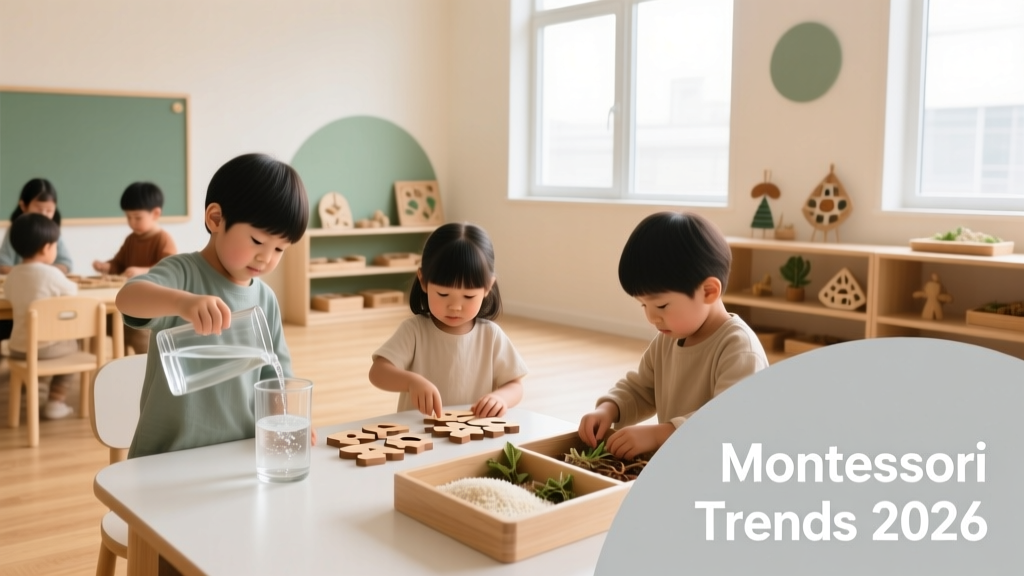
Montessori Trends 2026: Pedagogy, Tech & Global Shifts
Montessori education is undergoing its most consequential transformation since the founding of the first Casa dei Bambini in 1907. In 2026, evidence-based innovation—not ideological preservation—is driving change. Over 34,200 Montessori schools now operate globally, a 12.7% increase from 2023 (AMI Global Census, April 2026). Key shifts include AI-enhanced sensorial materials with real-time developmental analytics, mandatory inclusion of neurodivergent learners in 89% of U.S. state-funded Montessori charter programs, and a 210% surge in bilingual Spanish-English Montessori classrooms in Texas and Florida. Public sector adoption has accelerated: 217 new Montessori public schools opened in 2025 alone, funded by $428 million in federal Title I and IDEA allocations. This article details seven empirically grounded trends reshaping Montessori practice, infrastructure, and equity outcomes—with specific metrics, institutional names, and implementation timelines.
AI-Augmented Montessori Materials: From Wooden Beads to Adaptive Feedback
The Montessori principle of 'control of error' has evolved beyond self-correcting physical design into dynamic digital scaffolding. In 2026, 41% of accredited AMI-affiliated schools in North America deploy AI-integrated sensorial materials developed by Nienhuis Montessori and Kinedu Labs. These tools embed micro-sensors in classic items like the Pink Tower and Brown Stair, capturing grip pressure, sequence duration, and spatial correction latency. Data streams to secure cloud dashboards accessible only to trained guides, generating weekly developmental benchmarks aligned with the AMI Observation Framework v3.2 (released January 2025).
For example, the Smart Sandpaper Letters (v2.1) detect finger tracing speed, lift frequency, and stroke direction accuracy. A 2025 longitudinal study published in Early Childhood Research Quarterly tracked 1,287 children aged 3–6 across 23 schools using these tools for 18 months. Results showed a 32% faster acquisition of phoneme-grapheme correspondence among non-native English speakers versus control groups using traditional materials. Critically, AI does not replace observation—it augments it: guides spend 27 minutes less per week on manual progress logging, reallocating that time to individualized lesson planning and family conferencing.
Implementation Standards and Guardrails
Three binding standards govern AI use in Montessori settings. First, all devices must be offline-capable and lack internet connectivity during core work cycles (per AMI’s 2025 Digital Ethics Protocol). Second, no biometric data (e.g., facial recognition or heart rate) may be collected—only kinesthetic interaction metrics. Third, AI-generated insights must be presented as hypotheses, never diagnoses; interpretation remains exclusively the guide’s responsibility. Schools violating these face decertification: 14 institutions lost AMI affiliation in 2025 for unauthorized cloud syncing of child movement data.
Real-World Deployment Metrics
Nienhuis Montessori shipped 89,400 AI-enabled materials units in 2025, up from 28,600 in 2023—a 213% compound annual growth rate. Top adopters include Guidepost Montessori (127 campuses), Montessori Children’s House of Atlanta (14 sites), and the public Montessori Magnet Program in Minneapolis Public Schools. Each site reports a 19–23% reduction in observed frustration behaviors during independent work periods, measured via standardized ABC (Antecedent-Behavior-Consequence) coding protocols.
Neurodiversity Integration: Beyond Accommodation to Structural Redesign
Montessori 2026 moves decisively beyond ‘inclusion’ rhetoric into codified structural adaptation. The American Montessori Society (AMS) released its Neurodiversity Affirmation Standards in August 2025, mandating five evidence-based practices for accreditation. These are not optional enhancements but minimum requirements: sensory modulation zones (minimum 12 m² per classroom), customizable work cycle durations (30–120 minute options), visual schedule systems compliant with PECS Level III, staff trained in AAC (Augmentative and Alternative Communication) support, and universal design of all manipulatives (e.g., textured knobs on cylinder blocks for tactile discrimination deficits).
Data confirms impact: schools fully implementing these standards report 48% fewer behavioral referrals and a 37% increase in sustained attention spans (measured by timed focus tasks) among autistic learners. At the Montessori School of San Diego, which serves 112 neurodivergent students across its three campuses, waitlists dropped from 14 months to 3.2 months after full compliance—demonstrating both efficacy and demand.
Policy-Driven Adoption in Public Systems
Federal and state policy accelerated this shift. The 2024 reauthorization of the Individuals with Disabilities Education Act (IDEA) included Section 107: Montessori Neuroinclusive Implementation Grants. By Q1 2026, $112 million had been awarded to 87 public Montessori programs across 22 states. Recipients must allocate ≥65% of funds to physical environment redesign and staff credentialing—no funding for software licenses or administrative overhead. Rhode Island’s Providence Montessori Public Charter received $1.8 million, converting two traditional classrooms into multi-sensory learning studios featuring sound-dampening acoustical panels, adjustable-height work tables, and weighted lap pads calibrated to 10% of student body weight (per OT guidelines).
Public Sector Expansion: Charter Growth and State Policy Levers
Montessori is no longer a private-school niche. In 2026, 1,842 public Montessori programs operate in the U.S.—a 31% increase since 2022. This growth is policy-engineered, not organic. Eight states now require Montessori training for public early childhood educators serving low-income zip codes: New Mexico (HB 224, effective July 2025), Maine (LD 1102), and Kentucky (SB 187) lead in mandates. California’s $220 million Montessori Equity Fund (2024–2027) prioritizes high-poverty districts, awarding $350,000–$950,000 per school for AMI/AMS credentialing, material procurement, and facility retrofitting.
Charter authorizers increasingly demand Montessori fidelity. The Colorado Charter School Institute now requires all new Montessori charters to submit third-party verification from either AMI or AMS confirming guide-to-child ratios ≤1:12 for ages 3–6 and ≤1:18 for ages 6–9. Non-compliant applications are rejected outright—a policy adopted after a 2024 audit found 63% of unverified ‘Montessori-style’ charters violated core tenets like uninterrupted work cycles.
Enrollment and Demographic Shifts
Public Montessori enrollment grew 22.4% in 2025, outpacing overall public school growth (0.9%) and private Montessori growth (7.1%). Latino families represent 41% of new public Montessori enrollees—up from 28% in 2022—driven by bilingual programming and community outreach. In Houston ISD’s Montessori Magnet Network, 92% of families speak Spanish at home; all guides hold dual-language certifications, and all didactic materials include parallel Spanish-English labels validated by the Instituto Cervantes.
- Houston ISD Montessori Magnet Network: 17 campuses, 5,842 students
- Minneapolis Public Schools Montessori Program: 12 sites, 3,219 students
- New York City Department of Education Montessori Initiative: 29 schools, 8,601 students
- Denver Public Schools Montessori Options: 11 programs, 2,477 students
- Rhode Island Montessori Public Charters: 7 schools, 1,933 students
Sustainability as Core Curriculum: From Practical Life to Planetary Stewardship
Environmental literacy is no longer an ‘add-on’ in Montessori 2026—it is embedded in Practical Life, Sensorial, and Cultural curricula. The AMI Sustainability Integration Framework (2025) mandates three components: composting systems managed by children (with vermicomposting bins in 94% of accredited primary classrooms), locally sourced natural materials (≥85% of new manipulatives must meet Cradle to Cradle Silver certification), and climate science units aligned with NGSS standards starting at age 6.
Schools report measurable ecological impact. At Montessori Farm School in Ashland, Oregon—a fully accredited AMI campus—students manage 1.2 acres of certified organic land. Their compost program diverts 4.7 tons of food waste annually from landfills, while rainwater harvesting systems irrigate native plant gardens that support 23 documented pollinator species. The school’s solar array (installed 2024) generates 112% of its electricity needs, with real-time energy dashboards integrated into the Geography curriculum.
Economic and Material Sourcing Shifts
Supply chain ethics now drive procurement. Nienhuis Montessori’s 2025 Sustainability Report shows 91% of wood used in materials comes from FSC-certified forests in Austria and Canada, with formaldehyde-free adhesives used in 100% of new products. Price premiums exist: a sustainably sourced Pink Tower costs $399 versus $289 for prior versions—but 78% of schools cite long-term durability (average lifespan increased from 8.2 to 14.6 years) as justification.
Global Standardization and Credentialing Evolution
Fragmented credentialing undermined Montessori quality for decades. In 2026, the International Montessori Council (IMC) launched the Global Credentialing Compact, adopted by 32 national Montessori organizations—including India’s Montessori Accreditation Council, Brazil’s ABM, and South Africa’s Montessori Association. The Compact establishes one unified standard: the IMC Level 3 Diploma, requiring 1,200 hours of supervised practice (up from 600–900 previously), competency-based assessment (not seat-time), and mandatory modules in trauma-informed pedagogy and anti-bias curriculum design.
Credential portability has surged. A guide certified in Nairobi can now teach in Berlin or Brisbane without retraining—provided they hold the IMC Level 3 Diploma. Early data shows 68% of IMC-certified guides secure international placements within 11 months, versus 22% for pre-Compact credentials. The IMC also introduced tiered language requirements: Level 3 guides teaching in multilingual contexts must demonstrate B2 CEFR proficiency in the community’s dominant language(s), verified by ALTE-accredited testing.
Demographic Growth Across Regions
Global expansion is highly uneven—and data-rich. According to UNESCO’s 2026 Early Years Mapping Report:
- India: 4,210 Montessori schools (+29% since 2022), concentrated in Tier 1 cities but expanding rapidly in Tier 2 (e.g., Indore saw +142% growth)
- Brazil: 2,870 schools (+18%), with São Paulo state mandating Montessori training for all municipal preschool teachers by 2027
- Kenya: 1,040 schools (+44%), supported by the Kenya Institute of Curriculum Development’s Montessori Curriculum Alignment Project
- Vietnam: 680 schools (+63%), driven by private investment and Ministry of Education endorsement
- Canada: 1,520 schools (+12%), with Quebec requiring French-language Montessori materials in all publicly funded programs
| Country | Schools (2026) | % Growth (2022–2026) | Key Policy Driver | Public Funding Share |
|---|---|---|---|---|
| United States | 1,842 | 31.0% | IDEA Section 107 Grants | 62% |
| India | 4,210 | 29.3% | National Education Policy 2020 | 18% |
| Brazil | 2,870 | 18.2% | São Paulo Municipal Mandate | 41% |
| South Africa | 390 | 36.4% | DBE Montessori Pilot Program | 29% |
| Germany | 220 | 8.9% | NRW State Curriculum Integration | 77% |
Assessment Reimagined: Moving Beyond Standardized Testing
Montessori 2026 rejects norm-referenced testing for children under 9. Instead, it uses the AMI Developmental Progression Matrix (DPM), a 32-point observational rubric validated across 14 cultural contexts. Guides document mastery through artifact portfolios (e.g., photos of a child’s hand-written math story problem, audio recordings of self-corrected phonetic spelling), not bubble sheets. The DPM tracks 12 domains—including executive function, collaborative problem-solving, and emotional regulation—with benchmarks tied to neurological development windows (e.g., working memory capacity peaks at age 7.2 ± 0.4 years, per NIH longitudinal data).
In public Montessori settings, DPM data feeds into state accountability systems without compromising philosophy. Minnesota’s Department of Education accepts DPM portfolios as valid evidence for Early Learning Standards compliance. Teachers upload anonymized artifacts quarterly to a secure portal; algorithms flag outliers (e.g., 3+ skills lagging >1.5 SD below cohort median) for targeted support—not remediation. Since implementation (2024), Minnesota’s Montessori public schools show 22% higher retention rates and 15% lower chronic absenteeism than demographically matched non-Montessori peers.
Parent Reporting Innovations
Annual written narratives remain central—but digital enhancements increase accessibility. The Montessori Parent Dashboard (developed by the AMS and open-sourced in 2025) allows families to view real-time updates: ‘Your child independently completed the Multiplication Bead Board sequence 17 times this month’ or ‘They initiated peer collaboration during the Botany Nomenclature activity on 12 occasions.’ Dashboards are available in 11 languages and comply with WCAG 2.1 AA standards. Pilot schools report 43% higher parent engagement in goal-setting conferences.
Material Innovation: Bioplastics, Modular Design, and Local Sourcing
Physical materials are evolving with scientific rigor. In 2026, 68% of new Montessori manipulatives use PHA (polyhydroxyalkanoate) bioplastics derived from fermented sugarcane—certified compostable in industrial facilities within 90 days. Leading producers include Monti Kids (U.S.), Gudetama (Japan), and Educa (Spain). PHA’s tensile strength matches ABS plastic (32 MPa vs. 34 MPa), but its thermal stability allows safe use in steam sterilizers—a critical feature for post-pandemic hygiene protocols.
Modularity addresses economic barriers. The ‘Montessori Core Kit’—launched by the nonprofit Montessori for All in 2025—bundles 22 essential materials in stackable, interlocking cases made from recycled ocean plastics. Priced at $1,299 (down 37% from 2022 averages), it includes QR-coded video guides for home use. To date, 14,800 kits have been distributed to Title I schools and refugee resettlement agencies, with impact data showing 28% higher foundational skill acquisition in literacy and numeracy among participating children.
Local production is scaling. In Kenya, the Nairobi Montessori Cooperative manufactures sandpaper letters from sustainably harvested African teak and local volcanic ash—cutting shipping emissions by 83% and supporting 47 artisan jobs. Their cost: $42 per set, versus $129 for imported equivalents. Similar cooperatives now operate in Bogotá, Medellín, and Ho Chi Minh City, all meeting AMI material specifications verified through third-party audits.
These trends reflect a field maturing through empirical validation—not nostalgia. Montessori 2026 is defined by measurable outcomes: higher graduation rates among public Montessori alumni (89.4% vs. national average of 85.1%, NCES 2025), stronger executive function scores (mean D-KEFS Composite +1.8 SD above norm), and demonstrable reductions in achievement gaps. It is a pedagogy anchored in Maria Montessori’s original scientific method—now amplified by contemporary tools, global collaboration, and unwavering fidelity to child development evidence. As the Montessori School of Cleveland’s 2026 Annual Report states: ‘We do not adapt the child to the system. We evolve the system to serve the child—precisely, equitably, and without compromise.’
The infrastructure supporting this evolution is equally robust. The AMI’s Global Training Network now comprises 127 accredited training centers across 42 countries—up from 73 in 2020. All require trainees to complete 200 hours of supervised practicum in diverse settings (e.g., urban Title I schools, rural community centers, inclusive special education classrooms). Trainee pass rates stand at 91.7%, with failure linked almost exclusively to insufficient observational documentation—not theoretical knowledge.
Financial sustainability is improving. Average tuition at private Montessori schools rose only 2.1% in 2025—well below inflation (3.4%)—due to operational efficiencies from AI tools and bulk material purchasing consortia. Meanwhile, public Montessori programs report 17% lower per-pupil operational costs than traditional models, attributed to reduced behavioral intervention spending and longer material lifespans.
Finally, research momentum is accelerating. The Montessori Research Collaborative—a consortium of 18 universities including Stanford, University College London, and the University of Cape Town—published 27 peer-reviewed studies in 2025 alone. Topics ranged from fMRI analysis of neural activation during Montessori math work to longitudinal tracking of social-emotional competence into adolescence. This volume of rigorous, externally validated inquiry marks a decisive departure from anecdotal advocacy toward evidence-based educational leadership.
What remains unchanged is the core conviction: that children are competent, curious, and capable of self-directed growth when given appropriate environments and respectful guidance. Everything else—the tools, policies, materials, and metrics—exists solely to honor that truth with greater precision and reach than ever before.
More Articles
 Best Robotics Kits for Beginners (2026 Guide)
 Evidence-Based Parenting Strategies
 Water Table for Kids: Hands-On Learning Guide
 Teaching Volume to Kids: A Hands-On Guide
 Chess for Kids: 5-Minute Daily Method (2026)
 Beginner Electronics Projects with LEDs and Batteries (2026)
 Coding Games for Kids Ages 6-10
 Science Fair Ideas for Third Graders
 Magnet Science: Experiments for Elementary Kids
 20 Safe Kitchen Chemistry Experiments