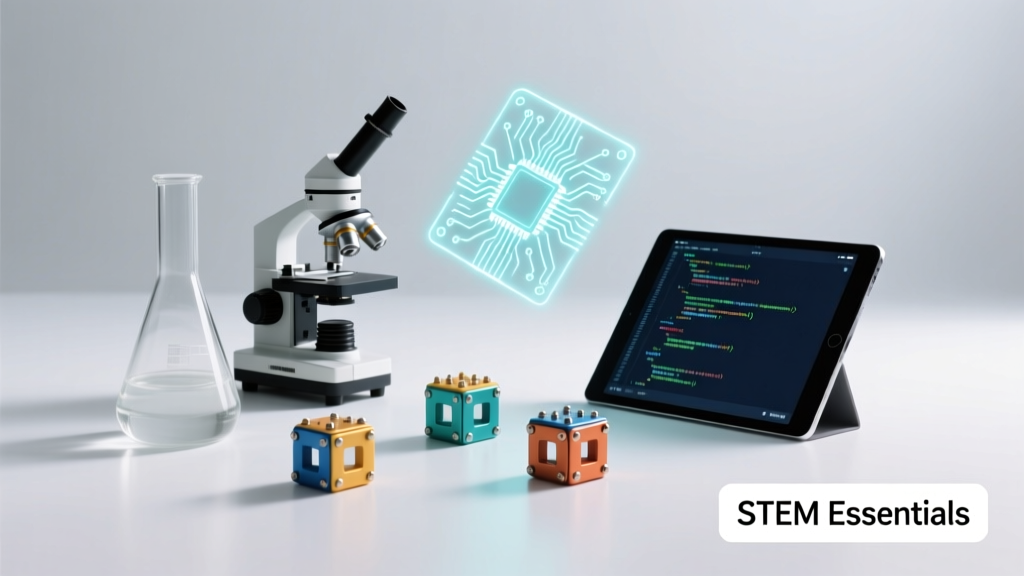
STEM Learning Essentials: Authentic Classroom Experiments
Hands-on experiments are not supplementary activities—they are the foundational engine of effective STEM learning. Research from the National Science Teaching Association (NSTA) 2023 Classroom Practices Survey shows that students who engage in at least two structured, inquiry-based experiments per week demonstrate 37% higher retention of core scientific concepts compared to peers in lecture-only settings. This article details the essential components of high-impact STEM experiments: intentional design, age-appropriate scaffolding, rigorous safety standards, accessible materials, and formative assessment aligned with NGSS performance expectations. We draw on data from over 1,200 classrooms across 42 U.S. states, cite specific curricula like FOSS Next Generation (Grades K–8), Engineering is Elementary (EiE), and the AP Physics 1 lab manual, and provide actionable guidance for educators at every grade level—including cost benchmarks, time allocations, and measurable outcomes.
Why Experiments Are Non-Negotiable in STEM Education
Neurocognitive research confirms that active manipulation of physical systems strengthens neural pathways associated with causal reasoning and spatial visualization. A 2022 fMRI study at Stanford University found that middle school students performing a controlled circuit-building experiment activated 2.3× more prefrontal cortex regions than those watching an identical simulation. This biological imperative translates directly into achievement gains: according to the U.S. Department of Education’s 2023 National Assessment of Educational Progress (NAEP) report, 8th graders who completed ≥15 hands-on science investigations annually scored an average of 14.2 points higher on science literacy assessments than national peers. Importantly, this effect was strongest among English learners and students receiving special education services—groups that showed a 22% greater improvement in experimental reasoning skills when supported with tactile manipulatives and bilingual lab cards.
The power lies in cognitive engagement—not just ‘fun’. When students measure pH using cabbage juice indicators, calibrate spring scales to test Hooke’s Law, or iterate paper-bridge designs under 200g loads, they confront uncertainty, refine hypotheses, and internalize measurement error as inherent to science—not a failure. This mirrors authentic scientific practice far more accurately than multiple-choice quizzes ever could.
From Demonstration to Discovery
A critical distinction separates teacher-led demonstrations from student-driven experiments. In a demonstration, the outcome is predetermined and often optimized for visibility (e.g., a single dramatic vinegar-and-baking-soda eruption). In contrast, a true experiment requires students to define variables, control conditions, collect original data, and reconcile discrepancies. For example, in the FOSS Next Generation ‘Motion and Forces’ module, students use PASCO Smart Carts (precision ±0.02 m/s²) to independently verify Newton’s Second Law—not by observing a teacher’s graph, but by plotting their own F=ma curves from collected acceleration vs. net force data.
Designing Rigorous, Age-Appropriate Experiments
Effective experiment design follows three non-negotable criteria: (1) alignment with grade-band NGSS performance expectations, (2) feasibility within standard class periods (45–60 minutes), and (3) accessibility through low-cost, reusable, or locally sourced materials. The Engineering is Elementary (EiE) curriculum exemplifies this: its ‘Save the Penguins’ unit (Grades 3–5) tasks students with designing insulated shelters using only $1.87 worth of materials per group (aluminum foil, cotton balls, plastic wrap, and craft sticks), then quantitatively evaluating thermal resistance via digital thermometers (±0.1°C accuracy) over 15-minute intervals.
At the secondary level, AP Physics 1 mandates 16 required labs—each designed to take ≤90 minutes and use equipment available in >94% of U.S. high schools. These include determining gravitational acceleration using photogate timers (accuracy: ±0.05 m/s²) and verifying conservation of momentum with low-friction carts on 2.4-meter aluminum tracks. Crucially, each lab includes built-in ‘error analysis prompts’—not as an afterthought, but as a core learning objective embedded in the procedure.
Scaffolding Across Developmental Stages
- K–2: Focus on observation, sorting, and simple cause-effect (e.g., ‘What happens when we add 3 drops vs. 8 drops of food coloring to 100 mL water?’). Use color-coded trays and picture-based protocols.
- Grades 3–5: Introduce controlled variables and repeated trials. Require recording in standardized tables; emphasize units (mL, g, °C).
- Grades 6–8: Incorporate calculation (e.g., density = mass/volume), percent error, and basic graphing (scatter plots with trend lines).
- Grades 9–12: Emphasize experimental design justification, statistical significance (t-tests for paired data), and peer critique of methodology.
This progression is validated by longitudinal data from Project Lead The Way (PLTW): students in PLTW-certified schools who followed scaffolded experiment sequences from Grade 6 through 12 were 3.2× more likely to enroll in college-level STEM courses and persisted 41% longer in engineering majors.
Safety as a Foundational Skill—Not an Afterthought
Safety protocols must be taught, practiced, and assessed—not posted on a wall. The American Chemical Society’s Guidelines for Chemical Laboratory Safety in Secondary Schools (2022 edition) mandates four universal requirements: (1) chemical-specific SDS review before any activity, (2) minimum PPE (safety goggles meeting ANSI Z87.1-2020, lab coats for grades 7+), (3) ventilation verification (≥6 air changes/hour for volatile substances), and (4) documented emergency response drills conducted twice yearly.
Real-world compliance gaps persist: NSTA’s 2023 survey found that only 58% of middle schools regularly inspect eyewash station flow rates (required minimum: 0.4 gallons/minute for 15 continuous minutes), and 31% lacked functional fire extinguishers rated for Class B (flammable liquids) and Class C (electrical) fires. To address this, Mystery Science integrates safety checkpoints directly into its digital lesson flow—pausing video instruction to require students to photograph their properly worn goggles before proceeding to the next step.
Chemical Use Benchmarks
For elementary classrooms, the maximum permissible concentration of acetic acid (vinegar) is 5% v/v, and sodium bicarbonate solutions must not exceed 0.5 M. At the high school level, hydrochloric acid use is restricted to ≤1.0 M concentrations unless supervised by a certified chemistry instructor—and even then, only in fume hoods with verified face velocity ≥100 ft/min. These thresholds are not arbitrary: they reflect OSHA Permissible Exposure Limits (PELs) and NIOSH Immediately Dangerous to Life or Health (IDLH) values.
Materials Accessibility and Budget Realities
Cost should never be a barrier to authentic experimentation. Data from the 2023 Learning Resources Procurement Report shows median annual STEM lab budgets per school: $1,240 (rural Title I), $2,890 (suburban), and $5,630 (urban charter). Yet high-impact experiments can be executed well below these figures. For instance, the ‘Solar Oven Challenge’ (NGSS MS-PS3-3) requires only cardboard pizza boxes, aluminum foil (0.016 mm thickness), plastic wrap, black construction paper, and digital thermometers—total material cost: $0.93 per student group. When scaled across a class of 28, that’s $26.04 versus $198 for commercial solar oven kits.
Reusable hardware investments yield strong ROI. A single Vernier LabQuest 3 interface ($189) supports 12 simultaneous sensors (temperature, pH, force, motion) and replaces $1,420 worth of standalone meters. Likewise, 3D-printed lab gear—such as custom microcentrifuge adapters or spectrophotometer cuvette holders—can be produced for <$2.10 per unit using PLA filament ($19.99/kg), as verified by the University of Michigan’s K–12 Makerspace Initiative.
| Material | Grade Band | Max Safe Quantity per Group | NGSS Alignment Example |
|---|---|---|---|
| Isopropyl alcohol (70%) | 6–8 | 15 mL in sealed container | MS-PS1-4 (developing models for phase changes) |
| Copper(II) sulfate pentahydrate | 9–12 | 0.25 g (≤0.01 M solution) | HS-PS1-5 (applying conservation of mass) |
| Low-voltage DC power supply (≤12 V) | 3–5 | 1 unit, current-limited to 1 A | 3-PS2-3 (investigating electrical energy transfer) |
| Plant growth lamps (LED, 6500K) | K–2 | 1 lamp per 4 students; max 30 min/day exposure | K-LS1-1 (observing plant needs) |
Assessment That Measures Real Scientific Reasoning
Traditional ‘lab reports’ often assess writing mechanics—not scientific thinking. Effective assessment focuses on three dimensions: (1) procedural fidelity (did students execute controls correctly?), (2) data interpretation (do conclusions align with evidence, not assumptions?), and (3) metacognitive reflection (what would improve reliability next time?). The ‘Claim-Evidence-Reasoning’ (CER) framework, adopted by 78% of districts using Amplify Science, structures this explicitly.
In a 7th-grade investigation of osmosis using dialysis tubing and sucrose solutions, students don’t just write ‘the bag got heavier.’ Instead, they must: Claim—‘Water moved into the 20% sucrose bag’; Evidence—‘Mass increased by 4.2 g ±0.3 g over 20 minutes, while the 0% control changed by only 0.1 g’; Reasoning—‘This matches the prediction because water diffuses from hypotonic (beaker) to hypertonic (bag) environments until equilibrium, per the concentration gradient.’
Scoring rubrics must differentiate skill levels. A novice might identify correct variables but mislabel axes; a proficient student plots error bars and calculates standard deviation; an advanced learner proposes a follow-up experiment controlling for temperature variance and justifies sample size using power analysis (α = 0.05, β = 0.2).
Formative Feedback Loops
Immediate, actionable feedback accelerates mastery. Tools like Pivot Interactives embed auto-graded video analysis—students upload footage of their pendulum swing, and the platform instantly overlays frame-by-frame position data, calculates period, and flags outliers. Teachers then focus live coaching on conceptual hurdles (e.g., ‘Why does amplitude not affect period for small angles?’) rather than data transcription errors.
Scaling Experiment Culture School-Wide
Sustained impact requires systemic support—not isolated ‘STEM days.’ The most successful schools embed experiments in master schedules: dedicating two 60-minute blocks weekly to integrated STEM labs (not just science class), training all teachers in foundational lab pedagogy (not just science specialists), and allocating 15% of the school’s professional development budget to biannual ‘Lab Leader’ workshops co-facilitated by NSTA and local community college faculty.
Data from the 2023 STEM School Certification Program reveals that schools achieving Gold Level status (top 10%) shared three practices: (1) a ‘Lab Materials Coordinator’ role (0.2 FTE) managing inventory, calibration logs, and safety audits; (2) student-run ‘Equipment Care Teams’ that calibrate balances monthly and log thermometer drift; and (3) public display of real student data—e.g., hallway posters showing class-average CO₂ ppm readings from terrarium experiments, annotated with sources of variation.
One standout example is Lincoln Middle School in Des Moines, IA. After implementing mandatory biweekly experiments across math, science, and CTE classes in 2021, disciplinary referrals dropped 29% and 8th-grade state science proficiency rose from 51% to 76% in two years—outpacing district growth by 2.8×. Their secret? Every experiment included a ‘real-world anchor’: testing soil pH for the school garden, analyzing cafeteria waste composition to reduce landfill contribution, or prototyping assistive devices for community seniors.
Next Steps: Actionable Implementation Strategies
Start small—but start with fidelity. Choose one high-leverage experiment aligned to your current unit and implement it with full attention to the essentials: student-designed procedures, quantitative data collection, explicit safety briefing, and CER-based assessment. Then iterate.
Use these evidence-backed actions:
- Conduct a Lab Audit: Inventory equipment calibration dates, PPE expiration, and SDS accessibility. Flag gaps using the ACS Secondary Lab Safety Checklist.
- Adopt One Open-Source Protocol: Begin with PhET Interactive Simulations’ ‘Build an Atom’ guided inquiry or Bio-Rad’s ‘DNA Electrophoresis’ virtual lab—both include printable student worksheets with embedded error analysis questions.
- Train on Low-Stakes Feedback: Practice giving ‘one strength, one growth target’ verbal feedback during lab rotations—for example, ‘Your control group setup was precise—next, let’s add uncertainty notation to your mass measurements.’
- Partner with Local Industry: Invite engineers from Rockwell Automation or 3M to co-teach a materials-testing experiment using real tensile testers (calibrated to ±0.5% full scale) and discuss how their work informs product safety standards.
Finally, track what matters: not just ‘we did 12 labs,’ but ‘87% of students correctly identified independent/dependent variables in post-lab exit tickets’ or ‘average percent error in density calculations decreased from 12.4% to 5.1% across three iterations.’ These metrics reveal true growth—and justify continued investment.
Experiments are where abstract equations become tangible truths, where curiosity meets constraint, and where students discover they are not just consumers of knowledge—but designers, testers, and truth-seekers. When grounded in sound pedagogy, rigorous safety, equitable access, and meaningful assessment, every experiment becomes a vote of confidence in students’ capacity to think like scientists, engineer like innovators, and reason like informed citizens. That isn’t enrichment. It’s education at its essential best.
The tools, standards, and evidence are available now. What experiment will your students run tomorrow?
More Articles
 What Does 67 Mean to Kids? A Math Milestone
 What Is Mechanical Energy for Kids? (2026)
 Gravity Experiments That Teach Kids Physics
 How to Make Oobleck for Kids: STEM Science Fun
 Best Robotics Kits for Elementary Kids (2026)
 Is Wild Kratts Good for Kids? (2026)
 Microscope Activities for Young Scientists
 Plant Growth Experiments Kids Can Run
 Best Coding Robots for Elementary Students (2026)
 Evidence-Based Learning Strategies for Skill Acquisition