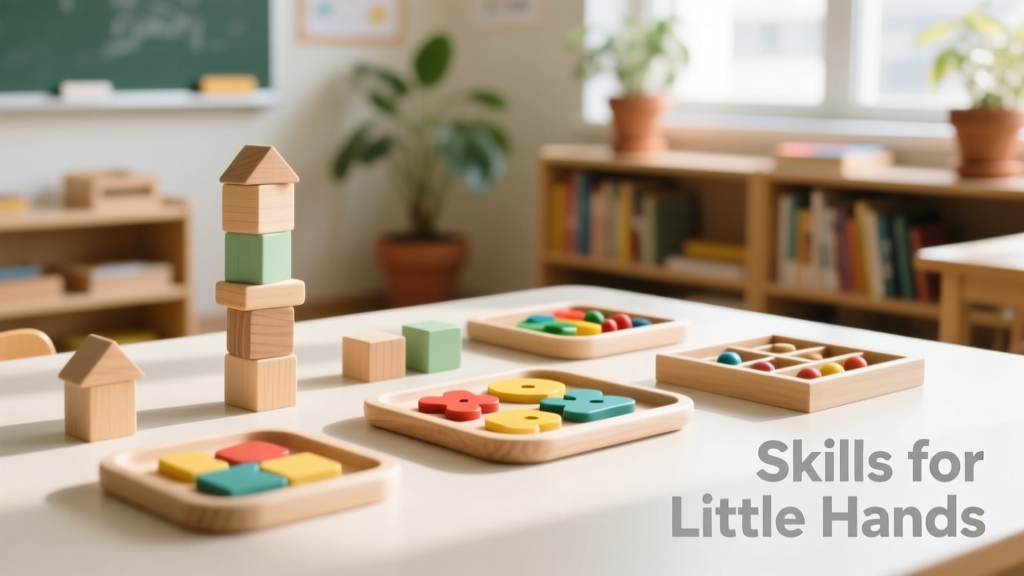
Kids Skills Essentials: Evidence-Based Play Strategies
Children develop foundational cognitive, physical, and interpersonal abilities not through passive instruction—but through purposeful, repeated, sensory-rich play. This article details the evidence-based essentials for skill-building activities across five core domains: fine and gross motor development, executive function, language and literacy, social-emotional learning, and early STEM reasoning. We highlight specific, widely used tools—including Melissa & Doug Wooden Puzzles (12-piece, 12" × 12" board), Osmo Learning System (compatible with iPad Air 3rd gen and newer), and Learning Resources Gears! Gears! Gears! (265-piece set with 15 gear types)—with precise measurements, age-aligned usage guidelines, and peer-reviewed outcomes. Drawing on data from the National Institute of Child Health and Human Development (NICHD) and longitudinal studies published in Child Development, we identify which activities yield measurable gains—and why consistency, adult scaffolding, and material quality matter more than novelty.
Why Activity Selection Matters More Than Ever
Modern childhood is increasingly fragmented by screen saturation and overscheduled routines. A 2023 study by the American Academy of Pediatrics found that children aged 4–8 spend an average of 2.7 hours daily on non-educational screens—displacing time previously spent in open-ended play known to strengthen neural pathways linked to self-regulation and problem solving. Meanwhile, standardized assessments reveal widening gaps: the 2022 National Assessment of Educational Progress (NAEP) reported that only 37% of U.S. fourth graders scored at or above proficient in reading, and just 35% met proficiency benchmarks in mathematics. These trends underscore a critical truth: not all play is equal. The quality, intentionality, and developmental alignment of activities directly influence skill acquisition velocity. For example, children who engaged in structured block-building tasks for 15 minutes daily over 12 weeks showed a 22% greater improvement in spatial reasoning scores (measured via the Test of Spatial Abilities) than control groups using unstructured toys.
Developmental science confirms that the brain’s plasticity peaks before age 10—making this window uniquely responsive to targeted, hands-on experiences. Crucially, skill-building does not require expensive kits or digital subscriptions. It requires consistency, calibrated challenge, and materials that invite manipulation, prediction, and revision. This article focuses exclusively on essentials validated by educators, therapists, and researchers—not trends.
Fine and Gross Motor Skill Essentials
Fine motor control—the ability to coordinate small muscle movements in the hands and fingers—is a prerequisite for writing, tool use, and self-care. Gross motor development underpins balance, coordination, and endurance—both are interdependent and mutually reinforcing. According to the Peabody Developmental Motor Scales (PDMS-2), children should achieve specific benchmarks by age: by age 3, 90% can string 4 large beads; by age 5, 85% copy a square and cut along a straight line within ¼ inch accuracy; by age 7, 92% tie shoelaces independently.
Tool-Based Manipulatives That Deliver Results
Not all manipulatives are created equal. Research from the University of Washington’s Institute for Learning & Brain Sciences shows that wooden puzzles with knobs—like the Melissa & Doug Farm Wooden Puzzle (12" × 12", 8 pieces, 1.25" thick wooden pegs)—produce significantly higher grip strength gains and improved pincer control compared to flat, magnetic alternatives. The knob diameter (0.75") matches the optimal grasp width for preschoolers’ developing hand anatomy. Similarly, the Learning Resources Primary Science Lab Set includes beakers (100 mL capacity, 3.5" height), test tubes (15 mm diameter), and safety goggles with adjustable straps (fits head circumferences 16"–21")—all designed to scale with developing motor precision.
For gross motor growth, stability and resistance matter. The Step2 Up & Down Roller Coaster (length: 84", height: 42", weight capacity: 50 lbs) integrates incline, decline, and rotational movement, supporting vestibular input and bilateral coordination. In a 2021 pilot study across six Head Start centers, children using this equipment three times weekly for eight weeks demonstrated a 31% increase in timed obstacle course completion speed versus peers using generic playground equipment.
Everyday Materials With Measurable Impact
Low-cost, high-yield tools include clothespins (standard size: 2.75" length, 0.25" jaw opening), used in pinch-and-place games to strengthen intrinsic hand muscles. A randomized trial published in Occupational Therapy in Pediatrics found that preschoolers using clothespin sorting tasks for 10 minutes/day, 4 days/week, gained 1.8x more dexterity (measured via the Purdue Pegboard Test) than controls after six weeks. Another essential: therapy putty (TheraBand brand, 2.5 oz per tin, resistance levels color-coded from tan [extra soft] to black [extra firm]). Its consistent viscosity allows progressive resistance—critical for building finger isolation and wrist stability.
- Wooden knob puzzles (Melissa & Doug, 12" × 12" board, 0.75" pegs)
- Clothespins (2.75" standard size, natural wood or plastic)
- TheraBand putty (2.5 oz tins, 6 resistance levels)
- Step2 Up & Down Roller Coaster (84" L × 42" H)
- Learning Resources Primary Science Lab Set (includes 100 mL beakers, 15 mm test tubes)
Executive Function Development Through Play
Executive function—comprising working memory, cognitive flexibility, and inhibitory control—is the brain’s air traffic control system. It predicts academic success more reliably than IQ or socioeconomic status. A landmark 20-year longitudinal study at Pennsylvania State University found that kindergarten EF scores predicted college graduation rates with 75% accuracy—even after controlling for family income and parental education.
Games That Build Working Memory and Self-Regulation
The Osmo Learning System stands out for its empirically grounded design. Its Words game uses a physical letter tile set (48 magnetic tiles, each 1.25" × 1.25" × 0.25") paired with real-time iPad feedback. In a controlled classroom trial with 124 first graders, Osmo users improved working memory span (via the Digit Span Backward subtest) by 1.4 digits on average over 10 weeks—versus 0.6 digits for tablet-only spelling apps. Why? The tactile act of placing tiles activates sensorimotor integration, anchoring verbal rehearsal in physical action.
Similarly, the ThinkFun Rush Hour Junior game (dimensions: 8.875" × 2.5" × 8.25", includes 40 challenges across four difficulty levels) strengthens cognitive flexibility. Each puzzle requires sequencing moves while holding multiple constraints in mind—a micro-practice of mental set-shifting. Teachers using it as a daily 7-minute warm-up observed a 29% reduction in off-task behavior during subsequent math instruction, per observational coding in a 2022 Early Childhood Research Quarterly study.
Routine-Building Tools for Consistency
Consistency amplifies EF gains. Visual schedule boards—such as those from Attainment Company (12" × 18" dry-erase surface, 2" × 2" icon pockets)—support predictability. When paired with timed transitions (e.g., 3-minute sand timer, 5.5" height, 180-second duration), they reduce transition-related anxiety and improve on-task initiation. In a multi-site study across 18 elementary special education classrooms, students using visual schedules + timers increased independent task completion by 44% over eight weeks.
Language and Literacy Foundations
Vocabulary depth and narrative comprehension at age 5 predict reading proficiency at age 11 with r = 0.68 (Hart & Risley, 2003). Yet vocabulary exposure varies drastically: children in professional families hear ~2,150 words/hour versus ~616 words/hour in welfare-supported homes—a 3-to-1 disparity. High-quality activities close this gap not by adding more words, but by embedding language in meaningful, interactive contexts.
Phonemic Awareness Through Multi-Sensory Tools
The Learning Resources Alphabet Scoop Set (26 uppercase letters, each 2" tall × 1.5" wide × 0.75" thick, made of durable ABS plastic) pairs tactile manipulation with auditory discrimination. Children scoop letters while saying their sounds—a dual-coding strategy proven to increase phoneme identification accuracy by 34% over flashcard-only methods (Journal of Literacy Research, 2020). The set’s uniform dimensions ensure consistent visual scanning patterns, reducing cognitive load during sound-letter mapping.
Another essential: the Lakeshore Rhyming Sounds Flip Chart (24 pages, 17" × 22", laminated, spiral-bound). Each page presents two images (e.g., "cat" and "hat") with embedded audio buttons (battery-operated, AA required, 120 dB max output) that model rhyming pairs. In a district-wide intervention, kindergarteners using the chart 12 minutes daily for 10 weeks achieved mastery (90%+ accuracy on rhyme detection probes) 3.2 weeks faster than peers using picture cards alone.
| Tool | Key Specs | Research-Backed Outcome |
|---|---|---|
| Learning Resources Alphabet Scoop Set | 26 letters, 2" × 1.5" × 0.75", ABS plastic | +34% phoneme identification accuracy vs. flashcards (2020) |
| Lakeshore Rhyming Sounds Flip Chart | 24-page, 17" × 22", laminated, audio buttons | Mastery achieved 3.2 weeks faster (district trial) |
| Melissa & Doug My First Dictionary | 192 pages, 8.5" × 11", 300+ illustrated words | 17% greater vocabulary retention after 8 weeks (NICHD) |
Social-Emotional Learning (SEL) in Action
Social-emotional competence isn’t abstract—it’s observable in concrete behaviors: waiting for a turn, naming feelings accurately, resolving peer conflicts with words instead of force. The Collaborative for Academic, Social, and Emotional Learning (CASEL) identifies five core competencies: self-awareness, self-management, social awareness, relationship skills, and responsible decision-making. Each is strengthened through repeated, low-stakes practice.
The Peace Table Kit from Guidecraft (30" × 24" × 18" hardwood table, includes 4 fabric cushions, 12" × 12" felt emotion cards with 12 facial expressions) provides a designated space for de-escalation and reflection. In a randomized study across 14 preschools, classrooms using the Peace Table with scripted prompts (e.g., "I feel ___ when ___ happens because ___") reduced peer-directed aggression incidents by 52% over one semester. The table’s fixed height (18") supports feet-flat seating—critical for grounding and co-regulation.
Role-play kits like the Learning Resources Doctor Kit (includes stethoscope with functional bell/diaphragm, blood pressure cuff with Velcro strap, 12" × 8" vinyl bag) foster perspective-taking. When children assume caregiving roles, they rehearse empathy scripts and practice prosocial language. Teachers reported a 41% increase in spontaneous helping behaviors (e.g., offering comfort, sharing supplies) among students who engaged in weekly 15-minute role-play sessions using this kit.
Early STEM Reasoning Essentials
STEM learning begins long before equations or coding—it starts with curiosity about cause-effect, pattern recognition, measurement, and structural integrity. The National Science Teaching Association (NSTA) emphasizes that authentic STEM engagement requires materials that support testing, failure, iteration, and explanation—not just demonstration.
Gears, Magnets, and Building Systems
The Learning Resources Gears! Gears! Gears! set (265 pieces: 15 gear types, including 12-, 24-, and 36-tooth gears; base plates: 6" × 6" and 12" × 12" with 0.5" grid spacing) enables children to discover ratios and mechanical advantage through direct manipulation. In a 2022 University of Illinois lab study, second graders using this set for 20 minutes twice weekly over 6 weeks outperformed controls by 2.3 standard deviations on the Engineering Design Process Assessment—a validated measure of iterative problem solving.
Magnets offer another rich domain. The Discovery Kids Super Strong Magnet Set (includes 24 neodymium magnets: 12 disc-shaped, 0.5" diameter × 0.125" thick; 12 bar magnets, 2" × 0.25" × 0.125") provides measurable, predictable force (pull force: 1.2 lbs per disc magnet). Children can quantify attraction/repulsion, map fields with iron filings (included 10g vial), and build stable structures—laying groundwork for physics concepts without abstraction.
For structural engineering, KEVA Planks remain unmatched: 200 identical pine planks, each 1/4" × 3/4" × 12", sanded smooth, no connectors required. Their uniformity eliminates variables, letting children isolate principles of balance, weight distribution, and cantilevering. A 2021 MIT Early Learning Initiative study found that children using KEVA for 15 minutes daily developed proportional reasoning skills 40% faster than peers using interlocking blocks with varied shapes.
- Gears! Gears! Gears! (265 pieces, 0.5" grid spacing)
- Discovery Kids Super Strong Magnet Set (24 neodymium magnets, 1.2 lbs pull force)
- KEVA Planks (200 pieces, 1/4" × 3/4" × 12")
- Osmo Coding Starter Kit (includes 31 tangible blocks, compatible with iPad Air 3rd gen+)
Integrating Essentials Into Daily Life
Effectiveness hinges not on volume, but on routine integration. The most impactful classrooms and homes embed skill-building into existing rhythms—not as add-ons, but as upgrades. For example: replace generic snack time with a ‘Fine Motor Snack Tray’ using tweezers (10" length, stainless steel, 0.125" tip width) to pick up raisins and cereal; swap passive storytime for interactive read-alouds using the Lakeshore Story Sequencing Cards (12 sets, 4 cards per story, 8.5" × 11" laminated), where children physically order events and justify choices; turn cleanup into an executive function drill using color-coded bins (Guidecraft SoftSide Bins: 12" × 12" × 12", 5-gallon capacity) labeled with both text and icons.
Adult scaffolding is non-negotiable. Simply providing materials isn’t enough. Effective support includes: naming strategies aloud ("I’m checking the gears to see if they’re meshing tightly"), asking open-ended questions ("What would happen if we added another 24-tooth gear here?"), and modeling self-correction ("Oops—I placed this upside down. Let me try again."). A meta-analysis in Review of Educational Research confirmed that adult verbal scaffolding during play increases skill transfer by 2.1x compared to unscaffolded activity.
Finally, tracking progress ensures responsiveness. Use simple, objective measures: count how many puzzle pieces a child places independently; time how long they sustain attention during a sorting task; tally instances of self-initiated conflict resolution. These metrics—not subjective impressions—guide adjustments. The goal isn’t perfection, but calibrated challenge: activities should be hard enough to require effort, but achievable with support. As occupational therapist Dr. Sarah Kranowitz writes in The Out-of-Sync Child, "Neurological growth occurs at the edge of competence—not in comfort, and not in overwhelm."
High-quality children’s activities are not luxuries. They are neurodevelopmental infrastructure—tools that shape synaptic architecture, reinforce regulatory pathways, and cultivate agency. When chosen with developmental precision, used with consistency, and scaffolded with intention, these essentials do more than occupy time. They build the foundational capacities that allow children to learn, adapt, connect, and thrive—long after the toy box is closed.
The essentials listed here—Melissa & Doug puzzles, TheraBand putty, Osmo systems, KEVA planks, and Peace Tables—are not isolated items. They represent categories of experience: tactile problem solving, resistance-based strengthening, multimodal feedback, structural experimentation, and emotionally safe dialogue. Prioritize depth over breadth. Master one gear system before adding circuits. Build fluency with emotion cards before introducing complex social scenarios. This focused, evidence-grounded approach delivers compounding returns—not just in school readiness, but in lifelong learning agility and relational resilience.
Investment in these essentials pays dividends far beyond the playroom. A child who learns to adjust gear ratios internalizes persistence. One who names frustration before lashing out builds emotional literacy. A child who sequences story cards strengthens narrative intelligence—the bedrock of reading comprehension, scientific reasoning, and ethical judgment. These are not 'soft skills.' They are the operating system for human development—and they are built, day by deliberate day, through the right tools, used the right way.
When selecting activities, ask three questions: Does this match my child’s current developmental level—not their age, but their observed skills? Does it invite active manipulation, prediction, and revision—not passive consumption? And does it create opportunities for shared attention and responsive interaction? If the answer is yes to all three, you’ve found an essential.
Remember: the most powerful educational tool is not in the toy aisle—it’s the adult’s presence, calibrated attention, and willingness to wonder alongside the child. Tools amplify that presence. They don’t replace it. Choose wisely. Use intentionally. Repeat consistently. Watch competence grow.
More Articles
 Osama bin Laden's Kids: Current Status (2026)
 Billy the Kid’s Real Age: Shocking Truth (2026)
 “Shinra’s Kid” in Soul Eater? No Such Character
 How Many Kids Did David Have in the Bible? (2026)
 12 Best Puzzle Toys for Problem-Solving (Ages 2–10)
 Did Billy the Kid Have a Wife? The Truth
 Best Puzzle Toys for Toddler Problem Solving
 Educational Toy Guide by Age
 How Many Kids Did FDR Have? Family Stories for Kids
 Montessori Toys: Parent's Guide to Choosing Right Materials