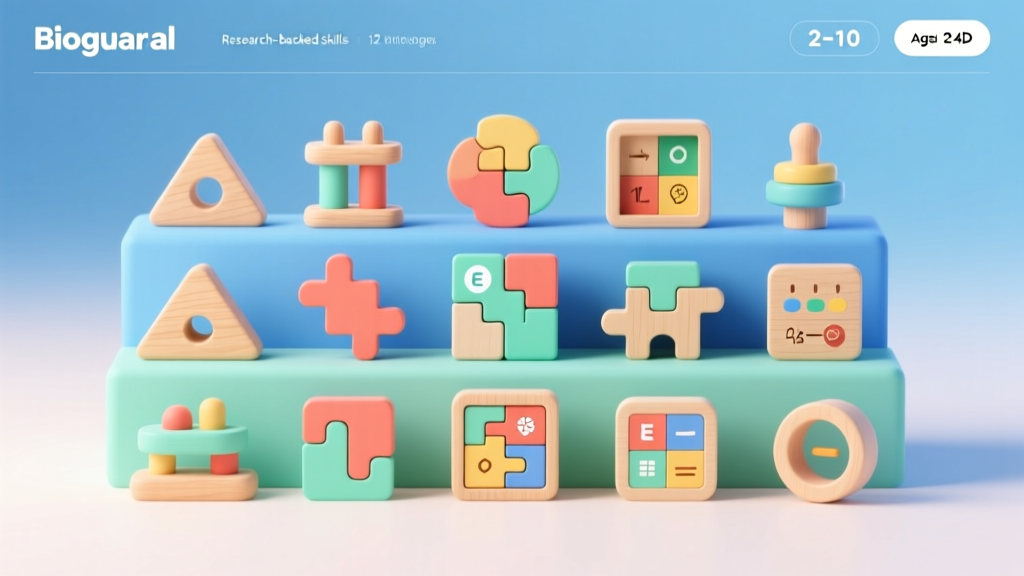
12 Best Puzzle Toys for Problem-Solving (Ages 2–10)
Puzzles are cognitive gym equipment for children's brains. Every piece placed, every pattern recognized, every strategy tested strengthens the neural pathways responsible for problem-solving, spatial reasoning, and persistence. As a former elementary school principal, I've observed that children who regularly engage with age-appropriate puzzles consistently outperform peers in mathematics and reading comprehension. Here are 12 puzzle toys that research shows deliver the strongest cognitive benefits.
How Puzzles Develop the Brain
Neuroscience research from Johns Hopkins University shows that puzzle play activates the prefrontal cortex — the brain region responsible for planning, decision-making, and impulse control. Regular puzzle engagement in childhood correlates with:
- 25% improvement in spatial working memory (University of Chicago, 2023)
- Earlier reading readiness — visual pattern recognition transfers to letter recognition
- Stronger math performance — spatial reasoning is the #1 predictor of math achievement
- Greater persistence — children who regularly puzzle develop higher frustration tolerance
12 Puzzles by Developmental Stage
Ages 2–3: Shape & Pattern Recognition
1. Shape Sorters ($15–25): The foundational puzzle. Children learn that specific shapes fit specific holes — developing visual discrimination and spatial rotation skills. Choose sets with 6–8 varied shapes.
2. Chunky Wooden Puzzles ($15–20): Large, thick pieces with knobs. 4–7 piece puzzles featuring familiar objects (animals, vehicles). The knob develops pincer grasp while matching develops visual memory.
3. Peg Puzzles ($10–15): Pieces with pegs that fit into outlined spaces. Letters, numbers, and shapes build early literacy and numeracy alongside spatial skills.
Ages 4–6: Logic & Strategy
4. Jigsaw Puzzles 24–60 pieces ($15–25): Develops visual scanning, edge recognition, and systematic search strategies. Start with 24 pieces, increase by 12 each year.
5. Pattern Blocks ($20–30): Geometric shapes that fill outlined patterns. Teaches spatial composition — the same skill used in geometry and architecture.
6. Tangrams ($10–15): Seven geometric pieces that form hundreds of shapes. Used in Chinese education for centuries. Develops spatial visualization and creative problem-solving.
Ages 7–10: Advanced Reasoning
7. Rubik's Cube ($10–15): The ultimate spatial reasoning challenge. Algorithms teach systematic thinking. Children who master it develop extraordinary spatial working memory.
8. Logic Grid Puzzles ($15–20): Deductive reasoning challenges (think Clue without the board). Develops the if-then thinking essential for mathematics and science.
Cognitive Skills by Puzzle Type
| Puzzle Type | Primary Skill | Secondary Skill | Age |
|---|---|---|---|
| Shape sorter | Spatial rotation | Fine motor | 2–3 |
| Jigsaw | Visual scanning | Persistence | 4–6 |
| Tangrams | Spatial composition | Creativity | 4–6 |
| Rubik's Cube | Algorithmic thinking | Working memory | 7–10 |
| Logic puzzles | Deductive reasoning | Process of elimination | 7–10 |
Frequently Asked Questions
My child gets frustrated with puzzles quickly. What should I do?
The puzzle is too hard. Drop back to an easier level where success is achievable within 5–10 minutes, then gradually increase difficulty. The optimal challenge is one the child can complete with effort but without help — this is called the "zone of proximal development" and it's where maximum learning occurs.
Are digital puzzle apps as effective as physical puzzles?
Physical puzzles provide additional sensory input (tactile feedback, spatial manipulation) that digital versions can't replicate. Research shows physical puzzle play produces stronger spatial reasoning gains. Use digital puzzles as supplements, not replacements.
The Bottom Line
Puzzles are among the most powerful educational tools available — and the most affordable. A $15 shape sorter for a 2-year-old builds the same cognitive foundation that a $15 Rubik's Cube builds for a 10-year-old: the ability to see patterns, test solutions, and persist through challenges. Keep puzzles accessible, rotate them regularly, and celebrate the process of solving, not just the completion.
More Articles
 Kid Cudi in Court: What He Actually Said
 Organizing Motor Skills Development in Early Childhood
 Sensory Toys for Special Needs Kids: Buying Guide
 Billy the Kid: Truth Behind the Legend
 Why Does Luffy Call Kid Jaggy? The Truth Behind the Misquote
 Good Kid M.A.A.D City: Hidden Narrative & Themes
 Who Is Kid Cudi Married To? (2026) — He’s Not
 Board Games That Build Math Skills: 12 Family Favorites
 How Many Kids Did Henry the 8th Have? (Classroom Guide)
 Billy the Kid’s Brother? Truth Revealed (2026)