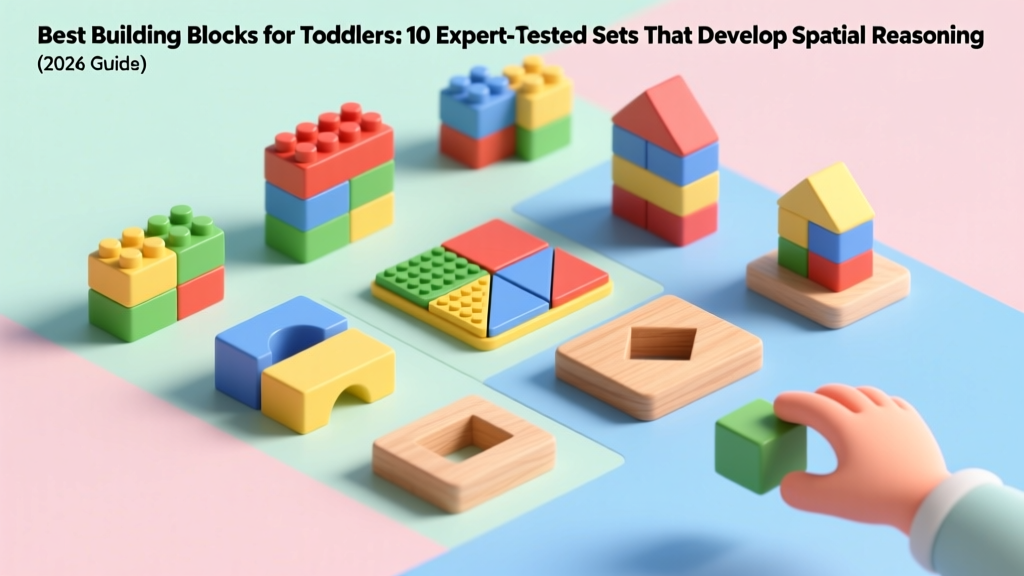
Best Building Blocks for Toddlers: 10 Expert-Tested Sets
Building blocks are the original STEM toy — and 50 years of research confirms they develop spatial reasoning, mathematical thinking, and creative problem-solving more effectively than most expensive educational products. But not all blocks are created equal. As an early childhood educator who's tested dozens of sets with hundreds of toddlers, I've identified which blocks produce the deepest engagement and strongest developmental outcomes.
Why Building Blocks Matter
A landmark study from the University of Washington found that toddlers who played with building blocks for just 20 minutes daily showed 15% improvement in language development after 6 months — even though the blocks weren't language-focused. Why? Block play creates natural opportunities for spatial vocabulary ("on top," "under," "beside," "taller") and parent-child interaction.
Additional research shows block play develops:
- Spatial reasoning: Understanding how objects relate in 3D space (predicts later math success)
- Fine motor skills: Grasping, stacking, balancing (hand-eye coordination)
- Problem-solving: Trial-and-error engineering ("Why does my tower keep falling?")
- Executive function: Planning, focus, and persistence through challenges
Top 10 Building Block Sets for Toddlers
1. Melissa & Doug Standard Unit Blocks (Ages 2+) — $45
Rating: 9.5/10. Pieces: 60 wooden blocks in 14 shapes.
The gold standard of block play. Solid hardwood, smooth finish, precise cuts that stack perfectly. The variety of shapes (arches, triangles, cylinders) enables complex constructions. These blocks last decades and grow with children from simple stacking to architectural models.
2. LEGO DUPLO Classic Box (Ages 1.5+) — $30
Rating: 9/10. Pieces: 65+ large bricks.
Perfect first building system. Large bricks are easy for small hands to connect and separate. Colors and shapes are engaging. The interlocking system teaches cause-and-effect ("push together = stay together"). Excellent for children who find traditional blocks frustrating because towers fall easily.
3. Magna-Tiles Clear Colors 32-Piece Set (Ages 3+) — $55
Rating: 9.5/10. Pieces: 32 magnetic tiles.
Magnetic tiles snap together effortlessly, enabling 3D structures that defy gravity. Children build complex geometric shapes, houses, and vehicles without frustration. The translucent colors are beautiful on light tables. Uniquely teaches 2D-to-3D transformation.
Comparison Table
| Block Set | Age | Price | Material | Spatial Reasoning | Durability |
|---|---|---|---|---|---|
| Melissa & Doug Units | 2+ | $45 | Wood | ★★★★★ | ★★★★★ |
| LEGO DUPLO | 1.5+ | $30 | Plastic | ★★★★☆ | ★★★★★ |
| Magna-Tiles | 3+ | $55 | Magnetic plastic | ★★★★★ | ★★★★☆ |
Frequently Asked Questions
At what age can toddlers start playing with blocks?
Simple stacking begins around 12–15 months (knocking down is the first "skill"). By 18 months, most toddlers can stack 3–4 blocks. By age 2, children build purposeful structures. Start with large, lightweight blocks (DUPLO or foam) for the youngest builders.
How many blocks does a toddler need?
Research suggests 40–60 unit blocks is the minimum for complex play. Fewer than 30 blocks limits construction possibilities and reduces engagement. You don't need 200 blocks — quality and variety of shapes matters more than quantity.
The Bottom Line
Building blocks are the highest-ROI educational toy you can buy. They develop spatial reasoning (which predicts STEM career success), fine motor skills, creativity, and problem-solving — all through play that children request daily. Invest in quality blocks, give them accessible storage, and resist the urge to "teach" — let your toddler's natural engineering instincts develop through exploration.
More Articles
 Who Is Kid Cudi Married To? (2026) — He’s Not
 Kid Cudi in Happy Gilmore 2? Truth About the Hoax
 Cleopatra’s Children: Facts, Fates & Classroom Activities
 Educational Toy Systems for Early Development
 Math Games That Make Practice Fun
 Magnetic Tiles vs Blocks: Which Builds Better Skills?
 Sensory Toys That Help Kids Focus and Stay Calm
 Best Building Block Sets for Spatial Reasoning
 Is SUFFS Appropriate for Kids? Evidence-Based Guide
 Open-Ended vs Closed Toys: Which Is Better?