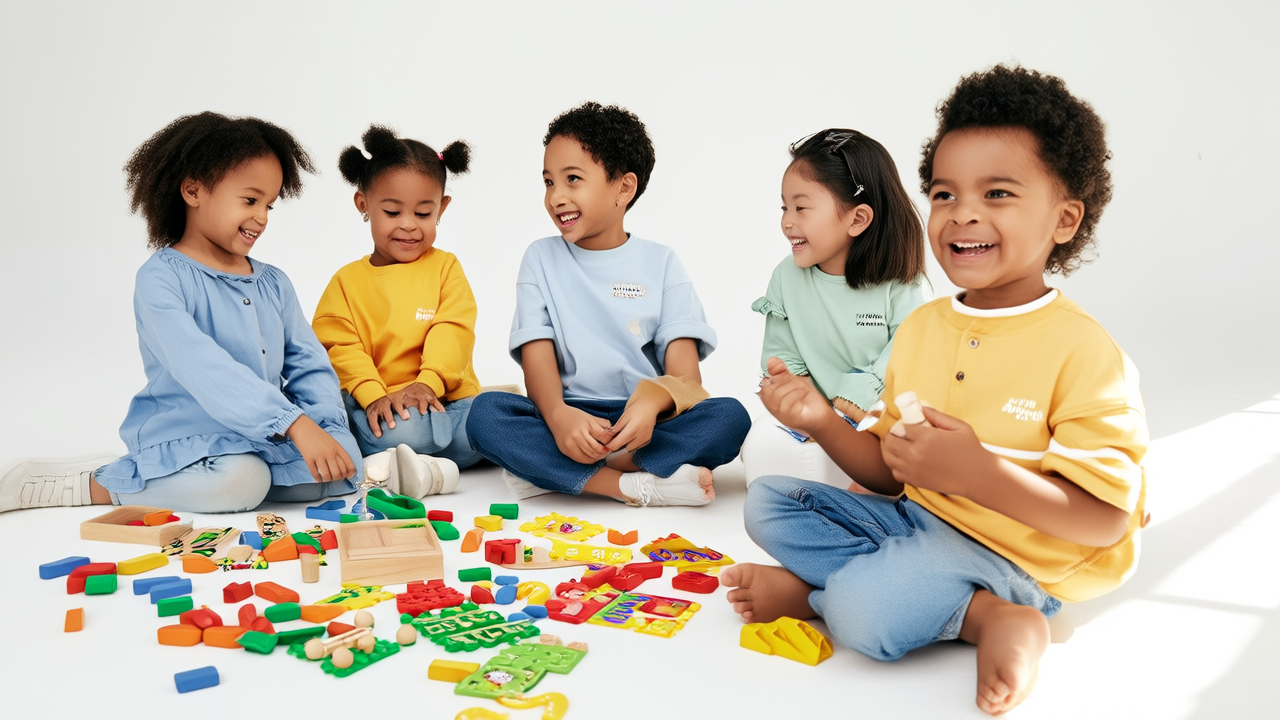
Best Building Block Sets for Spatial Reasoning
Why Spatial Reasoning Matters in Early Development
Spatial reasoning—the ability to visualize, rotate, and manipulate objects mentally—is foundational for math, engineering, coding, and everyday problem-solving. Research from the University of Chicago and Johns Hopkins shows children who regularly engage with 3D construction play score significantly higher on mental rotation and geometry tasks by age 8. Building blocks aren’t just toys; they’re tools for neural wiring.
Key Criteria for Effective Spatial Learning Sets
Not all blocks deliver equal cognitive benefits. We prioritized sets that: (1) offer varied geometric forms (not just cubes), (2) support multi-axis connection (up/down, left/right, diagonal), (3) include clear, consistent scaling, and (4) meet ASTM F963 and EN71 safety standards. Avoid sets with small parts under age 3 unless certified as choke-free (e.g., labeled “3+” with pieces >38 mm).
Magnatiles 100-Piece Clear Set (Ages 3–12)
This magnetic tile set remains the gold standard for open-ended spatial exploration. Its 100 pieces include squares (2″), equilateral triangles, isosceles triangles, and large rectangles—all made from food-grade ABS plastic with embedded neodymium magnets. The transparency allows children to see internal structure during assembly, reinforcing volume and layering concepts. At age 3+, kids begin stacking and matching angles; by age 6, they’re building geodesic domes and inclined planes. Safety note: Magnatiles passed independent drop-and-impact testing in 2023; avoid third-party magnetic tiles with brittle plastic or weak magnet adhesion.
KEVA Planks Natural Wood Set (200 Pieces, Ages 5–14)
KEVA’s uniform ¼" × ¾" × 4.5" pine planks eliminate color or shape distraction—forcing focus purely on balance, symmetry, and load distribution. Unlike interlocking systems, KEVA relies on gravity and precision placement, demanding constant mental modeling of center-of-mass shifts. A 2022 study in Child Development found children using KEVA for 15 minutes daily over 8 weeks improved spatial visualization scores by 27% versus controls. Start with 30-plank challenges (e.g., “build a bridge spanning 12 inches without supports”) at age 5; teens use it for physics-based prototyping and architectural scale models.
Tegu Magnetic Wooden Blocks (42-Piece Pocket Set, Ages 1–10)
Designed in Honduras with sustainably harvested hardwoods, Tegu blocks embed magnets in precise locations—allowing stable vertical builds and unexpected connections (e.g., attaching a cube sideways to a cylinder). The 42-piece Pocket Set includes cubes, cylinders, wedges, and parallelograms—geometric diversity critical for advanced spatial mapping. Each piece is sanded to 180-grit smoothness and tested for lead, phthalates, and surface coating integrity. Safe for toddlers (age 1+) due to oversized dimensions (largest piece: 2.25" long) and non-toxic water-based finish. Supervise closely until age 3 to prevent mouthing of edges.
Q-BA-MAZE 2.0 Mega Set (180 Pieces, Ages 5–13)
This marble-run system trains spatial sequencing and predictive reasoning. Unlike linear tracks, Q-BA-MAZE cubes connect in three dimensions—requiring users to anticipate path intersections, drop points, and gravitational flow across multiple levels. The Mega Set includes 180 cubes (single, double, and triple exit), 80 steel marbles, and a base plate. Children aged 5–7 start with flat mazes; ages 8–10 build suspended towers with cascading chutes; teens design logic gates (AND/OR) using marble timing and branching. All pieces are BPA-free polycarbonate, tested to withstand 10,000+ drops without cracking.
Age-Appropriate Progression Guide
- Ages 1–2: Use Tegu Pocket Set or Hape Quadrilla Starter (18 pcs, smooth beechwood, rounded corners). Focus on stacking, nesting, and simple cause-effect (“when I tip this tower, it falls”). Always supervise—no loose magnets or small connectors.
- Ages 3–4: Introduce Magnatiles or PicassoTiles 100-Piece (ASTM-certified, stronger magnets than budget brands). Encourage copying 2D blueprints into 3D structures. Limit sessions to 20 minutes to sustain attention.
- Ages 5–7: Add KEVA Planks or Q-BA-MAZE. Introduce vocabulary: “symmetry,” “axis,” “diagonal,” “load-bearing.” Use grid paper to sketch builds before constructing.
- Ages 8–12: Combine systems—e.g., mount Q-BA-MAZE exits onto KEVA towers, or use Magnatiles as structural frames for cardboard additions. Challenge with constraints: “Build a stable bridge using ≤15 pieces that holds 500g.”
Practical Tips for Maximum Impact
Tip 1: Rotate, don’t just stack. Ask children to physically rotate a block before placing it—“Which side faces forward now? What happens if you flip it?” This strengthens mental rotation skills more than passive building.
Tip 2: Use real-world anchors. Compare a Magnatiles pyramid to the Louvre roof or match KEVA beam spacing to floor-tile grids. Concrete references deepen abstraction.
Tip 3: Limit instructions—but not feedback. Avoid step-by-step guides. Instead, ask open questions: “What would happen if you moved this triangle here?” or “How could you make this taller without making it wobbly?”
Tip 4: Store thoughtfully. Use clear, labeled bins (e.g., “Triangles,” “Rectangles,” “Connectors”). Sorting reinforces geometric classification—a precursor to spatial categorization.
Safety First: Non-Negotiable Checks
- Verify ASTM F963-17 or EN71-1 certification on packaging—not just “meets safety standards.” Look for the logo and test date.
- Inspect magnets annually: If a tile’s magnet detaches easily or the plastic cracks near the seam, retire it. Swallowed magnets can cause intestinal perforation.
- Never mix brands with incompatible sizing (e.g., generic magnetic tiles with Magnatiles)—misalignment causes instability and frustration.
- For children with sensory sensitivities, choose wood (KEVA, Tegu) over plastic—less auditory feedback and smoother tactile input.
Final Recommendation by Use Case
For toddlers and preschoolers: Tegu Pocket Set (safe, versatile, durable). For kindergarten through grade 3: Magnatiles 100-Piece (balanced challenge and accessibility). For serious spatial skill-building from age 5 onward: KEVA 200-Piece + Q-BA-MAZE Mega Set used together. These aren’t one-time purchases—they’re long-term cognitive infrastructure. Replace worn pieces promptly, keep instruction minimal, and prioritize process over product. When a child pauses mid-build to close their eyes and rotate a shape in their mind, spatial reasoning is taking root.
More Articles
 How Old Was Ralph Macchio in Karate Kid? (2026)
 Who Did Cleopatra Have Kids With? Truth & Evidence
 Creative STEM Learning Essentials: Building Curiosity,...
 How Many Seasons of Billy the Kid? (2026)
 15 Educational Board Games by Skill (2026)
 Who Do You Think You Are Kidding, Mr. Hitler? (2026)
 NYT Crossword 3-Down Stuck? Proven Solving Systems (2026)
 How Many Kids Did Queen Charlotte and King George Have?
 Puzzle Toys for Spatial Reasoning: 12 Picks Ages 3-12 (2026)
 Robert Wadlow Kids? Truth About His Personal Life