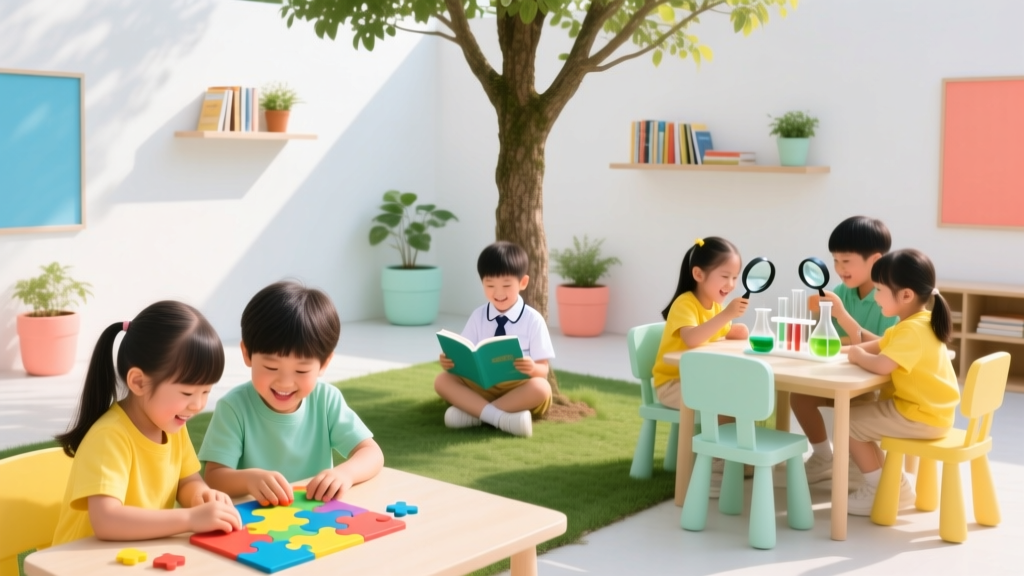
What Is a Hypothesis for Kids? (2026)
Why 'What Is a Hypothesis for Kids?' Is One of the Most Powerful Questions You’ll Ask This Year
When a curious 7-year-old points at a wilting basil plant and asks, "What if we watered it every day instead of every other day?"—they’ve just voiced their first real hypothesis. What is a hypothesis for kids? It’s not a fancy word to memorize—it’s the spark that turns wonder into investigation, guesswork into evidence, and playtime into authentic scientific thinking. In an era where critical thinking ranks among the top skills employers seek (and where screen-based 'answers' often replace deep questioning), helping children formulate testable predictions isn’t just science class prep—it’s cognitive scaffolding for lifelong learning. And the best part? You don’t need microscopes or grant funding—just curiosity, a notebook, and the right language.
What a Hypothesis *Really* Is (and What It’s Not)
Let’s start by demystifying the term. A hypothesis isn’t a ‘right answer’—it’s an educated guess based on observation and prior knowledge. Think of it like a scientist’s hunch: "If I change X, then Y will happen, because…" That ‘because’ part is crucial—it grounds the prediction in reasoning, not magic or wishful thinking. For kids, this means shifting from "I think the paper airplane will fly farther" to "If I fold the wings up, then it will stay in the air longer because the upward bend catches more air."
Developmental psychologist Dr. Laura E. Schulz, MIT professor and lead researcher on early causal reasoning, confirms this distinction matters deeply: "Children as young as 4 spontaneously generate hypotheses when exploring cause-and-effect—but they need adults to model the language of prediction and evidence, not just praise the outcome." Her landmark 2019 study in Child Development showed that kids who heard hypothesis-framed prompts ("What do you think will happen if…?") asked 3.2× more follow-up questions and designed more controlled tests than peers given open-ended prompts alone.
So how do we make this concrete? Start with three non-negotiable ingredients every kid-friendly hypothesis must include:
- An observable change (e.g., “more water,” “different color paper,” “adding salt”)
- A predicted result (e.g., “the ice melts faster,” “the plant grows taller,” “the balloon inflates bigger”)
- A simple reason (e.g., “because salt lowers freezing point,” “because plants need water to grow,” “because baking soda and vinegar make gas”)
Notice: no jargon, no passive voice, no vague verbs like “maybe” or “probably.” Clarity builds confidence—and confidence fuels experimentation.
Building Hypotheses Step-by-Step: From Preschool to Middle School
Hypothesis development isn’t one-size-fits-all. It evolves with cognitive maturity—and your support should too. Here’s how to scaffold it across ages, backed by American Academy of Pediatrics (AAP) developmental milestones and Next Generation Science Standards (NGSS) progression:
| Age Range | Hypothesis Language Template | Real-World Example | Adult Support Strategy | Red Flag (Avoid This!) |
|---|---|---|---|---|
| 5–7 years | "I think ___ will happen when I ___ because ___" | "I think the blue car will go faster down the ramp when I make the ramp steeper because it slides quicker!" | Use sentence frames on whiteboards; record predictions with drawings + voice notes; compare before/after photos | Accepting untestable guesses (“It’ll be magic!”) without gently probing for observable cause |
| 8–10 years | "If I ___, then ___ will happen, because ___" | "If I add 1 tsp of sugar to the yeast mixture, then it will bubble more in 5 minutes because sugar feeds yeast." | Introduce simple variables (independent/dependent); use T-charts to list 'what I change' vs. 'what I watch'); co-create data tables | Letting kids skip the 'because'—or accepting circular reasoning (“It bubbles more because it’s bubbling more!”) |
| 11–12 years | "Based on [observation/data], I predict that ___ will occur when ___ changes, because [scientific principle]." | "Based on our soil moisture readings, I predict that radish seeds in the sandy mix will sprout 2 days later than those in loam, because sand drains faster and dries out quicker." | Encourage citing prior experiments or research; introduce control groups; ask "How could we prove this wrong?" | Discouraging revision—even when evidence contradicts the hypothesis (a vital part of science!) |
Pro tip: Never say “That’s wrong!” when a hypothesis fails. Instead, celebrate the discovery: "Wow—that unexpected result just taught us something new about how light bends through water! Let’s write it down so others can learn too." According to NGSS Lead Writer Dr. Heidi Schweingruber, "The most powerful science classrooms treat failed hypotheses as data gold—not failure. That mindset shift starts with how adults respond in the moment."
5 Everyday Activities That Build Hypothesis Muscle (Zero Prep Needed)
You don’t need a lab kit to nurture scientific reasoning. These low-barrier, high-impact routines integrate seamlessly into home and classroom life—and each includes a built-in hypothesis prompt:
- The Breakfast Test: Offer two cereal bowls—one with milk, one with almond milk. Ask: "What do you think will happen to the cereal texture after 2 minutes in each? Why?" Then time it. Bonus: discuss solubility and starch breakdown.
- Shadow Mapping: At sunrise and sunset, trace your child’s shadow on pavement with chalk. Ask: "If we do this again at noon, what shape and size do you predict? Because?" Reinforces Earth’s rotation and light geometry.
- Laundry Logic: Sort socks by fabric (cotton, polyester, wool blend). Predict drying time on a clothesline. Track results. Introduces material science and evaporation rates.
- Sound Scavenger Hunt: Walk around the house with a notebook. Record sounds (refrigerator hum, faucet drip, window rattle). Ask: "Which sound travels farthest through the wall? Why might that be?" Opens doors to vibration, density, and acoustics.
- Cookie Chemistry: Bake cookies with one variable changed (e.g., brown sugar vs. white sugar, chilling dough vs. no chill). Before baking: "How will this change affect spread, chewiness, or browning? What’s your evidence from last time?"
Each activity embeds the hypothesis loop: Observe → Wonder → Predict → Test → Compare → Revise. And crucially—they’re repeatable. As Stanford’s Project Zero research shows, repetition with variation (same structure, new context) is how neural pathways for scientific reasoning solidify.
Why 'Hypothesis' Belongs in Your Child’s Emotional Toolkit—Not Just Their Science Notebook
Here’s what most guides miss: hypothesis-building is emotional intelligence training in disguise. When kids learn to state a prediction, gather evidence, and adjust their thinking, they’re practicing cognitive flexibility—a core resilience skill linked to lower anxiety and higher academic persistence (per a 2022 longitudinal study in Developmental Psychology). Consider this case study from Ms. Rivera’s 4th-grade class in Austin, TX:
"After introducing hypothesis framing during our 'Mystery Melt' unit (testing which materials insulate ice best), I noticed Maya—a student who’d shut down during math assessments—volunteered daily to share predictions. Her reasoning wasn’t always perfect, but her confidence soared. When her wool-wrap hypothesis failed (ice melted faster than expected), she didn’t cry. She said, 'Maybe wool traps heat from the air? Let’s test it outside!' That’s executive function in action: self-monitoring, error correction, and solution-oriented thinking. We now call it 'Maya’s Melt Mindset.'"
This isn’t anecdotal. The Collaborative for Academic, Social, and Emotional Learning (CASEL) explicitly lists “making reasoned judgments based on evidence” as a key indicator of responsible decision-making. So yes—teaching what is a hypothesis for kids does more than prepare them for middle school labs. It equips them to navigate friendships (“If I say sorry, will she smile?”), manage big feelings (“If I take five breaths, will my heart slow down?”), and evaluate online claims (“If this video says cats love cucumbers, what proof do they show?”).
Bottom line: hypothesis language is transferable thinking. Every time your child says “I think… because…” instead of “I just know!”, they’re strengthening both their brain and their bravery.
Frequently Asked Questions
Can kindergarteners really understand hypotheses?
Absolutely—when framed concretely. Research from the University of Chicago’s Early Math Project shows 5-year-olds reliably distinguish between guesses (“I hope it rains!”) and hypotheses (“If dark clouds cover the sky, rain will fall because clouds hold water”). Use physical props (e.g., “Let’s predict how many blocks this bridge holds”), visual sentence strips, and consistent language. Avoid abstract definitions—focus on the verb: predicting, testing, learning.
What if my child’s hypothesis is totally wrong?
That’s not wrong—it’s essential. In fact, disconfirming a hypothesis teaches more than confirming one. Neuroscientist Dr. Robert Sapolsky notes: "The brain lights up most intensely when expectations are violated—precisely when learning accelerates." Guide reflection: "What surprised you? What does that tell us about how this works? What would you test next?" This builds intellectual humility—the foundation of scientific integrity.
Do I need special materials or kits?
No. Everyday objects work best: paper, tape, water, food, toys, nature items. Over-engineered STEM kits often limit open inquiry. A 2021 University of Washington study found children using household items generated 40% more original hypotheses than those using branded experiment kits. Simplicity invites creativity.
How do I handle a child who hates being 'wrong'?
Reframe 'wrong' as data. Say: "Your hypothesis gave us amazing information—we now know this doesn’t work that way. That saves future scientists hours!" Display failed predictions proudly on a 'Learning Wall' with photos and notes. Celebrate the process, not just outcomes. AAP recommends praising effort (“You tested three ideas!”) over correctness.
Is there a difference between a hypothesis and a prediction?
Yes—and it matters. A prediction is a statement about what will happen (e.g., “It will rain tomorrow”). A hypothesis includes a reasoned explanation for why it will happen (e.g., “If humidity rises above 80%, rain will fall because moist air condenses into droplets”). For kids, start with prediction; gradually add the 'because' clause as reasoning skills mature.
Common Myths About Teaching Hypotheses to Children
- Myth 1: “Hypotheses must be proven true to be valuable.”
Reality: In real science, most hypotheses are revised or rejected. Nobel laureate Dr. Barbara McClintock spent decades refining her maize gene-transposition hypothesis before validation. The value is in the rigor of the question—not the answer. - Myth 2: “Only gifted kids grasp this concept.”
Reality: Hypothesis thinking emerges naturally in all children during play (e.g., “If I stack blocks this way, the tower won’t fall!”). Equity-focused educators like Dr. Gail Thompson emphasize that access—not ability—determines success. All kids thrive with consistent, joyful practice.
Related Topics (Internal Link Suggestions)
- Science Fair Projects for Elementary Students — suggested anchor text: "simple science fair projects for 3rd graders"
- How to Teach the Scientific Method to Kids — suggested anchor text: "scientific method steps for kids printable"
- STEM Activities for Rainy Days — suggested anchor text: "indoor STEM activities for kids ages 6-10"
- Growth Mindset Activities for Children — suggested anchor text: "growth mindset games for elementary students"
- Early Childhood Science Standards — suggested anchor text: "NGSS kindergarten science standards explained"
Ready to Launch Your Child’s First Hypothesis?
You already have everything you need: curiosity, patience, and the power of a single question—"What do you think will happen… and why?" Start tonight at dinner. Ask your child to hypothesize about something small: "If we stir the soup clockwise vs. counter-clockwise, will it cool faster? Why?" Write it down. Test it. Laugh when steam fogs the glasses. Revise. Repeat. Because what is a hypothesis for kids isn’t a definition to memorize—it’s an invitation to think like a scientist, every single day. Download our free Hypothesis Builder Printable (with age-differentiated sentence frames and 10 ready-to-go home experiments) to turn this insight into action—in under 60 seconds.
More Articles
 Match Experts With Facts: Evidence-Based Framework
 Plant Growth Experiments for School Projects
 How Things Are Made for Kids: Factory Tours & STEM Kits
 Teaching Critical Thinking Skills to Kids
 20 Engineering Challenges Using Only Paper and Tape (2026)
 How to Explain Ice to Kids: 5 Science-Backed Strategies
 Volcano for Kids That Erupts: STEM Activity (2026)
 Best Educational Toys for Skill-Building Play
 Sid the Science Kid Streaming & STEM Impact (2026)
 Coding for Kids: Scratch Tutorial Ages 8–12 (2026)