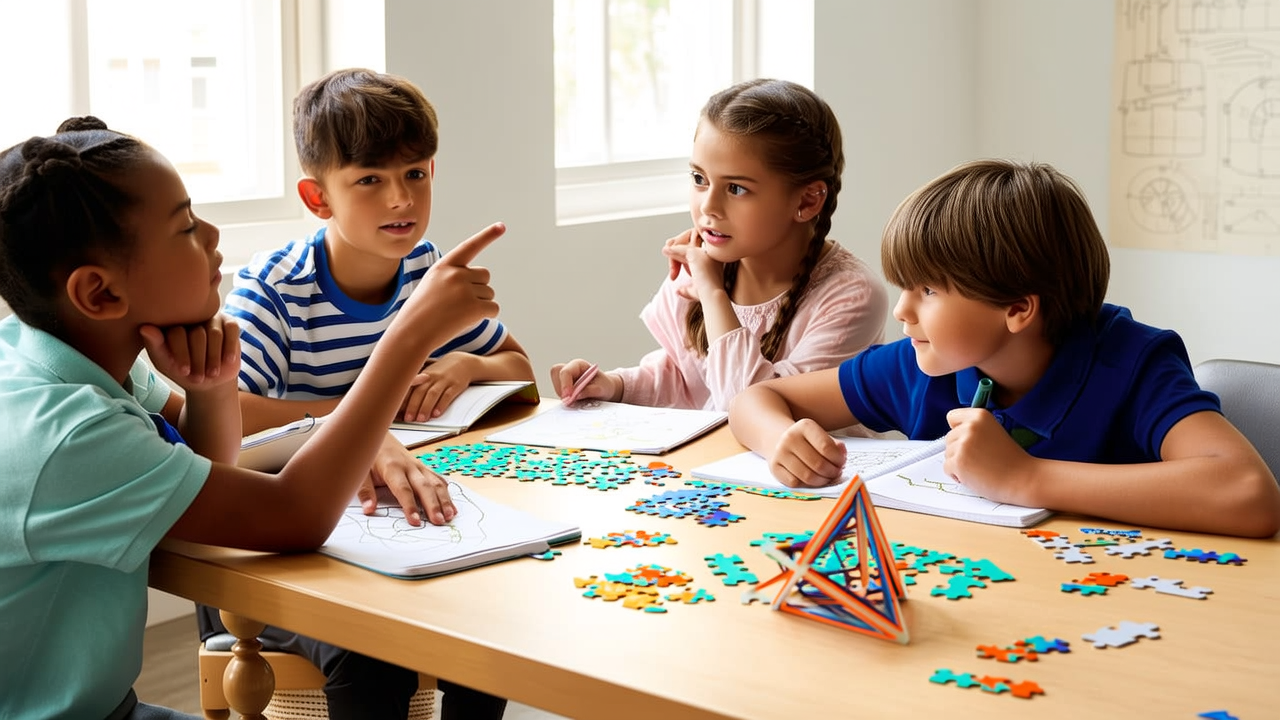
Teaching Critical Thinking Skills to Kids
What Critical Thinking Means for Kids
Critical thinking is the ability to analyze information, question assumptions, and form reasoned conclusions. It's not about what to think but how to think.
Daily Habits That Build Thinking Skills
1. Ask Open-Ended Questions
Instead of 'Did you have fun?' try 'What was the most interesting thing that happened today?' Open questions require analysis and reflection.
2. Model Thinking Aloud
Verbalize your own decision process. 'I'm choosing this route because the highway has construction.' Children learn by observing thought patterns.
3. Embrace 'I Don't Know'
When you don't know something, say so and research together. This models intellectual humility and the process of finding answers.
Questioning Techniques
The Five Whys
When a child asks why, answer, then ask 'And why is that?' Repeat five levels deep. This traces problems to root causes.
Devil's Advocate
Gently challenge conclusions. 'That's interesting. What if the opposite were true?' This builds perspective-taking and argument evaluation.
Compare and Contrast
'How is a lake different from a river? How are they similar?' Comparison exercises build analytical categorization.
Problem-Solving Games
Mystery Box
Place an object in a box. Children ask yes/no questions to identify it. Teaches systematic elimination and strategic questioning.
What Would You Do?
Present age-appropriate dilemmas. 'You found $20 on the playground. What would you do?' Discuss different choices and consequences.
Story Problems
Create math problems with real-world context. 'If you save $5 per week, how long to buy a $35 game?' Context makes abstract math concrete.
Critical Thinking by Age
- Ages 5-7: Sorting, categorizing, simple cause-and-effect
- Ages 8-10: Comparing viewpoints, identifying patterns, basic logic
- Ages 11-12: Evaluating sources, identifying bias, forming arguments
More Articles
 Math Games That Make Learning Fun: 20 Screen-Free Activities
 How Do Wires Work for Kids? Science-Backed Guide
 Economics for Kids: Play-Based Learning Guide
Kitchen Science Experiments for Chemistry Basics
 Arts & Crafts Tools Educators Actually Use
 Develop Critical Thinking Through Puzzles (2026)
 STEM Learning Strategies: What Research Shows Works
 Engineering Challenges for Elementary Kids
 Newton’s Childlessness and Its Impact on His Science
 Coding Games for Kids Ages 6-10