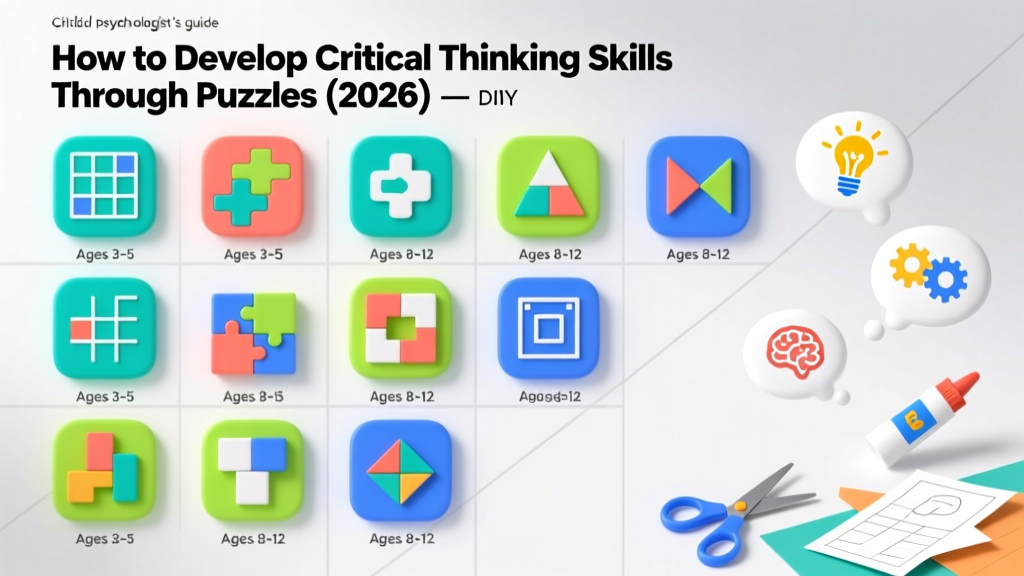
Develop Critical Thinking Through Puzzles (2026)
Thinking Skills and Their Puzzle Matches
| Thinking Skill | What It Is | Best Puzzle Types |
|---|---|---|
| Spatial reasoning | Mental rotation and visualization | Jigsaw, tangrams, Rubik's cube |
| Deductive logic | Drawing conclusions from evidence | Sudoku, logic grids, Clue |
| Pattern recognition | Finding rules in sequences | Pattern blocks, Raven's matrices |
| Working memory | Holding and manipulating information | Memory games, mental math puzzles |
| Planning | Thinking multiple steps ahead | Chess, Rush Hour, coding puzzles |
| Creative problem-solving | Finding novel solutions | Lateral thinking, riddles, escape rooms |
15 Puzzles by Age and Skill
Ages 3-5: Foundation Building
1. Shape Sorters → Spatial Reasoning
Classic shape sorters teach children to mentally rotate shapes to match holes. Start with 3-4 shapes, progress to 8+.
2. Floor Puzzles (24-48 pieces) → Visual Processing
Large-piece puzzles build the ability to see how parts form a whole. Start with puzzles that have distinct sections.
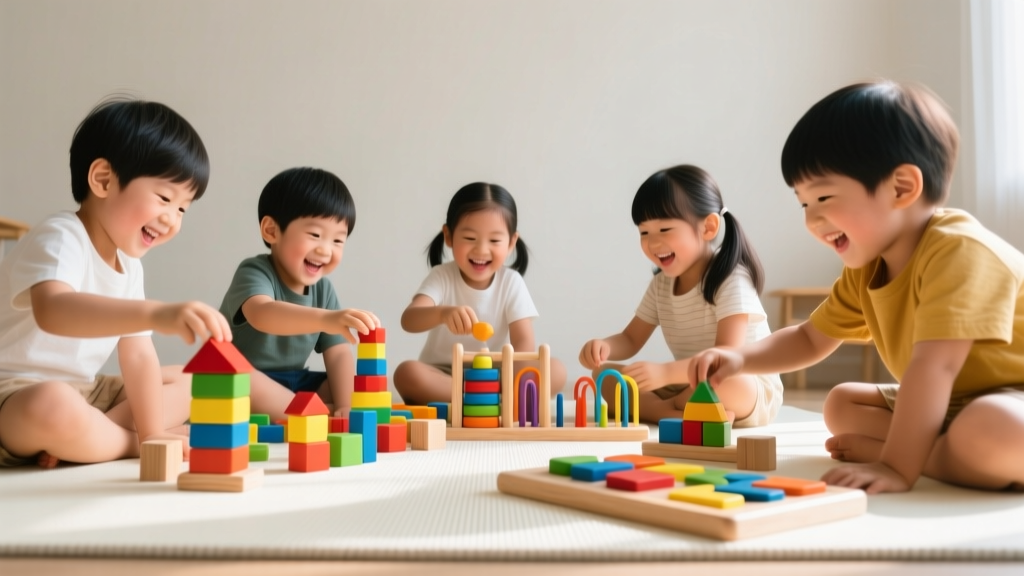
3. Pattern Blocks → Pattern Recognition
Colored geometric blocks that fill templates. Children copy patterns, then create their own. Builds understanding of symmetry and tessellation.
Ages 6-8: Logical Thinking
4. Sudoku (4×4 and 6×6) → Deductive Logic
Start with picture Sudoku (using symbols instead of numbers), progress to number grids. Teaches elimination and process of elimination.
5. Tangrams → Spatial Reasoning + Creativity
7 geometric pieces that form thousands of shapes. Start with outlined templates, progress to silhouette-only challenges.
6. Rush Hour Jr. → Planning
Slide cars to free the red car. Requires thinking 3-5 moves ahead. The Junior version has 40 graduated challenges.
7. Riddles → Lateral Thinking
"What has keys but no locks?" (a piano). Riddles teach children to think beyond literal meanings and consider multiple interpretations.
Ages 9-12: Advanced Reasoning
8. Logic Grid Puzzles → Deductive Reasoning
"Alice, Bob, and Carol each have a different pet, favorite color, and hobby. Use the clues to figure out who has what." Pure deductive reasoning.
9. Chess → Strategic Planning
The ultimate planning game. Start with pawn-only games, add pieces gradually. Studies show chess improves math scores by 14%.
10. Rubik's Cube → Spatial + Algorithmic Thinking
Learning to solve a Rubik's cube teaches algorithms (sequences of moves), pattern recognition, and persistence.
11. Escape Room Kits → Collaborative Problem-Solving
Tabletop escape rooms combine multiple puzzle types. Great for siblings or friends working together.
12. Coding Puzzles (Scratch) → Computational Thinking
Create programs that solve challenges. Decomposition, pattern recognition, abstraction, and algorithms — the 4 pillars of computational thinking.
How Parents Can Help (Without Solving It)
- Ask, don't tell: "What have you tried so far?" instead of "Here's the answer"
- Celebrate process: "I love how you tried three different ways" instead of "You're so smart"
- Model struggle: Do puzzles yourself and narrate your thinking: "Hmm, this piece doesn't fit here. Let me try rotating it."
- Match difficulty: If frustrated, go back a level. If bored, go up. The sweet spot is challenge without overwhelm.
More Articles
 Popsicle Stick Bridge Building for Kids
 Best Coding Games for Kids Starting Out (2026)
 Math Board Games for Family Game Night
 Best Kids Microscopes: Beginner to Advanced 2026
 Safe, Fun Elephant Toothpaste: STEM Learning for Kids
 Math Board Games for Kids: 12 Fun Family Favorites
Screen-Free Robot Kits for Kids
Math Board Games for Kids: 12 Fun Family Favorites
Screen-Free Robot Kits for Kids
 STEM Activities for Kids: 7 Safe, Thrilling Alternatives
 Best Microscope for Kids + 25 Things to See
 Math Games That Kids Actually Enjoy