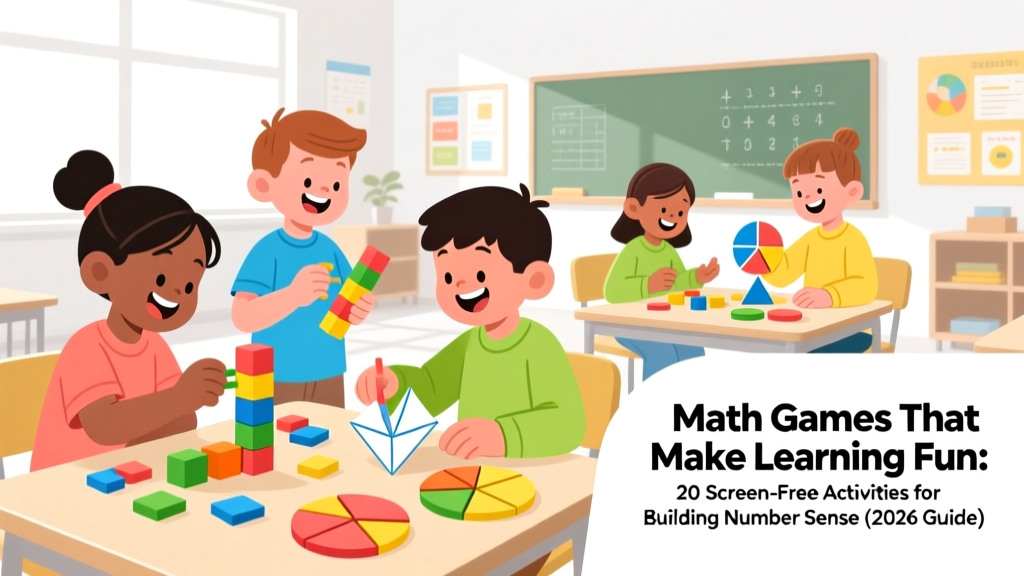
Math Games That Make Learning Fun: 20 Screen-Free Activities
After 25 years as an elementary school principal, I've seen what separates children who love math from those who fear it. It's not innate ability — it's whether math was presented as a game or a chore during the critical ages of 4–8. The children who thrive in math are those who played with numbers before they were drilled on worksheets. Here are 20 screen-free math games that build genuine number sense while kids think they're just having fun.
What Is "Number Sense" and Why Does It Matter?
Number sense is the intuitive understanding of how numbers work — estimating, comparing, decomposing, and reasoning about quantities. Research from Stanford University shows that children with strong number sense by age 8 consistently outperform peers through high school, regardless of IQ. The key insight: number sense develops through play, not memorization.
20 Math Games by Age Group
Ages 3–5: Counting & Quantity
1. Snack Math: Before eating goldfish crackers, count them. Eat 3. How many are left? Natural subtraction practice that children request daily.
2. Shape Scavenger Hunt: Find 5 circles, 3 rectangles, 2 triangles around the house. Builds geometry vocabulary and observation skills.
3. Number Line Hopscotch: Draw a number line (0–10) with chalk. Call out numbers; children jump to the right spot. Add "jump 2 more" for addition.
4. Sorting Station: Buttons, coins, or toys sorted by size, color, and count. Teaches classification — a foundational math skill.
5. Dice Addition: Roll two dice, add the dots. Use physical objects (blocks) to represent each number before combining. Makes abstract addition concrete.
Ages 6–8: Operations & Patterns
6. Grocery Store Game: Price tags on toys. "Budget" of play money. Calculate totals and change. Real-world math application.
7. Card War (Multiplication): Each player flips two cards, multiplies them. Higher product wins all four cards. Makes multiplication tables fun.
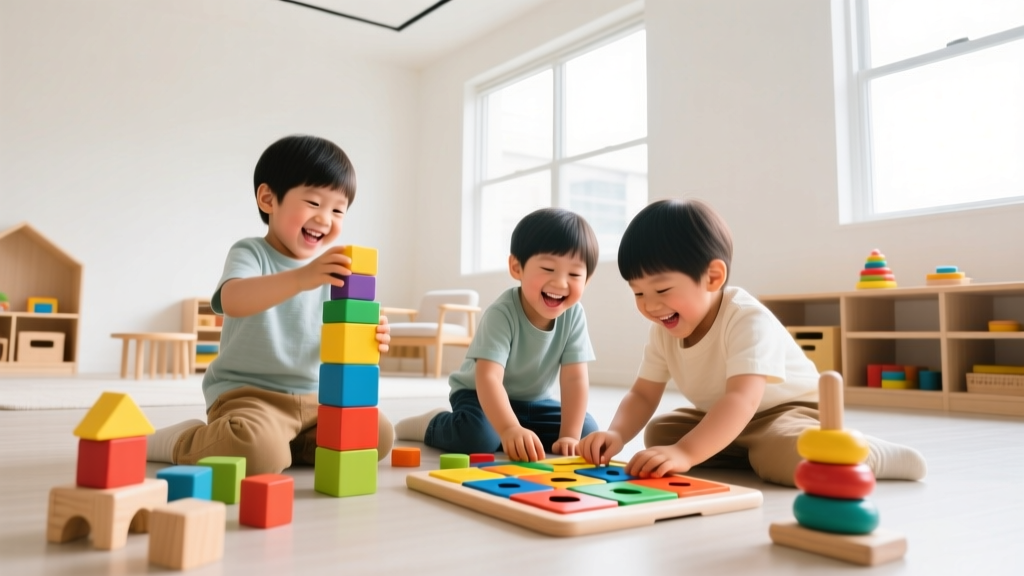
8. Pattern Blocks: Create repeating patterns with colored blocks. Extend patterns, predict the 20th shape. Builds algebraic thinking.
Ages 9–12: Advanced Concepts
9. Fraction Pizza: Cut paper pizzas into different fractions. "I want 3/8 of mine with pepperoni." Makes fractions tangible and visual.
10. Measurement Olympics: Measure household items in cm and inches. Estimate first, then measure. Compare estimates to actuals. Develops estimation skills critical for higher math.
Math Skills by Game
| Game | Math Skill | Age | Materials Needed |
|---|---|---|---|
| Snack Math | Counting, subtraction | 3–5 | Snack food |
| Card War | Multiplication | 6–8 | Deck of cards |
| Fraction Pizza | Fractions | 9–12 | Paper, scissors |
| Measurement Olympics | Estimation, measurement | 9–12 | Ruler, tape measure |
Frequently Asked Questions
My child says they "hate math." How do I change that?
Stop all worksheets and drills for 2–4 weeks. Replace with only games and real-world math (cooking, shopping, building). When math becomes associated with play rather than pressure, resistance typically fades within a month. The goal is rebuilding a positive emotional relationship with numbers.
How much math game time is enough?
15–20 minutes of focused math play, 3–4 times per week, produces measurable improvement within 8 weeks. More isn't better — consistency and engagement matter more than duration. Stop while the child is still having fun so they look forward to next time.
The Bottom Line
The children who excel at math aren't the ones who memorize the fastest — they're the ones who play with numbers the most. Every game on this list builds the intuitive number sense that makes higher math click. Put away the flashcards, break out the dice and cards, and watch your child's mathematical confidence grow one game at a time.
More Articles
 Unplugged Coding Activities For Kids No Screens (2026)
 How Old Is Sid the Science Kid? The Developmental Truth
 Best Screen-Free Coding Toys for Ages 4–8
 Best Coding Apps for Kids Ages 5–10
 Best Coding Apps for Kids 2026: 10 Educator-Ranked Picks
 Mae Jemison’s Elementary School & STEM Journey
Kitchen Chemistry Experiments for Preschoolers 2026
Evidence-Based Teaching Strategies That Improve Learning
Mae Jemison’s Elementary School & STEM Journey
Kitchen Chemistry Experiments for Preschoolers 2026
Evidence-Based Teaching Strategies That Improve Learning
 How to Start with Educational Toys: A Practical Guide
 Robotics Kits That Teach Real Engineering