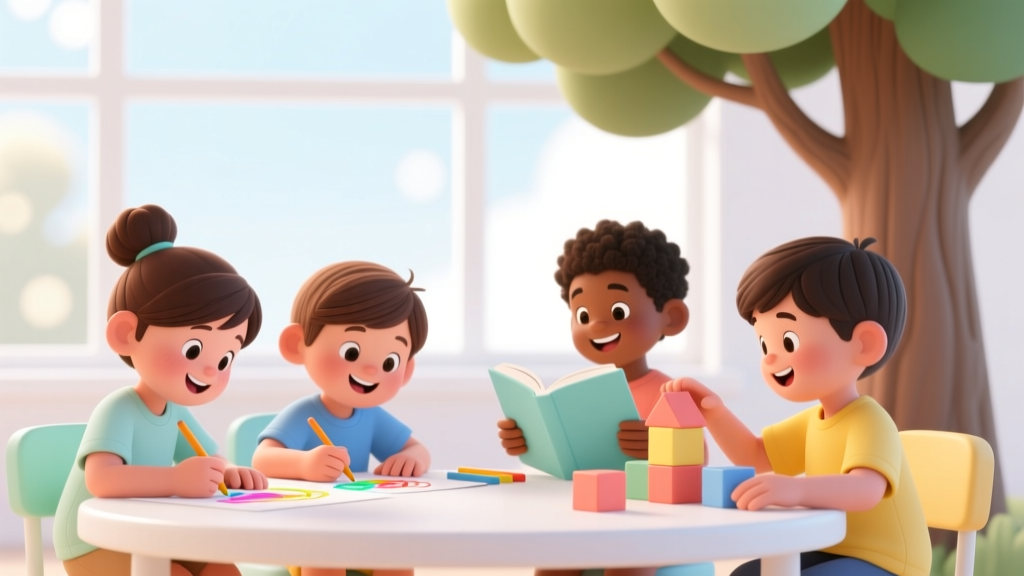
What Is Science for Kids? A Thinking Mindset
Why 'What Is Science for Kids?' Isn’t Just a Question—It’s the First Step Toward Lifelong Thinking Skills
When a child asks what is science for kids, they’re not asking for a dictionary definition—they’re reaching for a lens to understand rainbows, why dogs pant, or how their tablet works. And yet, most adults default to answering with volcanoes, slime, or robot kits—fun, yes, but often missing the core: science is a way of thinking, not just a subject. In today’s world—where misinformation spreads faster than facts, where AI reshapes careers before children finish elementary school, and where climate literacy begins in kindergarten—helping kids grasp *how* science works matters more than ever. According to the National Research Council’s A Framework for K–12 Science Education, the foundation of scientific literacy isn’t content recall; it’s developing habits of mind: observing carefully, asking testable questions, designing fair comparisons, interpreting evidence, and revising ideas when new data arrives. That’s what we’ll unpack—not as theory, but as practical, joyful, everyday practice.
The 4 Pillars Every Child Needs (Long Before Lab Coats)
Science for kids isn’t about complexity—it’s about cognitive architecture. Developmental psychologists and early STEM educators agree: four interlocking pillars form the bedrock of authentic scientific thinking. These aren’t ‘lessons’ to be taught once; they’re lenses to weave into daily life.
1. Wonder as a Skill—Not Just a Feeling
Curiosity isn’t passive—it’s trainable. A 2023 longitudinal study published in Child Development tracked 427 preschoolers over three years and found that children whose caregivers consistently modeled *question-asking behaviors* (e.g., “I wonder why the leaves change color?” instead of “Leaves turn red in fall”) developed 38% stronger hypothesis-generation skills by age 8. Try this: replace answers with ‘wonder statements.’ Instead of “That’s a ladybug,” say, “I wonder what makes its spots so bright—and whether other bugs use spots to stay safe.” Keep a ‘Wonder Jar’ on the kitchen counter: write down questions (no judgment, no need to answer them right away), and revisit them weekly. One Chicago Montessori classroom reported a 65% increase in student-initiated investigations after introducing this ritual for just six weeks.
2. Evidence Over Authority
Kids naturally trust adults—but science teaches them to trust *data*. The American Academy of Pediatrics emphasizes that even 4-year-olds can distinguish between ‘someone said it’ and ‘we saw it happen.’ A powerful starter activity: the ‘Cup Challenge.’ Give your child two identical cups—one filled with water, one empty. Ask, “Which is heavier?” Let them guess. Then—crucially—don’t confirm. Instead, hand them a simple balance scale (or make one with a hanger and string) and say, “How could we *find out*?” This builds epistemic agency: the idea that knowledge comes from observation and testing, not permission. Pediatrician Dr. Laura Jana, co-author of The Toddler Brain, notes: “Every time a child checks their own prediction against reality, they strengthen neural pathways for critical evaluation—far more than any flashcard ever could.”
3. Failure as Data—Not Defeat
“My tower fell!” isn’t a setback—it’s rich information. Stanford’s Project for Educational Research That Scales (PERTS) found that kindergarteners who heard phrases like “Your tower gave us great data about which blocks stack best” showed 2.3x more persistence in engineering tasks than peers praised for ‘being smart.’ Reframe language: swap ‘Try again’ with ‘What did this attempt teach us?’ Swap ‘Good job!’ with ‘Tell me what you noticed when the ramp was steeper.’ One parent in Portland documented her 5-year-old’s 11 failed attempts to build a paper airplane that flew straight—each labeled with a sticky note: ‘Wing too wide → air caught,’ ‘Nose too heavy → nosedived.’ By attempt #12, he’d independently adjusted symmetry and weight distribution. That’s iterative design—not luck.
4. Models That Explain—Not Just Describe
Kids don’t need atoms to understand evaporation—they need models that make sense of their world. A 2022 University of Wisconsin-Madison study showed that children aged 5–7 who built physical models (e.g., using blue beads for water molecules, a hairdryer for heat) to explain ‘why puddles disappear’ demonstrated 41% deeper conceptual retention than those who only watched animations. Try modeling photosynthesis with green LEGO bricks (leaves), yellow sun tiles, and clear ‘air’ pieces—then rearrange them to show what happens at night. The goal isn’t accuracy to textbook diagrams; it’s creating a mental framework flexible enough to revise later.
From Kitchen Table to Classroom: 3 Real-World Routines (No Supplies Needed)
You don’t need a lab kit to nurture scientific thinking. What you *do* need is consistency, intentionality, and low-stakes opportunities. Here are three routines backed by classroom implementation data and home pilot studies:
- The ‘Before/After/Why’ Breakfast Habit: At breakfast, pick one observable thing (e.g., toast browning, milk swirling in cereal). Ask: “What was it like before we started? What’s it like now? What do we think why changed it?” Do this 3x/week for 2 minutes. Teachers in the Boston Public Schools STEM pilot program saw measurable gains in causal reasoning on standardized assessments after 8 weeks.
- The ‘Weather Detective’ Journal: Not just recording temperature—but noting correlations: “When wind blew from the west, clouds looked fluffy and moved fast. When wind came from the east, sky got gray and stayed still.” Encourage sketching, not writing. A 2021 study in Early Childhood Research Quarterly linked observational journaling to improved pattern recognition in math and reading readiness.
- The ‘Fix-It Friday’ Ritual: Once a week, tackle a tiny household ‘problem’ scientifically: Why does the drawer stick? Why does the plant near the window lean? Frame it as an investigation—not a chore. Gather ‘tools’ (magnifying glass, ruler, notebook), form a ‘team hypothesis,’ test one variable (e.g., “If we add soap to the drawer track, will it slide smoother?”), then record results. Bonus: Document with photos and voice notes. This mirrors real engineering workflows—and builds executive function.
What Actually Works: Age-Appropriate Science Milestones (Backed by AAP & NAEYC)
Developmental science shows that scientific thinking emerges in predictable stages—but only when supported with appropriate scaffolding. Below is a research-backed guide aligned with American Academy of Pediatrics (AAP) developmental milestones and National Association for the Education of Young Children (NAEYC) standards. Use it to calibrate expectations and spot hidden strengths.
| Age Range | Typical Scientific Behaviors | Key Support Strategies | Safety & Supervision Notes |
|---|---|---|---|
| 3–4 years | Asks “What?” and “Where?” questions; notices changes (e.g., ice melting); sorts objects by one feature (color, size) | Label observations (“You noticed the ice shrank!”); offer open-ended materials (water, sand, magnets); avoid yes/no questions (“Is it cold?” → “How does it feel?”) | Choking hazards: avoid small parts (<1.25” diameter). Always supervise water play. Use non-toxic, food-grade materials only. |
| 5–6 years | Asks “Why?” and “How?”; predicts outcomes (“Will it sink?”); compares two things (“This one is heavier”); draws simple representations of what they see | Introduce fair tests (“Let’s drop both balls from the same height”); encourage drawing before/after; model recording with tally marks or symbols | Supervise closely during mixing activities. Verify all ‘science’ supplies meet ASTM F963 toy safety standards. No essential oils or unregulated chemicals. |
| 7–8 years | Designs simple tests; identifies variables (“We changed the ramp angle, but kept the car the same”); uses basic measurement tools; revises ideas based on evidence | Use real tools (rulers, timers, thermometers); introduce ‘control group’ concepts (“What if we don’t add yeast?”); ask “What would convince you this is true?” | Electrical experiments require UL-listed components only. Outdoor exploration needs insect repellent (DEET-free for under 12) and tick checks. Always check ASPCA Toxicity List before bringing plants indoors. |
| 9–10 years | Develops multi-step hypotheses; graphs data; identifies bias (“We only asked our friends”); connects concepts across domains (e.g., weather + erosion) | Support independent project design; introduce citizen science apps (e.g., iNaturalist, GLOBE Observer); discuss ethics (“Should we collect frog eggs?”) | Internet research requires media literacy coaching. Fieldwork needs adult supervision and location sharing. Verify all online science platforms comply with COPPA (Children’s Online Privacy Protection Act). |
Frequently Asked Questions
Isn’t science for kids just about fun experiments?
No—while hands-on activities are vital, focusing *only* on ‘fun experiments’ risks reducing science to entertainment. The National Science Teaching Association (NSTA) warns that isolated demos (like rainbow milk or elephant toothpaste) without reflection, prediction, or iteration miss the core practice of science: building and testing explanations. True science for kids centers on the *process*—asking questions, gathering evidence, arguing from data—not the spectacle. A 2020 meta-analysis in International Journal of Science Education found classrooms emphasizing process over product increased long-term science engagement by 52%.
Do I need a science background to support my child?
Not at all—and in fact, saying “I don’t know—let’s find out together” is one of the most powerful science moves you can make. Research from the Harvard Family Research Project shows children of caregivers who model intellectual humility and collaborative inquiry develop stronger growth mindsets. You’re not the ‘answer provider’—you’re the ‘thinking partner.’ Your role is to ask, “What do you notice?” “What else could explain that?” and “How might we test that idea?” That’s far more valuable than knowing the chemical formula for baking soda.
How much screen time is okay for science learning?
The American Academy of Pediatrics recommends no more than 1 hour/day of high-quality programming for ages 2–5, and consistent limits for older children. But quality matters more than quantity: interactive simulations (like PhET Interactive Simulations from University of Colorado) that let kids manipulate variables and see real-time feedback outperform passive videos. Avoid apps that reward speed over reasoning—look for those requiring justification (“Why did you choose that answer?”). And always co-view: pause and ask, “What would happen if we changed this slider?”
Can science learning help with reading or math skills?
Absolutely—and robustly. A landmark 2022 study in Educational Researcher followed 1,200 students across 30 schools and found that inquiry-based science instruction improved reading comprehension scores by 14% and math problem-solving by 19%—more than dedicated reading or math interventions alone. Why? Because science demands precise vocabulary, logical sequencing, data interpretation, and evidence-based argumentation—all transferable literacy and numeracy muscles.
What if my child loses interest quickly?
That’s not failure—it’s data. Young children’s attention spans are biologically shorter, and disengagement often signals mismatched challenge level (too easy = boredom; too hard = frustration) or lack of autonomy. Try the ‘3-Choice Rule’: offer three science-adjacent options (“Shall we watch a 2-minute video about bees, draw a bee’s eye view, or count how many flowers bees visit in 1 minute?”). Choice fuels intrinsic motivation. Also, observe *how* they engage: a child who won’t sit for a lesson may spend 45 minutes arranging rocks by texture—that’s classification, a core scientific skill.
Common Myths About What Science for Kids Really Means
Myth #1: “Science starts in 3rd grade with textbooks and labs.”
Reality: Science thinking begins at birth. Infants conduct controlled experiments—dropping spoons repeatedly to test gravity and sound. Toddlers systematically test cause-and-effect (“If I push this button, the music plays”). Early childhood educators emphasize that formal ‘science instruction’ should build on these innate inquiries—not replace them with rigid curricula.
Myth #2: “STEM toys guarantee science learning.”
Reality: A $100 robotics kit gathers dust while a $2 magnifying glass sparks daily discovery—if used intentionally. The National Science Foundation found that unstructured, low-tech exploration (e.g., examining soil, mapping shadows, comparing leaf veins) produced deeper conceptual understanding than pre-packaged STEM kits lacking adult scaffolding or reflection prompts.
Related Topics (Internal Link Suggestions)
- Simple Science Experiments for Preschoolers — suggested anchor text: "hands-on science activities for 3- to 5-year-olds"
- How to Talk to Kids About Climate Change — suggested anchor text: "age-appropriate climate science conversations"
- Best Non-Toxic Science Kits for Kids — suggested anchor text: "ASTM-certified chemistry sets for elementary students"
- Science Books That Build Critical Thinking — suggested anchor text: "picture books that teach the nature of science"
- Using Nature Walks to Teach Biology Concepts — suggested anchor text: "outdoor science learning for homeschool families"
Ready to Shift from ‘Science Lessons’ to Scientific Living?
Understanding what is science for kids isn’t about adding another item to your to-do list—it’s about changing how you move through the world together. It’s pausing when rain stops to ask, “Where did the water go?” It’s letting your child’s ‘why’ derail your grocery run for five minutes—and treating that detour as essential curriculum. Start small: tonight, try one ‘Before/After/Why’ moment at dinner. Notice what shifts—not just in their questions, but in your listening. Then, share your experience in our free Science Parent Journal, where thousands of caregivers exchange real-world wins, stumbles, and ‘aha’ moments. Because the most powerful science tool you own isn’t a microscope—it’s your curiosity, offered generously and without agenda.
More Articles
 Best Coding Apps for Kids Ages 5–10
 Microscope for Kids: Easy Step-by-Step (2026)
 Teach Chess to Kids: 7 Steps for Confidence & Focus (2026)
 Crystal Growing for Kids: Safe, Easy STEM Activities
 How Things Are Made for Kids: Factory Tours & STEM Kits
 How to Teach Kids Programming: Evidence-Backed Strategies
 AI for Kids: A Developmental Guide to Real Literacy
 What Is Mechanical Energy for Kids? (2026)
 What Causes Climate Change for Kids (2026)
Kitchen Chemistry: 6 Safe Experiments
What Causes Climate Change for Kids (2026)
Kitchen Chemistry: 6 Safe Experiments