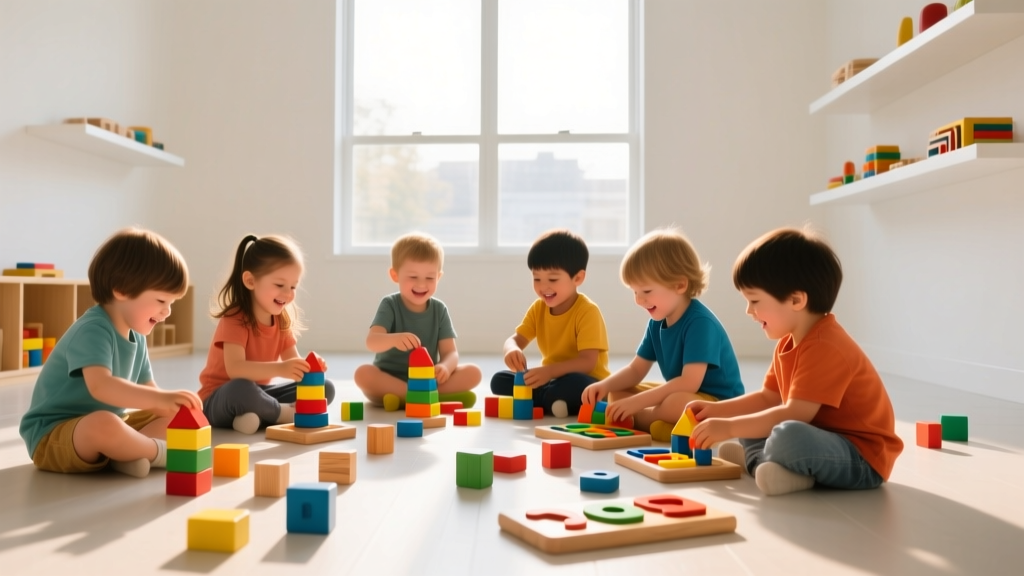
Math Games That Make Numbers Fun
Why Play Is the Secret Ingredient to Math Success
Many children don’t dislike math—they dislike how it’s often taught: as a series of abstract rules, timed drills, or isolated worksheets. But when math is embedded in play, something magical happens. Neural pathways light up, confidence grows, and persistence increases—not because the work is easier, but because it feels meaningful and joyful. Research from the University of Chicago and Stanford shows that playful, hands-on math experiences before age 8 build stronger number sense, spatial reasoning, and problem-solving stamina—foundations that predict long-term STEM success. The best part? You don’t need fancy apps or expensive kits. With everyday objects and intentional interaction, you can spark genuine curiosity at home—starting today.
10 Low-Prep Math Games You Can Play Tonight
These games require minimal setup (most use items already in your kitchen or toy bin), target key early-math skills, and scale easily for ages 4–10. Each includes a 'Why It Works' note so you know exactly what’s developing—and how to deepen the learning.
1. Counting Scavenger Hunt
Grab a clipboard and pen—or just use your phone notes. Challenge your child to find *exactly* 5 red things, 3 round objects, or 7 items taller than their hand. Rotate categories daily (shapes, textures, quantities). Why it works: Builds one-to-one correspondence, subitizing (instantly recognizing small quantities), and classification—core pre-number skills. Pro tip: Ask “How did you know there were 5?” instead of just checking for correctness. This encourages explanation and metacognition.
2. Kitchen Scale Showdown
Let kids weigh apples, cereal boxes, or stuffed animals on a kitchen scale. Compare weights (“Is the banana heavier than three grapes?”), estimate first, then verify. Introduce terms like *heavier*, *lighter*, *about the same*, and later grams/kilograms. Why it works: Develops measurement sense, estimation, and comparative language—key for later algebraic thinking. Pro tip: Use sticky notes to label items with their weights and arrange them from lightest to heaviest together.
3. Dice War (Addition/Subtraction Version)
Each player rolls two dice, adds (or subtracts) the numbers, and the higher (or lower) sum wins the round. First to 5 points wins. For older kids, add a third die or multiply. Why it works: Reinforces fluency with operations while building strategic thinking and probability intuition. Pro tip: After each round, ask, “What’s the biggest possible sum? Smallest? How many ways can you roll a total of 7?”
4. Shape Detective Walk
Take a 10-minute walk and hunt for real-world shapes: rectangles (windows), hexagons (tiles), cylinders (cans), symmetry (leaves, faces). Sketch or photograph finds. Back home, sort photos by attributes (number of sides, curved vs. straight edges). Why it works: Connects geometry to lived experience and strengthens spatial vocabulary—linked directly to future success in engineering and coding. Pro tip: Ask, “Could this shape roll? Why or why not?” to prompt reasoning about properties.
5. Grocery Store Estimation Jar
Fill a clear jar with dried beans, pasta, or buttons. Have your child guess how many are inside. Then count together—by 2s, 5s, or 10s—and discuss strategies (“We grouped into piles of 10—that made it faster!”). Why it works: Cultivates estimation, grouping, place value awareness, and flexible counting. Pro tip: Repeat weekly with increasing complexity—e.g., “Estimate how many would fit if we doubled the jar size.”
How to Maximize Learning—Without Turning Play Into Practice
Playful math loses its magic when adults default to correction, speed, or right answers. Instead, try these evidence-backed strategies:
- Ask open-ended questions: Swap “What’s 4 + 3?” for “How could we figure out how many cookies we have if you had 4 and I added 3 more?” This invites modeling, discussion, and multiple solution paths.
- Embrace productive struggle: If your child pauses or tries an unusual method, wait 5–10 seconds before jumping in. Say, “Tell me about your thinking,” not “That’s not quite right.” Struggle builds neural resilience.
- Notice and name math in daily life: “We’re cutting this pizza into 8 slices—how many will each person get if there are 4 of us?” or “This recipe serves 6, but we only need 3 servings—what do we do to the numbers?” These micro-moments reinforce relevance.
- Rotate roles: Let your child be the ‘teacher’ and explain a game rule or strategy to you—even if imperfectly. Teaching deepens understanding and boosts confidence.
- Keep it short and joyful: Aim for 5–15 minutes of focused math play most days—not marathon sessions. Consistency beats duration every time.
Remember: Your attitude matters more than your math degree. Saying “I’m curious how this works too!” or “Let’s figure it out together” models growth mindset far better than pretending to know everything.
Beyond the Game: Building a Math-Rich Home Environment
Games are powerful—but they’re most effective when embedded in a broader culture of mathematical noticing and wondering. Here’s how to nurture that environment without adding to your to-do list:
- Stock a ‘Math Basket’: Keep a low shelf or basket stocked with dice, dominoes, playing cards, measuring tapes, pattern blocks, and a notebook. Rotate 2–3 items weekly to sustain interest.
- Read math-infused stories: Try The Doorbell Rang (division), One Hundred Hungry Ants (arrays/factors), or Infinity and Me (big ideas). Pause to predict, count, or sketch what’s happening.
- Create a ‘Wonder Wall’: Tape up a sheet of paper labeled “I Wonder…” and add math-related questions your child asks (“Why do clocks go in circles?” “How tall is our tree?”). Revisit weekly—some become mini-investigations.
- Use tech wisely: Choose apps with zero ads, no time pressure, and open exploration (e.g., DragonBox Numbers, Motion Math Zoom). Limit screen-based math to 10–15 mins/day—and always co-play at first.
- Celebrate process, not perfection: Praise specific efforts: “You tried three different ways to share those crackers—that’s brilliant problem solving!” rather than “You’re so smart!”
Finally, ditch the myth that math is only about calculation. At its heart, math is about patterns, logic, creativity, and communication. When children see themselves as pattern-spotters, puzzle-solvers, and idea-sharers—not just answer-getters—they develop identity as mathematicians. And that identity? That’s the ultimate learning outcome no test can measure.
So tonight, skip the flashcards. Grab a deck of cards, a handful of pasta, or just your curiosity—and play. Because the most powerful math lesson isn’t on a worksheet. It’s in the laughter, the “Aha!”, and the quiet pride in a child who just proved—on their own terms—that numbers can be fun.
More Articles
 Coding for Kids: Beginner-Friendly Activities
Simple Circuit Experiments for Kids
 LEGO Engineering Challenges for Kids (2026)
 How Rainbows Form for Kids: Simple Science Guide
 20 Engineering Challenges Using Only Paper and Tape (2026)
 Weather Experiments for Kids: Rain Cloud in a Jar
 How to Organize Time: Evidence-Based Strategies That Work
 Is Minecraft Good for Kids? Evidence-Based Benefits & Risks
 Best STEM Learning Pathways for Ages 4–12
 Fun Multiplication Math Games for Kids