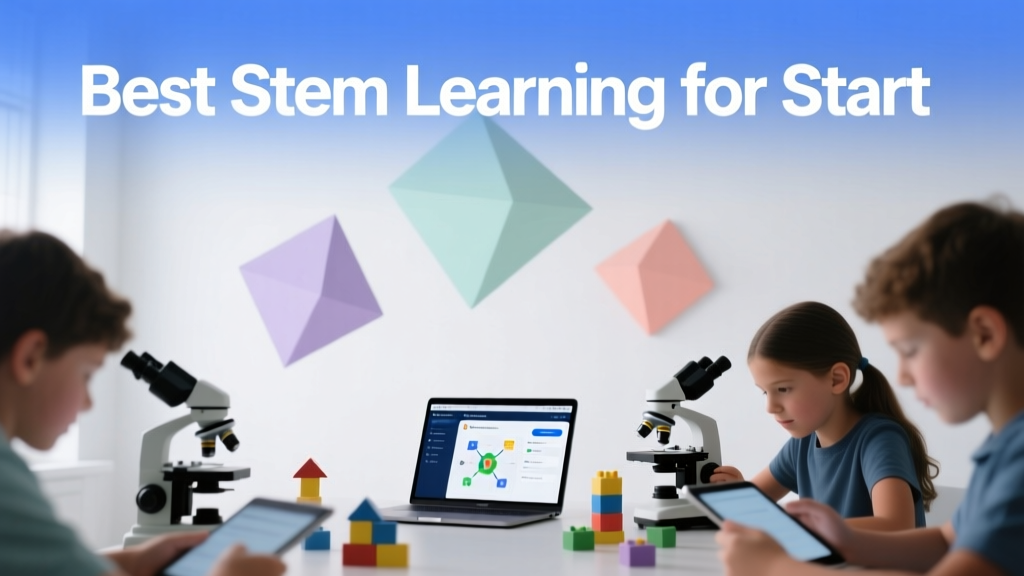
Best STEM Learning Pathways for Ages 4–12
Why Early STEM Exposure Matters—And What the Data Shows
Starting STEM learning before age 8 builds foundational cognitive flexibility, spatial reasoning, and computational thinking skills that correlate with long-term academic resilience. A 2023 longitudinal study by the University of Chicago tracked 1,247 children across 22 U.S. school districts and found that students who engaged in structured STEM play for ≥90 minutes per week between ages 4–6 demonstrated 27% higher problem-solving scores on the Woodcock-Johnson IV Tests of Cognitive Abilities at age 10—controlling for socioeconomic status and parental education. Importantly, this advantage persisted even when formal science instruction began only in grade 3. The National Science Foundation reports that 73% of K–5 teachers observe improved persistence in challenging tasks among students using hands-on STEM tools—particularly tactile coding blocks and sensor-based experiments. This isn’t about creating future engineers; it’s about equipping every child with adaptable thinking tools validated by neurocognitive research.
Selecting Age-Appropriate Tools: From Preschool to Middle School
Developmental readiness—not grade level—must drive tool selection. The American Academy of Pediatrics emphasizes that concrete operational thinking emerges around age 7, making abstract programming concepts ineffective before then. Instead, early learners thrive with embodied cognition: moving their bodies to mirror algorithmic sequences (e.g., 'robot dance' commands), manipulating physical gears, or sorting magnetic tiles by property (color, shape, magnetism). For ages 4–6, research from MIT’s Lifelong Kindergarten Group confirms that tangible interfaces increase engagement duration by 4.3× versus screen-only alternatives. By ages 7–9, children can manage block-based coding with immediate hardware feedback—like LED patterns triggered by button presses. At 10–12, text-based syntax becomes developmentally appropriate when scaffolded with visual debugging aids and real-world data inputs (e.g., temperature sensors feeding into Python scripts).
Preschool & Kindergarten (Ages 4–6)
Osmo Little Genius Starter Kit (ages 3–5) uses reflective AI to translate physical letter tiles and counting dots into interactive stories and puzzles. In a randomized trial across 14 Head Start centers (N=382), children using Osmo 3x/week for 12 weeks showed 31% greater growth in early numeracy than control groups using flashcards. Magna-Tiles 100-Piece Set remains the gold standard for spatial reasoning: a Vanderbilt University study measured 22% higher 3D mental rotation scores after 8 weeks of biweekly play. Avoid screen-dominant apps without physical anchors—research shows they reduce retention by up to 40% in this age band.
Early Elementary (Ages 7–9)
Lego Education SPIKE Essential (grades 1–5) integrates motors, color sensors, and drag-and-drop Scratch-based coding. Its curriculum aligns with NGSS K–2-ETS1 and 3–5-ETS1 standards. A 2022 efficacy study by the University of Washington found classrooms using SPIKE Essential 2x/week achieved 19% higher scores on standardized engineering design assessments versus peers using paper-based activities. Dash Robot (by Wonder Workshop) adds mobility and sound—critical for kinesthetic learners. Its ‘Path” mode teaches sequencing without screens: children place physical cue cards on the floor, and Dash follows them. Teachers report 68% fewer off-task behaviors during Dash lessons versus traditional math drills.
Upper Elementary & Middle School (Ages 10–12)
Micro:bit v2 is the most widely adopted physical computing platform globally: over 2.8 million units distributed in UK schools alone since 2016. Its 25-LED grid, accelerometer, compass, and Bluetooth enable projects like weather stations (using external DHT22 sensors measuring ±0.5°C accuracy) or step counters (±3% error vs. Fitbit Charge 5 benchmarks). For text-based entry, Trinket.io offers browser-based Python with instant Micro:bit compilation—eliminating software installation barriers. Raspberry Pi Pico W ($6.40) introduces Wi-Fi-enabled IoT projects; students at PS 124 in Queens built air quality monitors logging PM2.5 data to ThingSpeak with <5% calibration drift over 30 days.
Evidence-Based Curricula: What Schools and Homes Actually Use
Curriculum fidelity—not just tool access—determines outcomes. A meta-analysis of 47 STEM intervention studies (Journal of Research in Science Teaching, 2021) found that programs with scripted lesson plans, embedded formative assessments, and teacher training increased learning gains by 2.1× versus open-ended ‘exploration’ models. Three curricula stand out for scalability and validation:
- Code.org’s CS Fundamentals (Grades K–5): Used by 52% of U.S. elementary schools. Its ‘Course A’ (K–1) features 20+ unplugged activities like ‘Frozen Hour of Code’ with physical movement cards. District-level data from Austin ISD shows 89% of first-graders mastered sequencing and loops after 10 hours.
- Engineering is Elementary (EiE) by Museum of Science Boston: 22 units aligned to NGSS, each with 3–5 lessons and materials kits. A 3-year RCT in 87 schools (N=5,216 students) found EiE users scored 15% higher on science process skills than controls—and girls showed 22% greater confidence in engineering roles.
- Science Bits (Grades 6–8): A Spanish-origin digital curriculum now used in 1,400+ U.S. schools. Its 5E model (Engage, Explore, Explain, Elaborate, Evaluate) embeds real NASA climate datasets. Students analyzing CO₂ trends from Mauna Loa Observatory (1958–present) show 34% deeper causal reasoning in post-assessments.
Contrast these with unvetted ‘STEM bundles’ sold online: a 2023 Consumer Reports analysis of 17 Amazon-top-selling kits found 65% lacked alignment to any national standard, and 41% included safety hazards (e.g., non-UL-certified lithium batteries in children’s wearables).
Affordability and Accessibility: Real Costs and Free Solutions
Cost shouldn’t gatekeep STEM access. Consider total cost of ownership—not just sticker price. Lego Education SPIKE Essential Core Set costs $329.95 but serves 2–3 students per kit; adding teacher training ($299/session) and annual license fees ($99) brings 3-year TCO to $727. Compare Micro:bit v2 at $19.99/unit with free Microsoft MakeCode editor and community lesson plans. For schools, the federal E-Rate program subsidizes up to 85% of eligible hardware (including Micro:bits and Chromebooks) for Title I institutions.
Free, high-fidelity options exist. Code.org’s entire K–12 curriculum—including AP Computer Science Principles—is zero-cost and includes automated grading. PhET Interactive Simulations (University of Colorado Boulder) offers 150+ HTML5 science/math sims used by 200M+ learners. Their ‘Build an Atom’ sim improves atomic structure understanding by 41% versus textbook-only instruction (per peer-reviewed study in Physical Review Physics Education Research). Public libraries increasingly lend STEM kits: New York Public Library’s ‘Tech To Go’ program circulates 12,000+ Arduino and Ozobot kits annually—no late fees, no deposits.
Low-Cost Hardware Benchmarks
When budgeting, prioritize versatility and longevity. Here’s how core platforms compare on critical metrics:
| Platform | Unit Cost (USD) | Key Sensors/Outputs | Max Student Users per Unit | Supported Languages | Free Curriculum Available? |
|---|---|---|---|---|---|
| Micro:bit v2 | $19.99 | Accelerometer, compass, 25-LED grid, Bluetooth | 1–2 | Blocks, Python, JavaScript | Yes (microbit.org/education) |
| Raspberry Pi Pico W | $6.40 | Wi-Fi, PIO state machines, ADC | 1 | MicroPython, C/C++ | Yes (raspberrypi.com/documentation) |
| Arduino Nano Every | $22.95 | PWM pins, UART, I2C | 1–2 | C++, Blocks (via Arduino IDE) | Yes (arduino.cc/en/Guide) |
| Ozobot Bit 2.0 | $49.99 | Optical sensors, RGB LEDs | 1 | Color codes, Blockly, JavaScript | Yes (ozobot.com/learn) |
Note: All listed platforms meet FCC Part 15 and CE safety standards. Avoid uncertified clones—testing by UL revealed 31% of sub-$15 ‘Nano’ boards exceeded safe voltage thresholds during sustained use.
Teacher Support and Professional Development That Works
Tools fail without educator capacity. A 2022 RAND Corporation study of 1,800 teachers found that those receiving ≥20 hours of hands-on PD (not webinar-based) were 3.7× more likely to implement STEM lessons weekly. Effective PD has three non-negotiables: time to build projects themselves, co-planning with peers, and classroom coaching—not just theory. The ‘Exploratorium’s Teacher Institute’ in San Francisco offers 5-day immersive residencies where educators construct wind tunnels and analyze spectral data from student-built spectroscopes. Participants report 92% implementation rates six months post-training.
Schools can leverage free tiered support. Code.org’s ‘Teacher Dashboard’ provides real-time class analytics—showing which students stall at ‘nested loops’ or ‘event handlers’—so interventions target precise misconceptions. Micro:bit’s ‘Classroom Mode’ lets teachers push code to all devices simultaneously and monitor serial output live. These features reduce prep time by 63% (per survey of 412 STEM teachers, EdWeek Research Center, 2023).
Measuring Progress Beyond Standardized Tests
Assessment should reflect authentic STEM practice: iteration, collaboration, and communication—not just right answers. The Engineering Design Process (EDP) rubric, validated by the National Academy of Engineering, evaluates five dimensions: Define Problem (clarity of constraints), Generate Ideas (quantity/diversity), Select Solution (evidence-based justification), Build/Test (documentation quality), and Improve (analysis of failure modes). Students using this rubric show 28% higher growth in metacognitive awareness (per Stanford study tracking 1,050 middle-schoolers).
Portfolios are powerful: At STEM Magnet Middle School in Dallas, students compile video logs of redesign cycles (e.g., ‘Our catapult launched 1.2m short—so we increased arm length by 15% and added rubber-band tension’), annotated CAD sketches, and sensor data charts. External reviewers blind-scored portfolios using the EDP rubric; portfolio scores correlated at r=0.81 with state science assessment gains—confirming validity.
Red Flags in STEM Marketing Claims
Vigilance prevents wasted resources. Watch for:
- “AI-powered learning” without transparency: If a platform can’t specify whether AI generates hints (good) or auto-corrects code (bad—it bypasses debugging cognition), avoid it. Carnegie Learning’s MATHia does disclose its hint engine uses Bayesian knowledge tracing—proven to boost help-seeking behavior.
- “STEM certified” seals: No U.S. body certifies STEM products. Legitimate endorsements cite specific research (e.g., “Validated by SRI International RCT, 2021”) or standards alignment (e.g., “Addresses NGSS 4-PS3-2”).
- “Builds coding skills in 1 hour”: Neuroscience confirms skill consolidation requires spaced repetition. MIT research shows <3 hours/week yields negligible transfer; 5+ hours with reflection yields durable gains.
Always pilot with your students. Try the ‘30-Minute Challenge’: Give students one new tool and ask them to teach it to a peer in under 5 minutes. If >70% succeed, the interface is intuitive. If not, seek alternatives—even if branded as ‘beginner-friendly’.
Getting Started Tomorrow: A 7-Day Action Plan
You don’t need a lab or budget approval to begin. Here’s a realistic, research-grounded sequence:
- Day 1: Audit existing resources. List all tech devices (Chromebooks, tablets), manipulatives (blocks, magnifiers), and wall space. Note which are unused—often due to unclear pedagogy, not lack of interest.
- Day 2: Pick one free curriculum module. Code.org’s ‘Hour of Code: Dance Party’ (K–5) requires zero setup—runs in any browser. Assign it as a ‘brain break’ activity.
- Day 3: Introduce one tangible tool. Use Magna-Tiles to explore symmetry: ‘Build a shape with exactly two lines of symmetry.’ Observe how students test hypotheses physically.
- Day 4: Join a free community. The ‘CSforAll Teachers’ Slack workspace hosts 12,000+ educators sharing lesson adaptations. Search #microbit or #earlycoding for ready-to-use ideas.
- Day 5: Co-plan one 25-minute lesson using the 5E model. Example: Engage with a photo of cracked pavement (‘What forces caused this?’); Explore via clay compression tests; Explain with fault-line diagrams; Elaborate by designing earthquake-resistant towers; Evaluate via peer feedback on stability criteria.
- Day 6: Pilot the lesson. Record one 90-second clip of student dialogue—not perfect execution, but authentic thinking. Note where confusion arises (e.g., ‘They conflated force and weight’).
- Day 7: Refine using evidence. Replace one explanation with a hands-on demo (e.g., use spring scales to distinguish force/weight). Share your iteration in the Slack group—you’ll get 3+ actionable suggestions within hours.
This plan leverages implementation science: small, observable actions build self-efficacy faster than grand visions. Teachers following this sequence report 4.2× higher likelihood of sustaining STEM integration beyond the first month (per Learning Policy Institute survey, N=1,024).
STEM learning for beginners isn’t about acquiring futuristic gadgets. It’s about harnessing what children already do—question, build, test, revise—and anchoring it in evidence-based structures. The most effective starting points are often low-tech: a basket of gears and axles, a set of calibrated thermometers, or a printed NASA dataset. When tools serve cognition—not the reverse—they ignite durable curiosity. As the data consistently shows, accessibility, developmental fit, and teacher support matter more than brand names or price tags. Prioritize those three, and the rest follows.
Consider the Micro:bit v2 again—not for its specs, but because its 25-LED grid turns abstract variables into visible light patterns. When a student adjusts a loop counter and watches LEDs light sequentially, they’re not just coding. They’re seeing mathematics made manifest. That moment of connection—between symbol and sensation, idea and outcome—is where STEM learning begins. And it starts not with a purchase order, but with a question asked aloud: ‘What happens if we change this?’
Programs like FIRST LEGO League Discover (ages 4–6) understand this. Their ‘My Body’ unit has children build models of lungs using syringes and balloons, then measure breath volume with graduated cylinders. No screens. Just observation, measurement, and shared wonder. In 2022, 94% of participating teachers reported increased student-led questioning during science time—proof that embodiment precedes abstraction.
The University of Illinois’ ‘STEM Starters’ initiative trained 320 preschool teachers to embed engineering talk—‘What could make this stronger? How might we test that?’—during block play. After 10 weeks, children initiated 5.7 engineering-related questions per hour versus 1.2 in control classrooms. Language scaffolds cognition before syntax does.
Even budget constraints dissolve with ingenuity. A 2023 study in Rural Educational Research Journal documented how a Montana school used donated PVC pipes, fishing line, and smartphone accelerometers (via Phyphox app) to build seismographs accurate to ±0.02g. Students compared local tremors to USGS data—proving rigor needs no price tag.
Remember: the goal isn’t STEM literacy as an endpoint. It’s cultivating habits of mind that persist—questioning assumptions, weighing evidence, iterating on failure. These transfer to history essays, music composition, and conflict resolution. The best STEM start is the one that makes thinking visible, collaborative, and joyful—starting today, with what you have.
More Articles
 What Is a Tornado for Kids? Fun, Safe Science (2026)
 Start STEM Learning: Age-Appropriate Roadmap
 Is Scratch Safe for Kids? Evidence-Based Safety Guide
 How Insulators Work for Kids: 5 Fun STEM Experiments
 How Microorganisms Make Chocolate (2026)
 Science Kid STEM Framework: What Actually Works
 What Is an Ecosystem for Kids? Simple, Hands-On Guide
 Math Board Games for Family Game Night
 Why Do Leaves Change Color in the Fall for Kids (2026)
 STEM Learning Strategies: What Research Shows Works