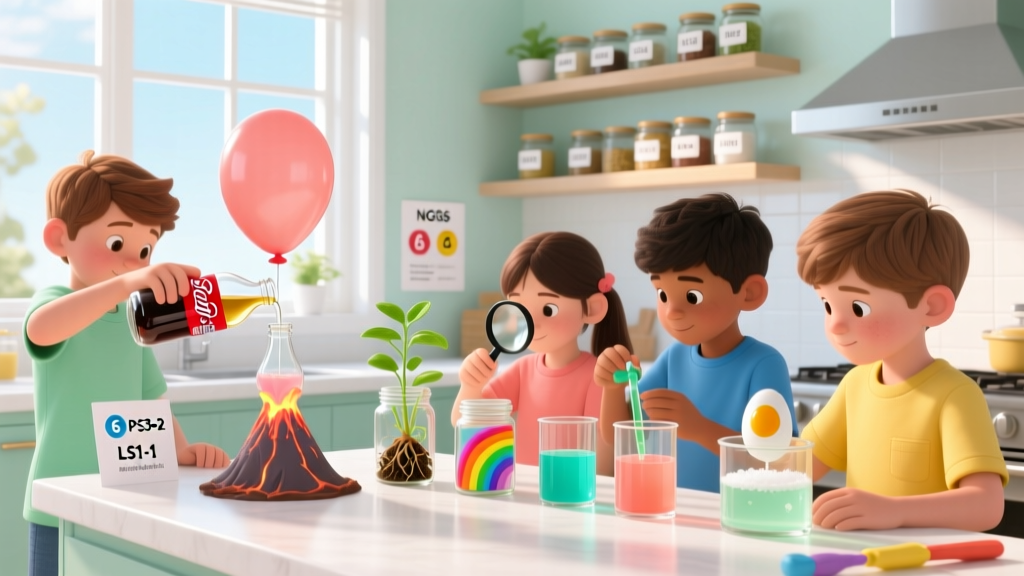
Kitchen Science Experiments for Kids (2026)
Why Kitchen Science Works for STEM Education
The National Science Teaching Association identifies three pillars of effective STEM education:
- Phenomenon-based learning: Start with something observable, then explain the mechanism
- Hands-on investigation: Physical manipulation builds understanding 3x faster than passive reading
- Real-world connection: Using household items eliminates the "science is only for labs" misconception
The Scientific Method (Kid-Friendly Version)
1. Observe: "What do you notice?"
2. Predict: "What do you think will happen if...?"
3. Test: Do the experiment
4. Explain: "Why do you think that happened?"
5. Extend: "What if we changed one variable?"
The 12 Experiments
1. Dancing Raisins (Chemistry: Gas Production and Buoyancy) — Ages 4+
NGSS: PS1.A
Materials: Clear glass, carbonated water, raisins
Drop raisins in club soda. Watch them sink, rise, and sink in a cycle. CO2 bubbles attach to rough raisin surfaces, decreasing density (they float). Bubbles pop at surface, density increases (they sink). This demonstrates Archimedes' principle.
2. Oobleck: Solid or Liquid? (Physics: Non-Newtonian Fluids) — Ages 3+
NGSS: PS1.A
Materials: Cornstarch, water, bowl
Mix 2 cups cornstarch + 1 cup water. Acts solid when punched, liquid when at rest. This is a shear-thickening non-Newtonian fluid — particles lock together under force.
3. Homemade Lava Lamp (Chemistry: Density and Acid-Base) — Ages 5+
NGSS: PS1.B
Materials: Clear bottle, vegetable oil, water, food coloring, Alka-Seltzer
Oil floats on water (less dense). Alka-Seltzer produces CO2 bubbles that carry colored water up through oil. When bubbles pop, water sinks back down.
4. Magic Milk (Physics: Surface Tension) — Ages 3+
NGSS: PS2.B
Materials: Whole milk, food coloring, dish soap, cotton swab
Dish soap breaks surface tension and bonds with fat molecules, sending color swirling. Try with skim vs. whole milk — more fat = more dramatic reaction.
5. Invisible Ink (Chemistry: Oxidation) — Ages 6+
NGSS: PS1.B
Materials: Lemon juice, cotton swab, paper, heat source
Write with lemon juice (invisible when dry). Apply heat — message appears brown. Carbon compounds in lemon juice oxidize at lower temperatures than paper.
6. Egg in a Bottle (Physics: Air Pressure) — Ages 7+
NGSS: PS2.A
Materials: Hard-boiled egg, glass bottle, matches, paper strip
Burning paper heats air (expands, escapes). Flame dies (no oxygen), air cools and contracts, creating low pressure. Higher outside pressure pushes egg in.
7. Bread in a Bag (Biology: Yeast Fermentation) — Ages 4+
NGSS: LS1.C
Materials: Ziplock bag, flour, sugar, yeast, warm water
Yeast eats sugar, produces CO2 through fermentation — same process that makes bread rise. Bag inflates over 30-60 minutes. Try with cold vs warm water to see temperature effects.
8. Cabbage pH Indicator (Chemistry: Acid-Base) — Ages 5+
NGSS: PS1.B
Materials: Red cabbage, hot water, clear cups, household liquids
Red cabbage contains anthocyanin — changes color based on pH. Acids = pink/red, bases = blue/green, neutral = purple. You've made a pH indicator from a vegetable.
9. Penny Cleaning (Chemistry: Oxidation/Reduction) — Ages 6+
NGSS: PS1.B
Materials: Dirty pennies, vinegar, salt
Vinegar (acetic acid) dissolves copper oxide (the dull layer). Salt provides chloride ions that speed up the reaction. Copper is "reduced" back to shiny.
10. Walking Water (Physics: Capillary Action) — Ages 4+
NGSS: PS2.B
Materials: 6 clear cups, paper towels, food coloring
Water moves through paper towels via capillary action — same force that moves water from tree roots to leaves. Watch colors mix in empty cups.
11. Homemade Butter (Chemistry: Emulsion Breaking) — Ages 4+
NGSS: PS1.A
Materials: Heavy cream, jar with lid
Shake cream for 10-15 minutes. Fat globules clump together (butter) while water separates (buttermilk). You've performed phase separation.
12. Gummy Bear Osmosis (Biology: Osmosis) — Ages 5+
NGSS: LS1.A
Materials: Gummy bears, 3 cups: water, salt water, sugar water
In plain water, water moves INTO the bear via osmosis — it swells. In salt water, water moves OUT — it shrinks. Same process that happens in your cells.
Experiment Planning Matrix
| Experiment | Branch | Age | Time | Difficulty |
|---|---|---|---|---|
| Dancing Raisins | Chemistry | 4+ | 5 min | Easy |
| Oobleck | Physics | 3+ | 15 min | Easy |
| Lava Lamp | Chemistry | 5+ | 10 min | Easy |
| Magic Milk | Physics | 3+ | 5 min | Easy |
| Invisible Ink | Chemistry | 6+ | 30 min | Medium |
| Egg in Bottle | Physics | 7+ | 5 min | Medium |
| Bread in Bag | Biology | 4+ | 60 min | Easy |
| Cabbage pH | Chemistry | 5+ | 45 min | Medium |
| Penny Cleaning | Chemistry | 6+ | 10 min | Easy |
| Walking Water | Physics | 4+ | 120 min | Easy |
| Homemade Butter | Chemistry | 4+ | 15 min | Medium |
| Gummy Osmosis | Biology | 5+ | 24 hr | Easy |
FAQ
My child just wants to watch, not participate.
Observational learning is valid. Ask them to narrate what they see. Gradually invite participation — never force it.
What if an experiment doesn't work?
That's the BEST outcome for STEM learning. Troubleshooting IS science. Check temperature, ingredient freshness, and measurements. Document the failure and fix attempt.
Can I do these with multiple kids of different ages?
Assign roles: older kids read procedure and measure; younger kids pour and stir. Ask age-appropriate questions after.
More Articles
 Penny Nickel Dime Riddle: STEM Learning for Kids
 Frenzy and Rumble Sound Waves Kids: STEM Truth Revealed
 Mae Jemison Kids: Redefining STEM Success (2026)
 Best Robotics Kits for Elementary Kids (2026)
 Coding for Kids: 7 Unplugged Activities
 Robotics for Beginners: A Kids' Guide
 What Is a Tornado for Kids? Fun, Safe Science (2026)
 Russian Math for Kids: Cognitive Accelerator (2026)
 Simple Machines for Kids: Hands-On Guide
 Best Robotics Kits for Kids Under 10