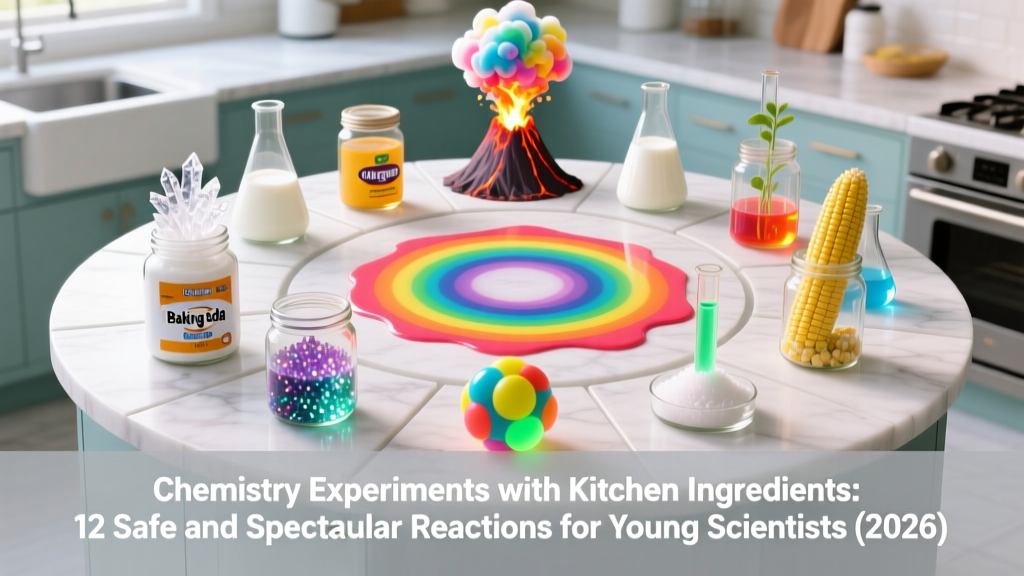
Kitchen Chemistry Experiments for Young Scientists
Your kitchen cabinet is a chemistry lab in disguise. Baking soda, vinegar, food coloring, cornstarch, and oil can demonstrate acid-base reactions, polymer chemistry, crystallization, and fluid dynamics. As a STEM educator, I've found that kitchen chemistry creates the strongest "wow" moments because children realize science is everywhere — not just in labs with beakers and goggles.
12 Kitchen Chemistry Experiments
1. Magic Color-Changing Milk (Surface Tension)
Materials: Whole milk, food coloring, dish soap, shallow plate. Age: 3+.
Pour milk into plate, add drops of food coloring. Touch a soap-coated cotton swab to the surface. Colors explode outward in mesmerizing patterns. The soap breaks surface tension and reacts with fat molecules in the milk.
2. Oobleck (Non-Newtonian Fluid)
Materials: Cornstarch, water. Age: 3+.
Mix 2 cups cornstarch with 1 cup water. The resulting substance acts as both a solid (resists fast force) and a liquid (flows slowly). Children can punch it (solid) then slowly sink their hand in (liquid). Teaches states of matter and non-Newtonian physics.
3. Baking Soda & Vinegar Rocket (Acid-Base Reaction)
Materials: Empty plastic bottle, cork, baking soda, vinegar, paper towel. Age: 6+.
Wrap baking soda in a paper towel "time delay." Drop into vinegar-filled bottle, cork it, step back. The CO2 gas pressure builds until the cork launches. Classic acid-base reaction producing carbon dioxide.
4. Crystal Growing (Supersaturation)
Materials: Sugar, water, string, pencil, jar. Age: 5+.
Dissolve 3 cups sugar in 1 cup boiling water (supersaturated solution). Suspend string in solution. Over 5–7 days, sugar crystals grow on the string. Teaches solubility, crystallization, and patience.
Science Concepts Table
| Experiment | Chemistry Concept | Key Vocabulary |
|---|---|---|
| Magic milk | Surface tension, lipid reactions | Hydrophobic, surfactant |
| Oobleck | Non-Newtonian fluids | Viscosity, shear force |
| Rocket | Acid-base reaction, gas pressure | CO2, neutralization |
| Crystals | Supersaturation, crystallization | Solute, solvent, lattice |
Frequently Asked Questions
Are these experiments safe without safety equipment?
All 12 experiments use food-grade ingredients that are safe for skin contact and accidental ingestion in small amounts. Safety goggles add fun "real scientist" feel but aren't required. The only experiment needing extra caution is crystal growing (hot water for dissolving sugar — adult handles this step).
The Bottom Line
Kitchen chemistry proves that science isn't confined to laboratories — it's in every meal, every cleaning task, every baking project. When children see the chemistry in their everyday environment, they develop a scientist's eye: always observing, always questioning, always experimenting.
More Articles
 How Do Plants Grow for Kids: Simple Science & Activities
 Fun Facts for Kids: 27 Mind-Blowing Truths (2026)
 Einstein’s Childhood Habits That Built Genius
 Savanna Biome for Kids: Fun Facts & Activities
 Place Value for Kids: 7 Research-Backed Ways (2026)
 What Does Geography Mean for Kids? (2026)
 Match Development to Learning: Framework for Educators
 Simple Machines: Hands-On Projects for Kids
 Coding Games for Kids Ages 6-10
 Best Microscopes for Kids: Build a Home Science Lab (2026)