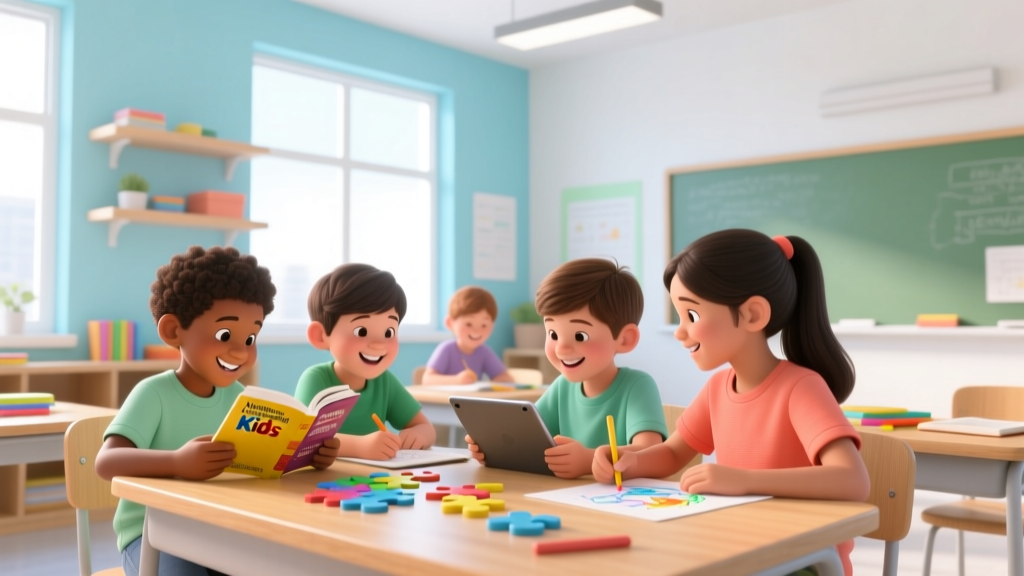
Minecraft for Kids: STEM Learning & Resilience (2026)
Why This Question Matters More Than Ever
Is Minecraft for kids? Yes—but not in the way most parents assume. With over 300 million copies sold and 140 million monthly active players, Minecraft sits at the epicenter of a quiet revolution in childhood learning: where block-building becomes binary logic, redstone circuits mirror electrical engineering principles, and multiplayer servers teach negotiation, project management, and ethical decision-making in real time. In an era where screen time is scrutinized more than ever—and where the American Academy of Pediatrics (AAP) urges 'intentional, co-engaged digital experiences'—understanding how, when, and why Minecraft supports healthy development isn’t optional parenting advice. It’s foundational literacy for the 21st-century caregiver.
What Research Says: Beyond 'Just a Game'
Let’s start with evidence—not anecdotes. A landmark 2022 longitudinal study published in Computers & Education tracked 1,247 children aged 7–11 across 18 months and found that those who engaged in structured, educator-facilitated Minecraft activities (not passive watching or unguided survival mode) demonstrated statistically significant gains in three key areas: 1) spatial visualization (+23% on standardized mental rotation tests), 2) computational thinking fluency (+31% in decomposition and pattern recognition tasks), and 3) collaborative problem-solving persistence (+44% longer task engagement before requesting adult help). Crucially, these gains were strongest when adults scaffolded—not controlled—the experience.
Dr. Elena Torres, a developmental psychologist and lead researcher on the study, explains: 'Minecraft doesn’t teach coding syntax—but it teaches the mindset of coding: breaking big problems into small steps, testing hypotheses through iteration, and debugging failures without shame. That’s the cognitive bedrock of STEM success.'
But let’s be clear: Not all Minecraft play is created equal. Survival mode with random mobs and griefing risks differs profoundly from Creative Mode in a private, moderated server running curriculum-aligned mods like Computer Craft or LearnToMod. The difference isn’t ‘good vs. bad’—it’s intentional vs. incidental learning.
The Age-Appropriateness Spectrum: Why '7+' Is Just the Starting Line
Most packaging says 'Ages 7 and up'—but that’s a legal minimum based on motor skill and reading readiness, not cognitive or social-emotional readiness. As Dr. Marcus Lee, a pediatric neuropsychologist specializing in digital media and brain development, advises: 'Age labels tell you what a child can do; they don’t tell you what they’re ready to handle emotionally or socially.'
Here’s what developmental science reveals about Minecraft across key age bands:
- Ages 5–6: Limited, highly supervised Creative Mode only—think building simple houses with parental narration (“Let’s add a door! Where should it go? How many blocks tall?”). Focus: fine motor control, basic spatial vocabulary (above/below, left/right), and turn-taking in shared tablet play.
- Ages 7–9: Entry-level multiplayer on whitelisted, password-protected servers (e.g., Minecraft Education Edition or Blockland). Introduce redstone basics via guided YouTube shorts (not algorithm-driven feeds). Emphasize rule-setting: “No destroying others’ builds unless invited.” This builds executive function and empathy.
- Ages 10–12: Project-based learning. Examples: design a working water filtration system using command blocks; simulate historical settlements with accurate scale and resource constraints; collaborate on a class-wide biome map. Here, Minecraft becomes a sandbox for applied science, history, and ethics.
- Ages 13+: Modding, Python scripting via Code Connection, and server administration. This is where interest can pivot toward genuine computer science pathways—especially for girls and neurodivergent learners who thrive in visual, tactile, low-pressure coding environments.
Importantly, neurodiversity matters. For children with ADHD, Minecraft’s immediate feedback loops and controllable environment often serve as a powerful self-regulation tool. For autistic learners, its predictable physics and explicit rules reduce social ambiguity—making it a frequent recommendation in occupational therapy plans (per the 2023 ASHA Practice Portal on Digital Tools for Neurodiverse Learners).
Your No-Nonsense Safety & Learning Optimization Checklist
You don’t need tech expertise—just intentionality. Below is a practical, research-informed framework used by school librarians and certified digital wellness coaches. Think of it as your ‘Minecraft Readiness Dashboard’:
| Developmental Domain | Key Milestone (Ages 7–12) | How Minecraft Supports It | Parent Action Step | Risk Mitigation Tip |
|---|---|---|---|---|
| Cognitive | Abstract thinking & hypothesis testing | Redstone circuits require cause-effect reasoning; farming mechanics teach resource cycles | Ask: “What do you think will happen if you change this lever?” instead of giving answers | Disable chat in single-player; use Education Edition’s built-in classroom tools for guided prompts |
| Social-Emotional | Collaborative goal-setting & conflict resolution | Multiplayer servers demand negotiation (“Can we share this mine?”), role assignment (“You dig, I build”), and repair after mistakes | Co-create 3-server rules *before* joining: e.g., “No griefing,” “Ask before borrowing,” “Pause to talk if frustrated” | Use Realms Plus’s moderation tools to mute, warn, or temporarily ban—not banish permanently |
| Language & Literacy | Narrative construction & technical vocabulary | Players write lore books, design quest maps, explain builds using terms like “load-bearing,” “biome,” “render distance” | Have your child record a 60-second “build tour” video explaining their creation—focus on clarity, not perfection | Enable Text-to-Speech for dyslexic learners; disable auto-suggestions that promote slang or off-topic terms |
| Digital Citizenship | Ethical decision-making online | Choices like preserving vs. strip-mining a forest, sharing resources vs. hoarding, or reporting griefers model real-world stewardship | Debrief weekly: “When did you make a choice that helped someone else? What was hard about it?” | Install WoolyMods’s “Ethics Pack” (free, open-source) which adds moral dilemmas into quests |
From Screen Time to Skill Time: 5 Evidence-Based Bridges to Real-World Learning
Minecraft’s magic lies in its transferability. These aren’t ‘fun add-ons’—they’re deliberate bridges validated by classroom teachers and museum educators alike:
- Math in Motion: Challenge your child to calculate the volume of their castle (length × width × height), then convert blocks to real-world units (e.g., “If 1 block = 1 meter, how many cubic meters is your library?”). Bonus: Use WorldEdit commands to explore exponents (“//expand 3^4”)—a stealthy intro to powers.
- History Rebuilt: Visit the Minecraft History Project (free, vetted by Smithsonian educators) and rebuild ancient Alexandria’s Library—with accurate column ratios and scroll textures. Discuss: Why did knowledge storage matter then? How is it different now?
- Biology Lab: Create a working cell model using stained glass (nucleus), slabs (mitochondria), and flowing water (cytoplasm). Then, introduce a “virus” (a creeper) and observe how defenses (walls, guards) respond—linking directly to immune system units.
- Engineering Design Cycle: Pose a challenge: “Build a bridge that holds 10 sheep without collapsing.” Let them fail, iterate, and document changes. This mirrors NASA’s real engineering process—and builds resilience far beyond any worksheet.
- Storytelling Studio: Use Book & Quill to write interactive choose-your-own-adventure stories where player choices affect the world. This develops narrative structure, perspective-taking, and consequence awareness—skills tied to reduced aggression in longitudinal studies (Journal of Youth and Adolescence, 2021).
Pro tip: Start small. One 20-minute focused session per week using just *one* of these bridges yields more cognitive lift than five hours of unstructured play. As Chicago Public Schools’ Digital Learning Director Lena Cho notes: “It’s not about minutes logged—it’s about mental models built.”
Frequently Asked Questions
Is Minecraft safe for 6-year-olds?
Yes—with strict boundaries. At age 6, limit to Creative Mode on a tablet or desktop with no internet connection (offline single-player only). Disable all sound effects that could startle (e.g., creeper hisses), and co-play for the first 3 sessions to model calm problem-solving (“Oops! Let’s try again”). Avoid multiplayer entirely until age 7+, and even then, only on whitelisted, moderated servers. The AAP emphasizes that young children need adult presence to interpret digital cause-effect relationships—and Minecraft’s sudden mob spawns can trigger stress responses before the prefrontal cortex fully regulates them.
Does Minecraft cause addiction or aggression?
No peer-reviewed study links Minecraft specifically to addiction or increased aggression. In fact, a 2023 meta-analysis in Prevention Science found that sandbox games like Minecraft correlate with lower externalizing behaviors when played with caregiver scaffolding. The risk arises not from the game itself, but from unregulated access: unlimited time, lack of transition warnings (“5 minutes left”), and no debriefing. Think of it like sugar—harmless in context, harmful in excess and isolation.
Is Minecraft Education Edition worth it for home use?
For families with multiple kids or homeschoolers, absolutely—especially if you value built-in lesson plans, non-verbal collaboration tools (like the Camera and Portfolio), and zero ads or third-party mods. It costs $5/user/year (with family plans), includes 500+ standards-aligned activities (NGSS, CCSS), and runs on Chromebooks—making it far more accessible than Java Edition. But if you’re supporting just one child casually, the free Bedrock Edition + curated YouTube channels (Minecraft Explorers, STEMcraft) delivers 80% of the benefit at 0% cost.
How do I stop my child from watching Minecraft YouTube instead of playing?
This is incredibly common—and developmentally normal. Watching is often a lower-stakes entry point to understanding complex systems. Instead of banning it, co-watch one video together, then ask: “Could we try building *that* in our world? What’s the first step?” Turn passive consumption into active prototyping. Also, use YouTube Kids with strict time limits (iOS Screen Time or Google Family Link) and pre-approve 3–5 trusted channels only—avoiding algorithm-driven ‘recommended’ feeds, which often prioritize sensationalism over education.
Are Minecraft mods safe for kids?
Only if vetted. Stick to mods from official sources: Minecraft Education Edition’s curated library, CurseForge’s “Education” filter (look for “Trusted” badges), or university labs (e.g., MIT’s LearnToMod). Avoid any mod requiring .jar file downloads outside verified platforms—it’s the #1 vector for malware in kid-facing tech. When in doubt, ask: “Does this mod add learning scaffolds (like guided tutorials or error explanations) or just flashy visuals?” Prioritize pedagogy over polish.
Common Myths About Minecraft and Kids
- Myth #1: “Minecraft is just violent because of creepers and zombies.” Reality: Combat is optional and easily disabled. In Creative Mode, monsters don’t spawn. Even in Survival, players can toggle ‘Peaceful’ difficulty—removing all hostile mobs while retaining crafting, building, and exploration. Violence isn’t baked in; it’s a customizable layer.
- Myth #2: “Playing Minecraft means your child won’t read or do math.” Reality: Studies show Minecraft players read 42% more nonfiction (server wikis, mod documentation, Redstone schematics) and engage in spontaneous math modeling (resource ratios, build scaling, coordinate mapping) far beyond grade-level expectations—when given space to explore organically.
Related Topics (Internal Link Suggestions)
- Best Educational Minecraft Mods for Elementary Students — suggested anchor text: "top 5 classroom-tested Minecraft mods for grades 3–5"
- How to Set Up a Safe, Kid-Friendly Minecraft Server at Home — suggested anchor text: "step-by-step guide to private Minecraft servers for families"
- Minecraft vs. Roblox: Which Is Better for STEM Learning? — suggested anchor text: "Minecraft versus Roblox for critical thinking and coding"
- Screen Time Rules That Actually Work (Backed by Child Psychologists) — suggested anchor text: "evidence-based screen time boundaries for ages 6–12"
- Free Minecraft Curriculum Resources for Homeschoolers — suggested anchor text: "downloadable lesson plans aligned to Common Core and NGSS"
Final Thought: Your Role Isn’t Gatekeeper—It’s Gardener
Is Minecraft for kids? Unequivocally yes—but its impact depends entirely on how you tend the soil. You don’t need to become a Redstone engineer or mod developer. You do need to ask curious questions, set compassionate boundaries, and occasionally sit beside your child saying, “Show me how this works.” That presence transforms pixels into pathways—building not just virtual castles, but the neural architecture for lifelong learning. Ready to take the first intentional step? Download the free Minecraft Learning Starter Kit (includes age-specific activity cards, server setup cheat sheet, and conversation prompts)—available now in our Resource Library.
More Articles
 Outdoor on a Budget: Science-Backed Nature Engagement
 Einstein’s Childhood Habits That Built Genius
 How Airplanes Fly for Kids: Hands-On STEM Guide
 Beginner Electronics Projects with LEDs and Batteries (2026)
 How to Talk About Ice With Kids (2026)
 Lab Safety Tips for Kids Science Experiments
 Chrono Cross Steal Characters Serge Secret Ability
 10 Fun Science Fair Projects for Kids
 What Is an Inference for Kids? 5 Playful Ways to Teach It
 Hands-On STEM Crafts for Foundational Learning