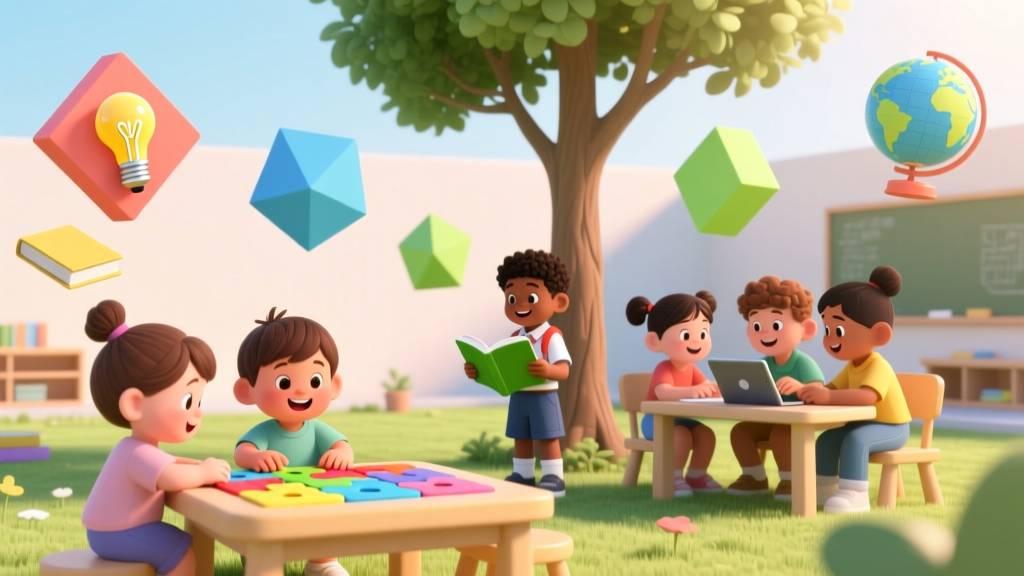
What Does Geography Mean for Kids? (2026)
Why 'What Does Geography Mean for Kids?' Is the Most Important Question You’ll Ask This Year
If you’ve ever watched a child press their nose against a window during a car ride, pointing at rivers, farms, or city skylines while blurting, 'Why is that river blue there but brown here?'—you’ve witnessed geography in action. What does geography mean for kids? It’s not just memorizing capitals or coloring maps. It’s the joyful, essential superpower that helps them understand where they are, how places connect, and why the world works the way it does. In an era of screen saturation and shrinking outdoor time, geography is the antidote: a hands-on, sensory-rich STEM discipline that builds spatial reasoning, empathy, environmental awareness, and critical thinking—all before kindergarten graduation.
And here’s the urgent truth: According to the National Council for Geographic Education (NCGE), only 17% of U.S. elementary schools offer dedicated geography instruction—and most teachers report feeling underprepared to teach it meaningfully. Yet research from the American Geographical Society shows children who engage with geography before age 8 develop 3x stronger problem-solving skills in math and science later on. That’s not trivia—it’s neural wiring. So let’s move past flashcards and into real-world discovery.
Geography Isn’t Just Maps—It’s a Way of Thinking (and Here’s How to Nurture It)
When we ask what does geography mean for kids, we’re really asking: How do we help them think like geographers? Not cartographers—thinkers who ask where, why there, how connected, and what if. Dr. Sarah Witham Bednarz, former president of the NCGE and professor of geography education at Texas A&M, emphasizes: 'Geographic thinking begins with observation, not terminology. A 5-year-old noticing that puddles last longer on the shady side of the playground is already analyzing landforms, climate, and surface materials.'
That means ditching the dictionary definition ('the study of Earth’s landscapes, environments, populations, and places')—which is accurate but meaningless to a 6-year-old—and replacing it with experience-first language:
- 'Geography is being a place detective.' (Who lives here? What grows here? Why did people build a town right here?)
- 'Geography is noticing how things fit together.' (How does rain in the mountains become water in your glass? Why do some neighborhoods have more trees?)
- 'Geography is asking “Where?” and “Why there?” about everything.'
Try this tomorrow: Next time your child asks, 'Why is the sky orange at sunset?', don’t jump to atmospheric scattering. Instead, say, 'That’s geography! Let’s be place detectives. Where are we standing? What direction is the sun? What’s between us and the sun? What changed since noon?' You’re modeling geographic inquiry—not delivering facts.
The 4 Pillars of Kid-Friendly Geography (and How to Build Them Daily)
Based on the National Geography Standards and AAP-endorsed developmental milestones, every child’s geographic foundation rests on four interconnected pillars. These aren’t abstract concepts—they’re observable, actionable behaviors you can nurture through everyday moments:
- Location Literacy: Understanding relative position (‘next to’, ‘across from’, ‘upstream’) and simple coordinates (‘third house on the left’). Starts at age 3–4.
- Place Sense: Recognizing that places have unique physical and human characteristics (a desert feels hot & sandy; a fishing village smells salty & has boats). Peaks in sensitivity between ages 5–8.
- Human-Environment Interaction: Seeing how people adapt to, modify, and depend on nature (building dams, planting drought-resistant crops, using solar panels). Emerges clearly around age 6–7.
- Movement & Connection: Grasping how people, goods, ideas, and even animals travel across space (migrating birds, food delivery trucks, video calls with Grandma). Becomes concrete by age 7–9.
A powerful case study comes from the Chicago Public Schools’ ‘Neighborhood Geography’ pilot program. Teachers used students’ own blocks as curriculum: mapping sidewalks, interviewing local shop owners, testing soil pH in school gardens, and tracking bus routes. After one semester, 92% of second graders could correctly explain why their neighborhood had more brick buildings than nearby areas (historical clay deposits + local brickworks)—a concept previously taught only in middle school. The secret? They started with their place—not a textbook map of Egypt.
From Sidewalks to Satellites: Age-Appropriate Geography Activities That Stick
Forget ‘geography hour.’ The most effective geography learning happens in micro-moments woven into routines. Below is a research-backed progression—validated by the Association of American Geographers’ Early Learning Task Force—that matches activities to developmental readiness, safety needs, and cognitive capacity:
| Age Range | Core Geography Skill Developing | Simple, Low-Cost Activity (Under 10 Minutes) | Why It Works (Developmental Rationale) | Safety & Supervision Notes |
|---|---|---|---|---|
| 3–4 years | Basic location vocabulary & body-space awareness | “Treasure Hunt” with positional language: “Find something UNDER the table,” “Put the toy BEHIND the chair,” “Jump BETWEEN the pillows.” | Builds neural pathways for spatial reasoning; uses motor memory to cement prepositions (key for map reading later). | Clear floor space needed; avoid small objects for under-3s due to choking risk (CPSC guidelines). |
| 5–6 years | Observation of physical features & simple map-making | Create a “Backyard Map”: Draw fence, tree, swing set using symbols (stick figure = person, triangle = tree). Add a legend. | Supports symbolic representation (a core literacy precursor); reinforces scale, orientation, and symbol-meaning relationships. | Non-toxic crayons only; supervise near fences/water features per AAP outdoor safety recommendations. |
| 7–8 years | Understanding human-environment interaction | “Water Journey” experiment: Trace tap water back to source using local watershed maps; compare bottled vs. tap water labels; discuss plastic footprint. | Links abstract systems (water cycle, supply chains) to tangible choices; fosters environmental agency. | Use only FDA-approved water testing kits if sampling; avoid stagnant water sources per CDC guidance. |
| 9–10 years | Global connections & perspective-taking | “Pen Pal Geography Swap”: Exchange photos + voice notes with a classroom abroad via ePals; map each other’s commutes, meals, weather, and festivals. | Develops cultural empathy and challenges ethnocentric assumptions; meets Common Core social studies standards for global awareness. | Use only school-vetted, COPPA-compliant platforms; no personal identifiers shared (per FTC guidelines). |
Notice what’s missing? Worksheets, quizzes, and rote memorization. Instead, these activities activate multiple intelligences—kinesthetic, visual, linguistic, and interpersonal—while building what Dr. Laura L. D’Amico, a developmental psychologist at UCLA, calls “geographic identity”: the quiet confidence that comes from knowing you belong *somewhere*, understand *something* about how places work, and can navigate change.
Frequently Asked Questions
Is geography just for older kids—or can toddlers really 'do' it?
Absolutely—even infants engage with geography! Think about it: A baby tracking a mobile learns spatial movement. A toddler navigating a playground develops mental mapping. Research published in Child Development shows infants as young as 6 months demonstrate basic spatial memory—remembering where toys are hidden behind barriers. For toddlers, geography is sensory: texture of sand vs. grass, slope of a hill, echo in a tunnel. Start with language (“up/down,” “near/far”) and safe exploration—not concepts.
My child loves Minecraft. Is that actually helping their geography skills?
Yes—when guided intentionally. Minecraft’s block-based terrain generation mirrors real-world geomorphology (erosion, sediment layers, biomes). A 2022 MIT Playful Journey Lab study found children who played Minecraft with geography prompts (“Design a village that survives floods—where will you build? What materials will you use?”) scored 40% higher on spatial reasoning assessments than control groups. Key: Pair gameplay with reflection. Ask, “How is your Minecraft river like the one we saw on vacation? How is it different?”
Do I need special tools or expensive kits to teach geography?
No—and in fact, over-reliance on commercial kits can limit authentic learning. A landmark University of Georgia study compared classrooms using $300 geography kits versus those using only local resources (library atlases, Google Earth on shared tablets, sidewalk chalk, community maps). The low-resource group showed deeper retention and more creative application. Your best tools are curiosity, open-ended questions (“What would happen if this hill were taller?”), and permission to get messy. A mud pie is topographic modeling. A grocery list is a supply chain map.
How much screen time is appropriate for geography learning?
The American Academy of Pediatrics recommends no more than 1 hour/day of high-quality programming for ages 2–5, and consistent limits for older children. For geography, prioritize interactive over passive: Use Google Earth Voyager stories (free, curriculum-aligned), National Geographic Kids videos (with discussion pauses), or NASA’s Climate Kids site. Always co-view and ask predictive questions (“What do you think happens next to this glacier?”). Avoid autoplay feeds—geography demands attention, not distraction.
Isn’t geography mostly about memorizing countries? Shouldn’t I focus on that first?
This is the biggest misconception—and it’s holding kids back. Memorizing country names without context creates fragile, disconnected knowledge. The NCGE explicitly advises against country-name drills before age 10. Instead, start with phenomena: Why do some places have volcanoes? Why do deserts form where they do? Why do cities grow near rivers? When children understand processes, country names become meaningful anchors—not random syllables. One fourth-grade teacher in Austin replaced her ‘Countries of South America’ unit with ‘Chocolate’s Journey’: tracing cacao beans from Ecuadorian farms to local stores. Her students not only named 8 countries—but explained trade routes, elevation effects on flavor, and fair-trade economics.
Common Myths About Teaching Geography to Children
- Myth #1: “Geography is just map reading.” Reality: Map literacy is one tool—not the discipline. As Dr. Bednarz states, “Geography is the science of connection. A child who can name every capital but doesn’t know why their town floods when it rains hasn’t learned geography.”
- Myth #2: “You need to travel the world to teach geography.” Reality: The most powerful geography happens locally. The USDA’s Natural Resources Conservation Service reports that children who study their own watershed, soil type, or native pollinators develop stronger environmental stewardship than those who only learn about Amazon rainforests. Proximity breeds care.
Related Topics (Internal Link Suggestions)
- Geography activities for preschoolers — suggested anchor text: "hands-on geography for toddlers"
- Best geography apps for kids — suggested anchor text: "educational geography apps ages 4–10"
- How to make a classroom map — suggested anchor text: "student-created maps step-by-step"
- Geography and social-emotional learning — suggested anchor text: "using geography to build empathy"
- Outdoor geography scavenger hunt ideas — suggested anchor text: "free printable neighborhood geography hunt"
Your Next Step: Launch a 5-Minute Geography Moment Today
You don’t need a lesson plan, a budget, or a degree to answer what does geography mean for kids. You just need five minutes—and one curious question. Tonight at dinner, ask: “What’s something that traveled far to get to our plate?” Tomorrow morning, pause on the walk to school and say: “Let’s be place detectives for 60 seconds. What do you notice about the ground here? The air? The sounds?” That’s geography. It’s not about perfection. It’s about presence. It’s about helping your child see themselves as part of a vast, vibrant, interconnected world—not separate from it. So go ahead: point to a cloud, follow a bee, trace a river on a napkin. You’re not just teaching geography. You’re helping them find their place—in every sense of the word.
More Articles
 Best Robotics Kits for Beginners 2026
 AI in School: 7 Evidence-Backed Boundaries (2026)
 Common STEM Back-End Mistakes & How to Fix Them
 10 Beginner Robotics Projects for Kids Under 10
 Teaching Measurement to Kids (Fun Way)
 Is Osmosis Jones for Kids? Science Learning Truth (2026)
 Weather Station DIY Project for Kids: Build & Track Data
Kitchen Science Experiments for Chemistry Basics
Weather Station DIY Project for Kids: Build & Track Data
Kitchen Science Experiments for Chemistry Basics
 Evidence-Based Learning Strategies for Skill Acquisition
 AI for Kids: A Developmental Guide to Real Literacy