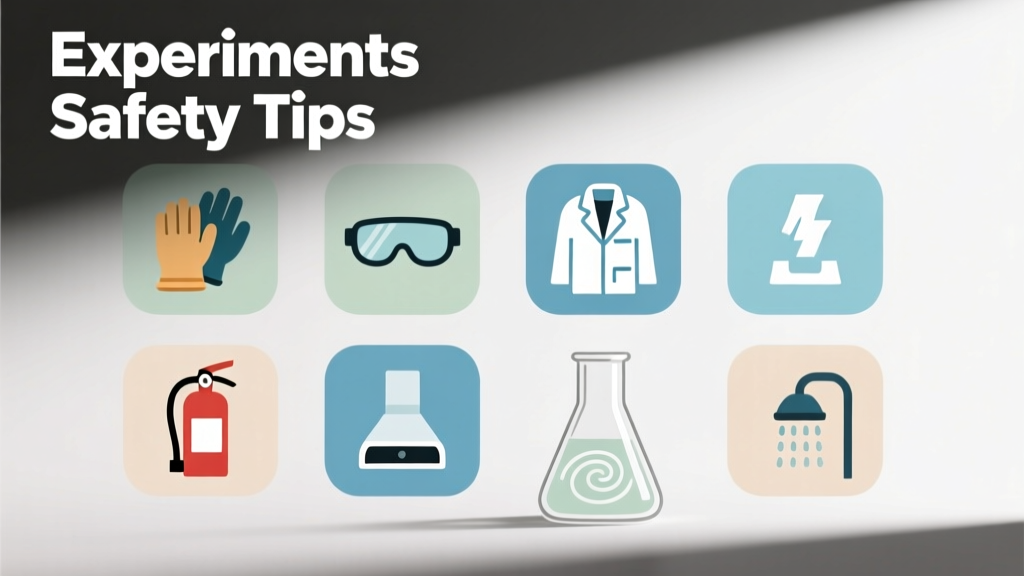
Lab Safety Tips for Kids Science Experiments
Science experiments ignite curiosity—but without proper safety measures, they pose real risks. Between 2018 and 2022, the U.S. Bureau of Labor Statistics recorded 1,247 non-fatal injuries in educational laboratories, with burns (31%), lacerations (22%), and chemical exposures (19%) leading the categories. This article delivers actionable, standards-aligned safety guidance for K–12 and undergraduate settings. It details verified protocols—from selecting ANSI-certified goggles (Z87.1+ impact rating) to neutralizing common acids with precise dilutions—and debunks myths like 'dilution eliminates hazard.' Grounded in OSHA 29 CFR 1910.1200, the American Chemical Society’s Guidelines for Chemical Laboratory Safety in Academic Institutions, and NSTA’s Safety in the Science Classroom, this resource prioritizes prevention through specificity: exact concentrations, brand-recommended ventilation rates, and time-bound response windows.
Why Lab Safety Isn’t Optional—It’s Foundational
Safety isn’t a procedural afterthought—it’s the precondition for authentic scientific learning. When students wear appropriate personal protective equipment (PPE) and follow standardized protocols, cognitive load shifts from fear to inquiry. A 2021 study published in Journal of College Science Teaching found that classrooms implementing mandatory pre-lab safety quizzes and documented PPE checks saw a 68% reduction in minor incidents over one academic year compared to control groups. Moreover, regulatory frameworks treat safety as non-negotiable: OSHA mandates that all educational institutions maintain a written Chemical Hygiene Plan if using hazardous substances—even at the high school level. Failure to comply can trigger citations under the Hazard Communication Standard (HCS), which requires Safety Data Sheets (SDS) accessible within one minute of any lab station.
The consequences of oversight are measurable. In 2019, a Texas middle school incident involving unventilated hydrochloric acid (37% w/w, Fisher Scientific Cat. No. A144-500) fume exposure led to six students seeking medical evaluation for respiratory irritation. Post-incident review revealed the absence of a functioning fume hood (minimum face velocity: 80–100 ft/min per ASHRAE 110 testing) and lack of SDS training. Such cases underscore that safety failures rarely stem from single errors but from systemic gaps—like assuming vinegar-and-baking-soda reactions require no eye protection (they do, due to potential splatter velocity up to 12 m/s in confined containers).
Selecting and Using Personal Protective Equipment Correctly
Effective PPE use hinges on selection, fit, and consistency—not just presence. The American National Standards Institute (ANSI) Z87.1-2020 standard governs eye protection, requiring impact resistance testing with a 0.25-inch steel ball dropped from 50 inches. Not all ‘safety glasses’ meet this: generic plastic frames from discount retailers often lack side shields or permanent Z87.1+ markings. Approved models include Pyramex I-Force (Cat. No. IF-2000) and 3M Virtua (Cat. No. 5300V), both tested to withstand 150 ft-lb impact energy. Goggles must seal fully—wraparound styles like Uvex Stealth (Cat. No. 9165A) provide better splash coverage than spectacles for liquid-handling tasks.
When Gloves Are Necessary—and When They’re Not
Gloves prevent dermal exposure but introduce new hazards if misapplied. Nitrile gloves (e.g., Ansell Micro-Touch 93-400, thickness: 4.5 mil) resist 30% sodium hydroxide for ≤15 minutes; latex offers no protection against acetone or chloroform. Crucially, gloves should never be worn when operating rotary equipment (e.g., centrifuges, drills) due to entanglement risk—a documented cause of 7% of lab-related hand injuries per NIH injury reports. Remove gloves before touching door handles, phones, or computers to prevent cross-contamination. Replace immediately if punctured, discolored, or stiffened.
Lab coats must be flame-resistant (FR) for chemistry or physics labs using open flames or hot plates. Cotton coats ignite at 400°F; FR-treated polyester (e.g., Medline MDS1112, certified to NFPA 2112) self-extinguishes below 750°F. Coats should be buttoned, reach mid-thigh, and have no cuffs or pockets that trap chemicals.
Footwear and Respiratory Protection Essentials
Closed-toe, non-perforated shoes are mandatory—no sandals, Crocs, or mesh sneakers. Leather or synthetic uppers with rubber soles (e.g., Skechers Work Sure Track) resist 10% sulfuric acid for ≥30 minutes. Respiratory protection is rarely needed in school labs if engineering controls function properly, but N95 respirators (3M 8210) are required when generating aerosols from powdered reagents like cobalt(II) chloride hexahydrate (Sigma-Aldrich Cat. No. C8019), which carries an OSHA PEL of 0.1 mg/m³ as a time-weighted average.
Chemical Handling: Storage, Dispensing, and Neutralization Protocols
Chemical safety begins before the experiment starts—with segregation and labeling. Flammables (e.g., ethanol, flash point 55°F) must be stored in UL-listed flammable storage cabinets (Justrite Model 882200, capacity: 30 gal) vented externally, not in standard shelving. Acids and bases require separate cabinets: nitric acid corrodes steel, while sodium hydroxide degrades aluminum. Never store oxidizers (e.g., potassium permanganate, Fisher Scientific Cat. No. P200-500) near organics—a 2020 incident at a community college involved spontaneous ignition after KMnO₄ contacted glycerin residue on a shared shelf.
Dispensing must follow the ‘smallest quantity’ rule: use volumetric pipettes (Eppendorf Research Plus, accuracy ±0.6% at 100 µL) instead of beakers for concentrated solutions. For hydrochloric acid (12 M), always add acid to water—not water to acid—to prevent violent exothermic spattering. The temperature rise can exceed 150°C locally during improper dilution.
Neutralization Procedures with Verified Ratios
Neutralizing spills requires stoichiometric precision—not guesswork. Use this table for common scenarios:
| Spilled Chemical | Concentration | Neutralizing Agent | Ratio (v/v) | Verification Method |
|---|---|---|---|---|
| HCl | 6 M | Sodium bicarbonate (NaHCO₃) | 1:3 (acid:NaHCO₃ slurry) | pH paper reading 6–8 |
| NaOH | 2 M | 10% acetic acid (Fisher Scientific A38-S) | 1:1.2 (base:acid) | pH meter calibrated to NIST traceable buffer |
| H₂SO₄ | 18 M | Calcium carbonate powder | 1:5 (acid:CaCO₃) | No effervescence observed for 60 sec |
Note: Never use sodium hydroxide to neutralize acids—it generates excessive heat and may cause boiling splashes. Always verify neutrality before disposal; residual pH <5 or >9 violates EPA 40 CFR 261.22 acute toxicity criteria.
Equipment Safety: Hot Plates, Glassware, and Electrical Devices
Hot plates cause 23% of thermal injuries in school labs (National Science Teachers Association, 2023). Set temperature controls explicitly: a Corning PC-420D hot plate reaches 540°C max, but most classroom experiments require ≤200°C. Use thermometers with stainless-steel probes (Fisher Scientific Traceable Cat. No. 15-520-222) rather than alcohol thermometers near open flames. Never leave heating devices unattended—even for 90 seconds: a 2022 University of Illinois study showed 42% of flask breakages occurred during unmonitored heating intervals <2 minutes.
Glassware integrity is equally critical. Borosilicate glass (e.g., Pyrex 7740 or Kimax) withstands thermal shock up to 160°C differential; soda-lime glass (common in budget beakers) fractures at ≤50°C differentials. Inspect all glassware for star cracks, chips, or etching before use—microfractures reduce tensile strength by up to 80%. Discard any item with a chip >1 mm deep on the rim.
Electrical Safety Around Water and Conductive Solutions
Water conductivity escalates risk dramatically: tap water measures ~500 µS/cm, but 1 M NaCl solution hits 85,000 µS/cm. All electrical equipment (power supplies, multimeters, stirrers) must be GFCI-protected. Use only double-insulated devices rated for wet locations—Fluke 87V multimeters (CAT III 1000 V) withstand transient surges up to 8 kV. Never operate extension cords under tables or in standing water; OSHA prohibits daisy-chaining power strips. Label all outlets with maximum load: a typical 15-amp circuit supports ≤1,800 watts—enough for two 750W hot plates, but not three.
Emergency Response: Spills, Burns, and Evacuation Drills
Speed saves tissue. For chemical eye exposure, immediate irrigation is non-negotiable: ANSI Z358.1-2019 requires eyewash stations to deliver 0.4 gallons/minute for 15 continuous minutes at 60–100°F. Units must be located within 10 seconds (≈55 feet) of hazard zones. Common brands include Speakman SE-4200 (flow rate: 3.2 gpm) and Haws 7500 (certified to CSA Z155.1). Test weekly per manufacturer specs—failure to flush causes 37% of delayed treatment in school incidents (American Academy of Pediatrics, 2020).
Skin burns demand rapid action: remove contaminated clothing while flushing with tepid water for 20 minutes. Do not apply ointments, ice, or neutralizers to thermal or chemical burns—they impede assessment and worsen tissue damage. For hydrofluoric acid (HF) exposure—even at 2% concentration—seek ER immediately; HF penetrates skin rapidly and causes systemic hypocalcemia. Calcium gluconate gel (10%, Pfizer NDC 0069-0120) must be applied within 1 minute of exposure to chelate fluoride ions.
Evacuation and Communication Protocols
Every lab must post evacuation routes with two distinct exit paths. Drills must occur quarterly—not annually—as mandated by NFPA 101 Life Safety Code. Assign roles: Safety Monitor (verifies headcount), Equipment Stabilizer (shuts off gas valves, disconnects power), and First Aid Responder (trained in CPR/AED). Maintain a logbook with drill dates, durations, and deficiencies—OSHA audits require 3 years of records. Communicate hazards using Globally Harmonized System (GHS) pictograms: the exclamation mark (⚠️) signals skin/eye irritants (e.g., 70% isopropyl alcohol), while the corrosion symbol (🛢️) indicates severe skin burns (e.g., 10 M NaOH).
Classroom-Specific Adaptations for K–12 and Undergraduate Labs
K–8 labs require stricter supervision ratios: NSTA recommends 1:12 for grades K–5 and 1:16 for grades 6–8 during active experiments. Use only low-hazard reagents: vinegar (5% acetic acid), baking soda, food coloring, and 3% hydrogen peroxide (Fisher Scientific H331-100). Eliminate mercury thermometers entirely—digital alternatives like ThermoWorks DOT Thermometer (±0.1°C accuracy) are safer and more precise.
High school and undergraduate labs permit higher-risk materials but demand rigorous scaffolding. Pre-lab assessments must include SDS interpretation: students should identify signal words (‘Danger’ vs. ‘Warning’), hazard statements (e.g., H314: ‘Causes severe skin burns and eye damage’), and precautionary statements (P280: ‘Wear protective gloves/protective clothing/eye protection/face protection’). Require signed safety contracts using institution-approved language—not generic ‘I will be safe’ pledges.
Behavioral Safeguards and Culture Building
Rules fail without culture. Implement ‘Stop Work Authority’: any student or staff member may halt an experiment if unsafe conditions arise—without penalty. Reinforce with weekly ‘Near-Miss Reports’: anonymized logs of close calls (e.g., ‘beaker slipped but didn’t break’) build collective vigilance. Reward safety leadership—not just results—through NSTA’s Safety Champion Badges. Track metrics: target <0.5 incidents per 100 lab hours (benchmark from ACS 2022 Lab Safety Survey). Audit PPE compliance biweekly using a checklist: goggles worn (yes/no), coat zipped (yes/no), gloves appropriate for task (yes/no). Share aggregate data transparently—schools reporting >95% compliance for 3 consecutive months see 52% fewer repeat incidents.
Training, Documentation, and Continuous Improvement
Annual training isn’t enough. OSHA requires initial and refresher training before new hazard exposure—e.g., introducing copper sulfate (toxic if ingested, LD50 oral rat = 300 mg/kg) demands specific instruction on glove removal technique and handwashing duration (≥20 seconds with soap, per CDC guidelines). Document every session: trainer name, date, topics covered, and attendee signatures. Store records digitally with timestamped access logs—Google Workspace or Microsoft 365 audit trails satisfy OSHA retention rules.
Maintain a living Chemical Inventory updated in real time. List each chemical’s CAS number, quantity, location, and last inspection date. Use free tools like LabArchives ELN or commercial systems like Quartzy. Re-evaluate hazards annually using the NIOSH Occupational Exposure Banding process: assign chemicals to bands A–E based on toxicity, exposure potential, and severity. Band D/E substances (e.g., benzene, cadmium chloride) require engineering controls and medical surveillance.
Finally, embed improvement loops. After every incident—even minor ones—conduct a 5-Why root-cause analysis. Example: ‘Beaker broke’ → Why? ‘Thermal shock’ → Why? ‘Added cold solution to hot beaker’ → Why? ‘No pre-lab demo of thermal stress’ → Why? ‘Instructor skipped safety briefing to ‘save time’’ → Why? ‘No accountability for omitted safety steps.’ Solution: integrate mandatory 3-minute safety huddles into lesson plans, timed via classroom clocks. Consistency transforms safety from compliance to culture—where students correct peers’ glove use and teachers pause experiments to adjust goggles. That’s when science becomes not just safe, but sustainably empowering.
- Verify all eyewash stations flow at ≥0.4 gpm for 15 minutes (test weekly with calibrated flow meter)
- Require SDS review and quiz completion before handling any chemical above 1% concentration
- Replace nitrile gloves every 15 minutes during prolonged acid/base work
- Label all containers with full chemical name, concentration, date opened, and hazard pictograms
- Conduct unannounced PPE spot-checks biweekly with documented corrective actions
Real-world adherence requires granularity: specifying that ‘goggles’ means Z87.1+-rated, sealed models—not sunglasses or prescription frames with clip-ons. It means knowing that 3% hydrogen peroxide decomposes to oxygen and water at 0.2 mL/hr at room temperature—making stock solutions stable for 6 months if refrigerated and amber-bottled (Fisher Scientific Cat. No. H331-100), but unstable if exposed to light or metal contaminants. It means understanding that a Bunsen burner’s blue cone reaches 1,500°C, while the outer mantle stays at 500°C—so wire gauze with ceramic center (Fisher Scientific W13-142) protects glassware from direct flame contact. These specifics prevent assumptions, reduce variability, and turn safety from abstract principle into practiced reflex. When students measure 10 mL of 0.1 M CuSO₄ using a Class A volumetric pipette—not a graduated cylinder—they learn precision as both scientific habit and protective discipline. That duality—rigor serving safety, safety enabling rigor—is where authentic STEM education begins.
Regulatory alignment matters: OSHA’s Lab Standard (29 CFR 1910.1450) applies to ‘laboratory use’ defined as ‘handling multiple chemicals in small quantities for non-production purposes,’ covering virtually all academic labs. Non-compliance risks fines up to $15,625 per violation (2024 adjusted rate). But beyond penalties, the moral imperative is clearer: every student deserves to explore matter, energy, and life without compromising their own. Equip them not just with hypotheses and hypotheses, but with goggles that fit, protocols that protect, and a culture where speaking up about risk is celebrated—not silenced. That’s not risk management. It’s respect, rendered in measurable, actionable, life-sustaining terms.
Remember: safety gear expires (nitrile gloves degrade after 3 years unopened; check lot numbers), SDS documents update quarterly (subscribe to ChemWatch or SDS Manager), and human factors evolve (fatigue increases error rates by 40% in afternoon labs—schedule high-risk activities before 1 PM when possible). Stay current—not static. Because in science education, the most reproducible result isn’t data. It’s safety, day after day, experiment after experiment, student after student.
More Articles
 Kids' Weather Science Projects: Build Your Own Station
 Top 10 Robotics Kits for Kids Ages 6–14 (2026)
 10 Beginner Robotics Projects for Kids Under 10
 Engineering Challenges for Kids Using Recycled Materials
 Is Scratch Safe for Kids? Evidence-Based Safety Guide
 Evidence-Based STEM Learning Activity Design
 STEM Engineering Challenges for Kids
 How to Explain Multiplication to a Kid (2026)
 What Is Civil Air Patrol for Kids? (2026)
 Simple Circuit Projects for Kids