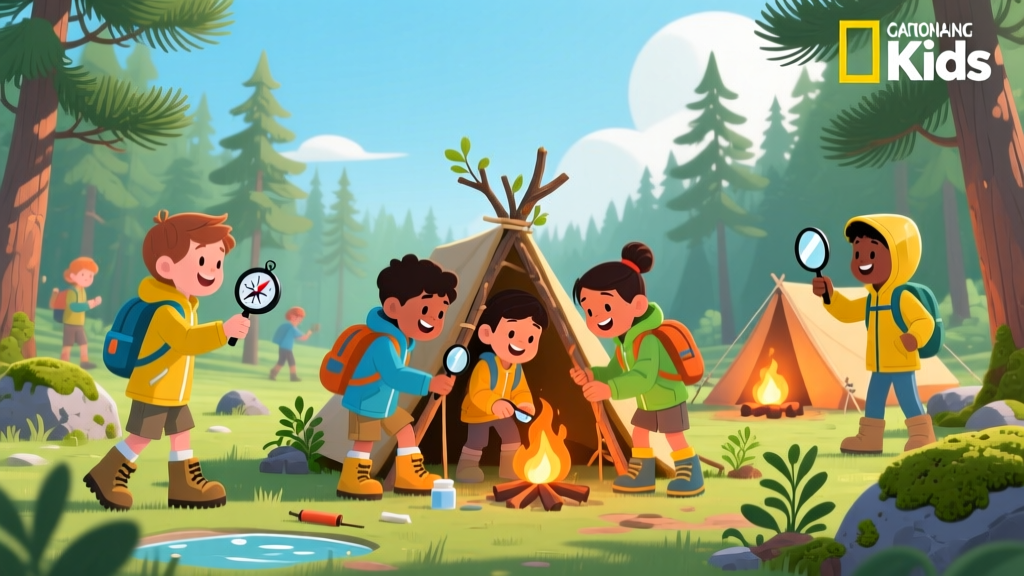
Camping Games That Teach Kids Survival Skills
Every experienced outdoorsman knows: the best way to learn survival skills is through play. As a wilderness guide, I've watched children absorb complex outdoor competencies — navigation, fire safety, shelter building — when they're framed as games rather than lessons. Here are 10 camping games I've designed that teach real survival skills while kids think they're just having fun.
Why Game-Based Learning Works for Outdoor Skills
Research from the Outdoor Foundation shows that children who learn outdoor skills through play retain 3× more information than those taught through instruction alone. The reason is simple: play creates emotional engagement, and emotional engagement creates memory. When a child successfully navigates to a "treasure" using a compass, the dopamine hit reinforces the skill permanently.
10 Survival Skill Camping Games
1. Compass Treasure Hunt (Navigation)
Skill: Map reading and compass use.
Setup: Hide small prizes at GPS coordinates. Give each team a compass and a simple map with bearings and distances. Example: "Walk 50 paces north, then 30 paces east."
Ages: 6+. Time: 30–45 minutes.
2. Shelter Build Challenge (Shelter Construction)
Skill: Emergency shelter building.
Setup: Teams collect natural materials (branches, leaves, bark) and build a shelter that can withstand a "storm test" (gentle water spray from a watering can). Judge on stability, coverage, and creativity.
Ages: 5+. Time: 45–60 minutes.
3. Fire Starter Relay (Fire Safety)
Skill: Fire preparation and safety protocols.
Setup: Teams race to correctly build a fire lay (teepee, log cabin, or lean-to) using collected materials. Points for correct structure, safety circle setup, and extinguishing procedure demonstration. No actual fire needed for young kids.
Ages: 7+ (with fire); 4+ (without fire). Time: 20 minutes.
4. Wildlife Detective (Animal Tracking)
Skill: Animal identification and tracking.
Setup: Create plaster casts of animal tracks beforehand and hide them around camp. Kids find tracks, identify the animal using a field guide, and record findings. Bonus points for finding other signs (scat, scratches, nests).
Ages: 5+. Time: 30 minutes.
5. Knot Tying Olympics (Knot Skills)
Skill: Essential knot tying.
Setup: Stations for bowline, clove hitch, taut-line hitch, and square knot. Kids learn each knot, then race to tie them correctly under timed conditions. Final challenge: use knots to hang a bear bag.
Ages: 7+. Time: 30 minutes.
Safety Framework for Survival Games
| Skill Area | Key Safety Rules | Adult Supervision |
|---|---|---|
| Navigation | Never leave designated area; buddy system required | One adult per team |
| Fire | Fire circle cleared 10ft; water bucket ready; no loose clothing | 1:4 ratio minimum |
| Shelter | No dead standing trees (widowmakers); check for wasp nests | Inspect all sites first |
| Water | No water deeper than knees; life jackets for any boating | Constant supervision |
| Knife/Tools | Blood circle (arm's reach clear); cut away from body | 1:2 ratio minimum |
Frequently Asked Questions
What age can kids start learning survival skills?
Basic skills like "hug a tree" (staying put when lost) can be taught from age 3. Compass use and shelter building work well from age 5–6. Fire starting and knife skills are appropriate from age 7–8 with close supervision.
How do I teach survival skills without scaring kids?
Frame everything as adventure and empowerment, not danger. "Learn to be a wilderness explorer" rather than "learn what to do if you get lost." Focus on competence and confidence, not fear scenarios.
The Bottom Line
The survival skills children learn through camping games stay with them for life. A child who can read a compass at age 8 becomes an adult who doesn't panic when their GPS dies on a hike. Make it fun, make it safe, and let the learning happen naturally through play.
More Articles
 Why Kids Need Recess: Brain Benefits Backed by Science
 Backyard Nature Trail: Easy DIY Guide for Kids
 Building a Tree Fort With Kids: Safe Guide
 Natural Obstacle Course Ideas for Kids
 Seasonal Outdoor Toys for Kids: 7-Step Parent Checklist
 Arizona Family Adventures: Stress-Free, Weather-Smart & Safe
 Adventure Cameras for Kids & Pets: Weather Risks (2026)
Kid-Friendly Garden Projects That Teach
Adventure Cameras for Kids & Pets: Weather Risks (2026)
Kid-Friendly Garden Projects That Teach
 Traverse City with Kids: 12 Stress-Free Outdoor Adventures
 What to Do in Blue Ridge GA with Kids (2026)