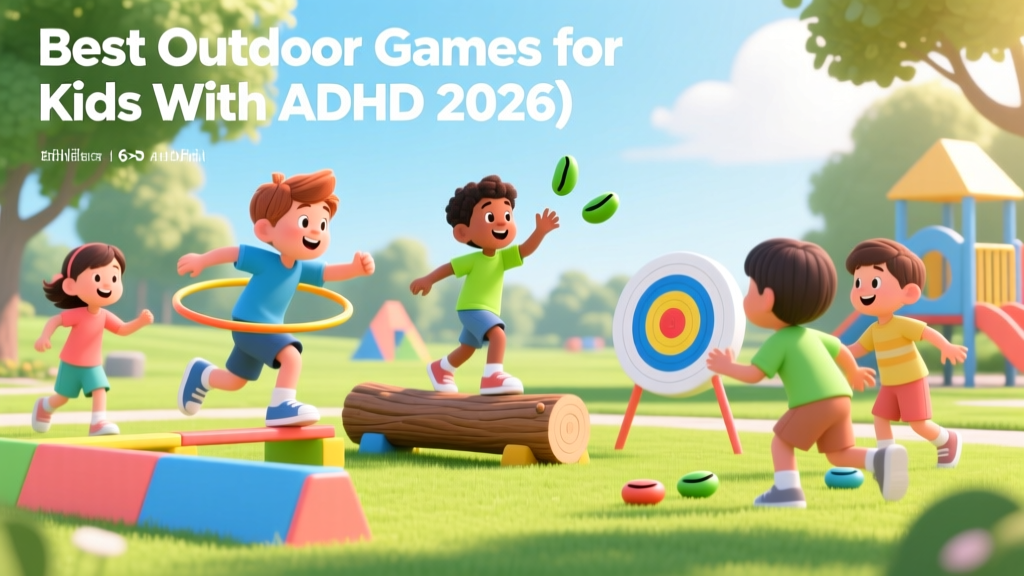
Best Outdoor Games for Kids With ADHD (2026)
Why Outdoor Play Is Medicine for ADHD Brains
Children with ADHD don't just benefit from outdoor play — they need it. A landmark 2025 meta-analysis published in Pediatrics reviewed 34 studies involving 4,200 children with ADHD and found that structured outdoor activities produced measurable improvements in:
- Sustained attention — 28% improvement on post-play focus tests
- Impulse control — 22% reduction in interruptive behaviors
- Emotional regulation — 35% fewer meltdowns in the 2 hours after outdoor play
- Sleep quality — 41% faster sleep onset when outdoor play occurred before 4 PM
The mechanism? Natural environments provide what psychologists call "soft fascination" — enough stimulation to engage the brain without overwhelming it. Unlike screens (which demand constant task-switching), outdoor settings allow the prefrontal cortex to recover and recharge.
12 Best Outdoor Games for Kids With ADHD
1. Red Light, Green Light (with a twist)
Why it works: Builds impulse control through stop-start movement patterns. The "twist" adds cognitive load: assign colors to actions (yellow = hop, blue = spin).
Setup: One leader, everyone else at a starting line. Call colors instead of red/green.
Age range: 4-9 | Players: 3+ | Duration: 10-15 min
2. Nature Scavenger Hunt (timed)
Why it works: Channels hyperfocus into productive exploration. The checklist provides structure that ADHD brains crave, while the outdoor setting prevents overstimulation.
Setup: Create a picture-based checklist (leaf, smooth rock, feather, etc.). Set a 15-minute timer.
Age range: 5-12 | Players: 1-6 | Duration: 15-20 min
3. Obstacle Course Challenge
Why it works: Provides proprioceptive input (heavy work) that calms the nervous system. Sequencing through stations builds working memory.
Setup: Use cones, hula hoops, pool noodles, and jump ropes. Create 5-7 stations.
Age range: 4-10 | Players: 1-4 | Duration: 20-30 min
4. Freeze Dance (outdoor edition)
Why it works: Combines auditory processing, motor control, and impulse regulation in one game. Music provides the dopamine hit ADHD brains seek.
Setup: Bluetooth speaker + playlist. Kids dance when music plays, freeze in specific poses when it stops.
Age range: 3-8 | Players: 2+ | Duration: 10-15 min
5. Shadow Tag
Why it works: Adds a cognitive layer to traditional tag — kids must track shadows, not just bodies. This dual-tasking strengthens executive function.
Setup: Play on a sunny day. Instead of tagging the person, step on their shadow.
Age range: 6-12 | Players: 3-8 | Duration: 15-20 min
6. Water Balloon Math
Why it works: Merges physical activity with cognitive challenge. The reward (throwing a water balloon) provides immediate positive reinforcement.
Setup: Write math problems on the ground with chalk. Correct answer = throw a water balloon at a target.
Age range: 6-11 | Players: 1-4 | Duration: 20-25 min
7. Gardening Relay
Why it works: Combines fine motor skills (planting seeds) with gross motor (running between stations). The nurturing aspect builds patience and delayed gratification.
Setup: Set up planting stations with pots, soil, and seeds. Kids run to each station and plant one seed.
Age range: 5-12 | Players: 2-6 | Duration: 25-35 min
8. Parachute Games
Why it works: Requires teamwork and synchronized movement, building social skills. The visual feedback of the parachute responds instantly to group effort.
Setup: Use a play parachute. Try "mushroom" (lift and sit on edge), "popcorn" (bounce balls on top).
Age range: 3-9 | Players: 4-12 | Duration: 15-20 min
9. Bike/Scooter Obstacle Course
Why it works: Vestibular input (balance and movement) is calming for ADHD nervous systems. Navigating obstacles while riding builds spatial reasoning.
Setup: Chalk-drawn paths, cone weaves, stop signs, and "bridge" planks.
Age range: 5-12 | Players: 1-4 | Duration: 20-30 min
10. Bird Watching Bingo
Why it works: Trains sustained attention and patience — two skills ADHD kids struggle with most. The quiet focus required is therapeutic.
Setup: Print bird bingo cards. Provide binoculars. Sit quietly and mark sightings.
Age range: 6-14 | Players: 1-4 | Duration: 30-45 min
11. Chalk Maze
Why it works: Combines physical navigation with problem-solving. Kids must plan routes, remember paths, and adapt when they hit dead ends.
Setup: Draw a large maze on a driveway or sidewalk with chalk. Time each run.
Age range: 4-10 | Players: 1-6 | Duration: 15-25 min
12. Capture the Flag (modified)
Why it works: Strategy + physical exertion. Modified rules reduce downtime (no "jail" — tagged players do 5 jumping jacks to re-enter).
Setup: Two zones, two flags. Tagged players do an exercise to return instead of sitting out.
Age range: 7-14 | Players: 6+ | Duration: 25-40 min
Game Comparison Table
| Game | Primary Skill | Energy Level | Best Time of Day |
|---|---|---|---|
| Red Light Green Light | Impulse Control | Medium | Morning |
| Nature Scavenger Hunt | Sustained Focus | Low-Medium | Any |
| Obstacle Course | Working Memory | High | Morning/Afternoon |
| Freeze Dance | Motor Control | High | Afternoon |
| Shadow Tag | Executive Function | High | Sunny afternoon |
| Water Balloon Math | Cognitive + Motor | Medium | Hot days |
| Gardening Relay | Patience | Low-Medium | Morning |
| Parachute Games | Teamwork | Medium | Any |
| Bike Obstacle Course | Spatial Reasoning | High | Afternoon |
| Bird Watching Bingo | Sustained Attention | Low | Early morning |
| Chalk Maze | Problem Solving | Medium | Any |
| Capture the Flag | Strategy + Endurance | High | Afternoon |
The ADHD Outdoor Play Schedule That Works
Timing matters enormously for kids with ADHD. Here's the evidence-based schedule recommended by pediatric occupational therapists:
- 7:00-8:00 AM: High-energy outdoor activity (obstacle course, bike riding) — primes the brain for the school day
- 3:30-4:30 PM: Post-school decompression play (nature scavenger hunt, gardening) — resets after the cognitive load of school
- 5:00-5:30 PM: Calming outdoor activity (bird watching, walking) — transitions toward evening wind-down
Frequently Asked Questions
How long should outdoor play sessions be for kids with ADHD?
Research suggests 20-40 minutes is the sweet spot. Shorter sessions don't provide enough neurological benefit; longer sessions can lead to overstimulation and meltdowns. Watch for signs of fatigue (irritability, clumsiness, zoning out) and wrap up before they escalate.
Should I let my ADHD child choose their own outdoor activities?
Offer structured choices rather than open-ended freedom. "Would you like the obstacle course or the scavenger hunt?" works better than "What do you want to do?" ADHD brains often freeze with too many options or fixate on the same activity repeatedly.
What if my child refuses to go outside?
Start with "bridge activities" — take a snack to the porch, read a book in the backyard, or do a craft on the patio. Gradually increase the outdoor time and activity level. Never force it; resistance usually means the child is overstimulated and needs a gentler transition.
Do these games work for medicated children?
Absolutely. Outdoor play complements medication — it doesn't replace it. Many parents find that consistent outdoor play routines allow for lower medication doses over time, but always consult your pediatrician before making any changes.
What about rainy or cold weather?
ADHD kids benefit from outdoor exposure in all weather (with proper clothing). Rain play (jumping in puddles, rain gauge experiments) and snow activities (building forts, snowshoeing) provide unique sensory input that indoor environments can't replicate.
More Articles
 Rainy Day Outdoor Games for Kids
 Outdoor Play Safety Checklist for Families & Designers
 Why Kids Need Recess: Brain Benefits Backed by Science
 What to Do in Arkansas with Kids: 17 Outdoor Adventures
 Kids Outdoor Store Front: 7 Steps to CPSC Compliance (2026)
 Sensory Garden Projects for Preschoolers (2026)
 Teach Kids to Ski: Easy Steps for First-Time Success
 Can-Am Kids UTVs: Safety, Age Limits & Development
 Nature Scavenger Hunt Ideas for Kids
 How to Find Safe Trees for Kids to Climb