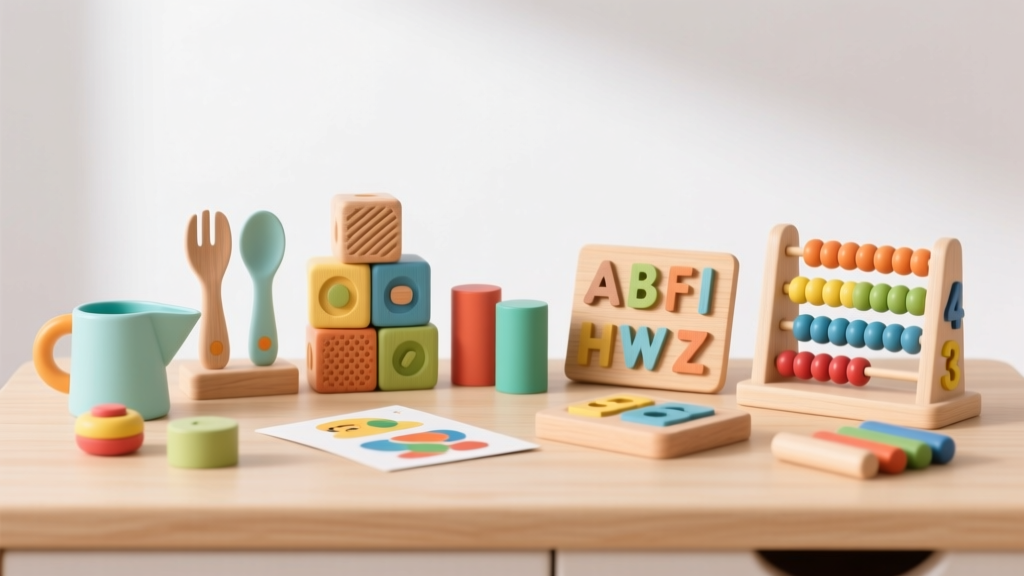
Montessori Toys for 2-Year-Olds: Guide to Independence
Two-year-olds are in a sensitive period for independence, order, and sensorial exploration. Montessori toys aren't flashy, battery-operated, or character-branded — they're carefully designed tools that match these developmental needs. As an early childhood educator with 12 years of experience, I've seen the dramatic difference Montessori-aligned materials make in concentration, independence, and self-confidence. Here's your complete guide to choosing wisely.
What Makes a Toy "Montessori"?
Genuine Montessori materials share five characteristics:
- Self-correcting: The child can see their own mistake and fix it without adult intervention
- Single-purpose (initially): Each material isolates one skill, preventing overwhelm
- Natural materials: Wood, metal, glass, fabric — providing authentic sensory feedback
- Reality-based: Realistic representations rather than cartoon abstractions
- Child-sized: Proportioned for small hands, promoting independence
Essential Montessori Toys for 2-Year-Olds
Practical Life (Independence)
1. Pouring Station ($15–25): Small pitcher + two cups + tray + dried beans. Children practice pouring, transferring, and controlling movements. Develops wrist control needed for writing.
2. Dressing Frame ($20–35): Fabric frame with buttons, zippers, or snaps. Children practice clothing fasteners at their own pace. Builds independence and fine motor precision.
3. Cleaning Set ($15–20): Child-sized broom, dustpan, spray bottle, cloth. Real participation in household tasks builds responsibility and gross motor skills.
Sensorial (Perception)
4. Stacking Tower ($20–30): Graduated rings or cubes that stack by size. Self-correcting (wrong order is visually obvious). Develops size discrimination — foundational for math.
5. Sound Cylinders ($15–25): Pairs of cylinders filled with different materials. Children match by sound. Develops auditory discrimination — critical for language development.
6. Color Tablets ($15–20): Pairs of colored tablets for matching and grading. Develops visual discrimination and vocabulary (light, lighter, lightest).
Language
7. Object Permanence Box ($20–30): Ball drops through hole into tray. Reinforces that objects exist when unseen. Builds concentration and cause-effect understanding.
8. Nomenclature Cards ($10–15): Realistic photos of animals, fruits, vehicles with labels. Builds vocabulary and prepares for reading.
Montessori Toy Guide
| Category | Toy | Skill Developed | Price Range |
|---|---|---|---|
| Practical Life | Pouring station | Wrist control, concentration | $15–25 |
| Practical Life | Dressing frame | Fine motor, independence | $20–35 |
| Sensorial | Stacking tower | Size discrimination | $20–30 |
| Sensorial | Sound cylinders | Auditory discrimination | $15–25 |
| Language | Nomenclature cards | Vocabulary building | $10–15 |
Frequently Asked Questions
Do Montessori toys have to be expensive?
No. Many Montessori materials can be DIY'd: pouring station from kitchen items, color cards from paint chips, sound cylinders from pill bottles. The principles matter more than the price tag. However, well-made wooden materials last through multiple children and maintain their appeal longer than plastic alternatives.
How many toys should a 2-year-old have available?
Montessori philosophy recommends 8–12 materials displayed on low shelves — not in a toy box. Too many choices overwhelm and reduce concentration. Rotate toys every 2–3 weeks to maintain interest. Quality over quantity always.
The Bottom Line
Montessori toys aren't about keeping children busy — they're about supporting the intense developmental work happening at age 2. When a toddler spends 20 minutes carefully pouring beans from one cup to another, they're building the concentration, wrist control, and independence that will serve them for life. Choose toys that match these developmental needs, display them accessibly, and step back to watch your child's capabilities unfold.
More Articles
 Thunderbolts Toys for Kids: Safe & Developmentally Right?
 Who Did Vergil Have a Kid With? Canon Truth (2026)
 Best Building Blocks for Spatial Reasoning
 Who Starred in Butch Cassidy and the Sundance Kid?
 Sensory Toys for Autism: 15 Therapist-Recommended Options
 Who Do You Think You Are Kidding, Mr. Hitler? (2026)
 Top 12 Hands-On Science Kits for Ages 4–14
 William Zabka’s Age in Karate Kid Revealed
 Kid Cudi Dating Status 2026: Facts vs. Rumors
 How Many Songs in Good Kid M.A.A.D City? (2026)