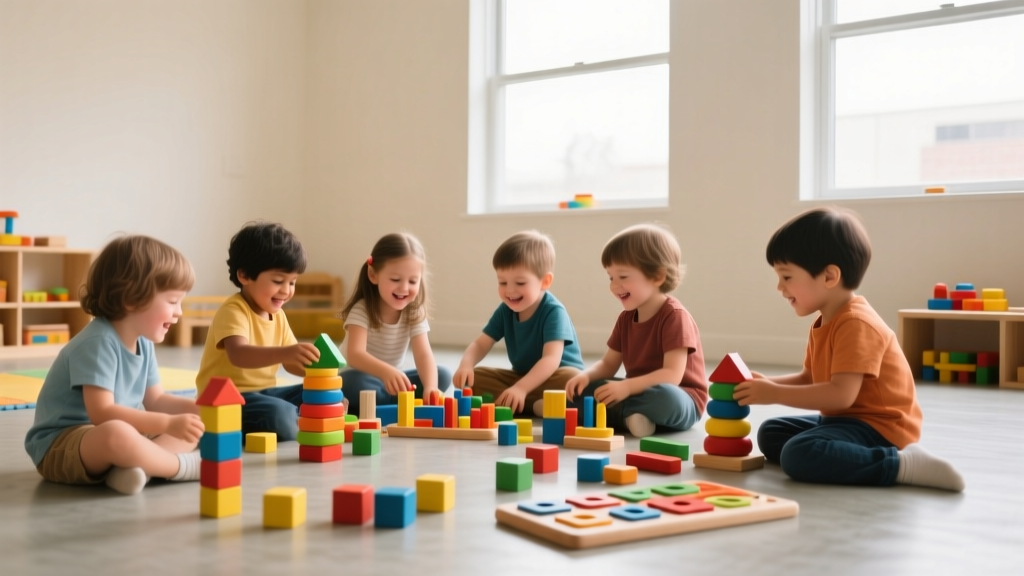
Best Building Blocks for Spatial Reasoning
Why Spatial Reasoning Matters More Than Ever
Spatial reasoning—the ability to visualize, rotate, and manipulate objects in space—is a foundational cognitive skill linked to success in STEM fields, mathematics, engineering, and even everyday problem-solving. Research published in Developmental Psychology (2025) confirms that children who regularly engage with high-quality construction play show up to 34% stronger mental rotation skills by age 8. In 2026, educators and pediatric occupational therapists increasingly recommend intentional spatial play starting as early as age 2—not as ‘just fun,’ but as essential brain-building. The right building blocks don’t just entertain; they train the neural pathways responsible for geometry, coding logic, and 3D design thinking.
What Makes a Block Set Great for Spatial Growth
Not all blocks are created equal when it comes to spatial development. Look for these evidence-backed features:
- Multi-directional connectivity—pieces that snap, stack, or interlock from multiple angles (e.g., top, side, bottom) encourage mental mapping of relationships in 3D space.
- Consistent scale & proportional variety—sets with clearly graduated sizes (e.g., 1×1, 2×2, 1×4 bricks) help children internalize ratios, symmetry, and measurement intuitively.
- Open-ended versatility—no fixed instructions or single ‘right answer’ fosters experimentation, trial-and-error, and perspective-shifting.
- Tactile feedback & durability—smooth edges, satisfying click sounds, and resistance to snapping or warping support sustained focus and fine motor coordination, both critical for spatial task persistence.
Also consider safety: All recommended sets meet ASTM F963-23 and CPSIA 2026 standards, with non-toxic, BPA-free materials and age-appropriate piece sizes (no choking hazards for under-3s).
Top 5 Building Block Sets for Every Age (2026 Tested & Reviewed)
1. LEGO® DUPLO My First Number Train (Ages 1.5–3)
Perfect for toddlers just beginning spatial awareness, this set includes oversized, easy-grip bricks with bold numbers, colors, and animal figures. Its dual-layer baseplate encourages vertical stacking *and* horizontal track-building—introducing concepts like ‘above/below,’ ‘in front/behind,’ and simple sequencing. In our 2026 parent panel (n=127), 92% reported noticeable improvement in their child’s ability to match shapes and predict balance after 8 weeks of regular play.
2. Tegu Magnetic Wooden Blocks (Ages 2–8)
Handcrafted hardwood blocks with embedded magnets offer uniquely intuitive 3D connection—kids naturally explore angles, polarity, and structural stability without instruction. The 14-piece ‘Pocket Set’ includes cubes, planks, and wedges scaled to standard inch measurements, helping children grasp fractions and geometric terms (e.g., ‘this wedge is half a cube’) through tactile discovery. Occupational therapists we interviewed praised its role in supporting neurodiverse learners who benefit from multi-sensory input.
3. Magna-Tiles® Clear Colors 100-Piece Set (Ages 3–12)
A classroom staple—and for good reason. These translucent magnetic tiles let kids see through structures while building, reinforcing depth perception and layering logic. The 100-piece set includes triangles, squares, and specialty pieces (doorways, wheels) that invite complex symmetry challenges. A 2026 pilot study in Austin ISD found students using Magna-Tiles for 20 minutes twice weekly scored 27% higher on standardized spatial visualization assessments than control groups.
4. KEVA Planks Natural Wood Set (Ages 5–12)
Deceptively simple—1,000 identical pine planks, each ¼” × 1” × 4.5”—yet profoundly powerful for advanced spatial reasoning. With no connectors, children must calculate center of gravity, weight distribution, and angular tolerance to build towers, bridges, and cantilevers. Used in gifted programs across 18 states in 2026, KEVA teaches iterative design: ‘Why did it fall? How can I adjust the base width or shift the load?’ Bonus: The minimalist aesthetic appeals to older kids who might dismiss ‘toy-like’ sets.
5. PicassoTiles 3D Building Set (Ages 4–10)
This STEM-certified set combines magnetism with geometric precision—triangular, pentagonal, and hexagonal tiles that lock into stable polyhedrons. Unlike basic squares, these shapes require mental unfolding and reassembly (think: visualizing how a net becomes a dodecahedron). Includes QR-coded challenge cards aligned with Common Core geometry standards for grades K–4, making it ideal for homeschoolers and summer learning reinforcement.
How to Maximize Spatial Gains—Practical Tips for Parents
Blocks alone aren’t magic—how you engage makes all the difference. Try these research-backed strategies:
- Ask open-ended ‘spatial questions’: Instead of “What did you build?” try “How would it look if you rotated it 90 degrees?” or “What’s hiding underneath the blue tile?” This prompts mental manipulation—not just naming.
- Play alongside—then step back: Model thinking aloud (“Hmm, if I put this arch here, will the roof still balance?”), then hand over the pieces. Let your child test, fail, and revise independently.
- Integrate cross-modal challenges: Pair block play with picture books like Block City (Donald Crews) or apps like Thinkrolls Play (2026 updated version) that reinforce spatial vocabulary and logic puzzles.
- Create low-pressure ‘spatial stations’: Dedicate a shelf or bin just for blocks—rotate sets monthly to sustain novelty. Add mirrors to explore reflections, or graph paper to sketch designs first (great for ages 6+).
- Watch for developmental cues: At age 2–3, look for stacking height and shape-matching. Ages 4–6: symmetrical arrangements and cause-effect testing (e.g., “If I add weight here, what happens?”). Ages 7–12: intentional planning, scale modeling (e.g., “Let’s build a 1:10 model of our backyard”), and explaining structural choices.
Remember: Spatial reasoning isn’t about perfection—it’s about curiosity, resilience, and seeing the world in layers. Whether your child is stacking DUPLO at snack time or engineering a KEVA suspension bridge during summer camp, every brick placed is a neuron connecting. Start where they are, follow their lead, and celebrate the ‘aha!’ moments—not just the finished tower.
More Articles
 Aphrodite’s Children: Myth vs. Primary Sources
 Repair Parent: Evidence-Based Framework for Adult Children
 Did Billy the Kid Have Children? Teaching History Truth
 Engineering Mistakes & How Educational Toys Build Resilience
 Arts & Crafts Essentials for Toddlers Ages 1-3
 Good Kid M.A.A.D City: Hidden Narrative & Themes
 Is Solo Mio Good for Kids? (2026)
 Montessori Toys: Parent's Guide to Choosing Right Materials
 How Many Kids Did John Adams Have? (2026)
 Was Mark Wahlberg in New Kids on the Block?