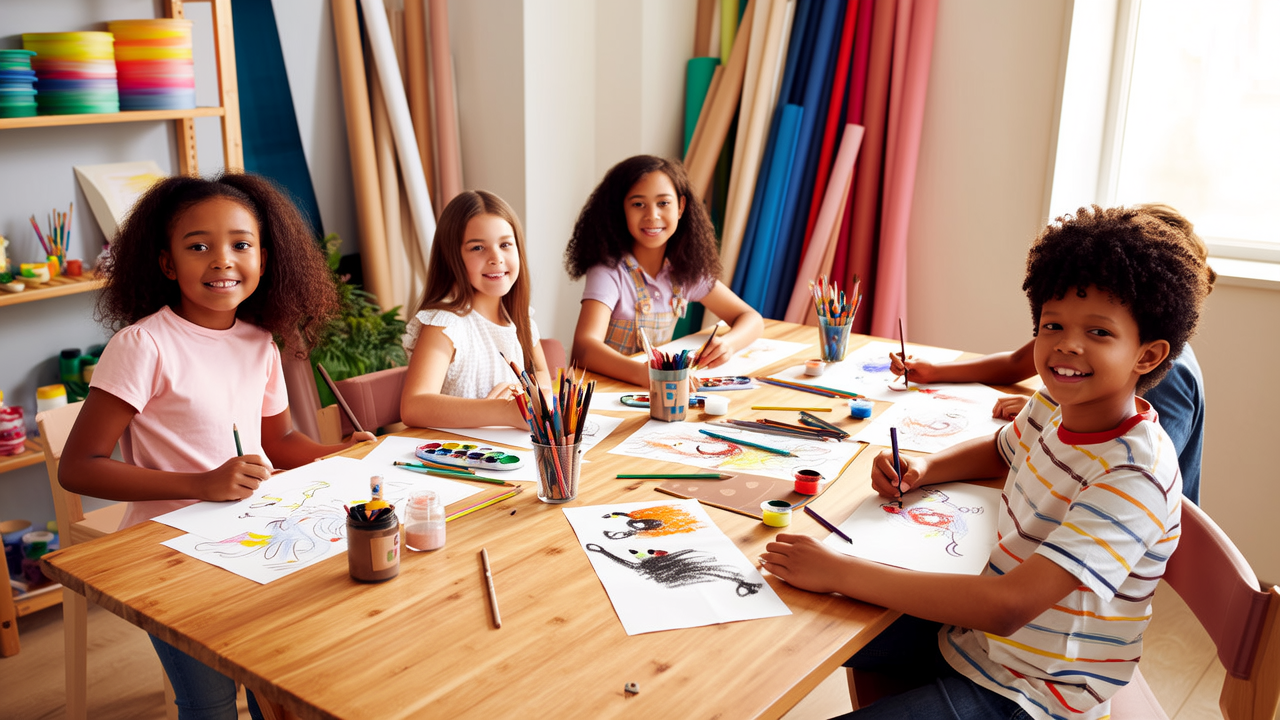
Drawing Techniques Every Kid Should Learn
Building Drawing Confidence
Drawing is a learnable skill, not just talent. These foundational techniques give children tools to draw anything they imagine.
1. Basic Shapes Foundation
Everything starts with circles, squares, triangles, and ovals. Practice drawing a cat: circle head, oval body, triangle ears. Break complex subjects into simple shapes.
2. Line Quality
Practice different line types: light sketch lines, confident outlines, crosshatching for texture. Light lines first, darken when satisfied with placement.
3. Shading and Values
Create a value scale from white to black in 5 steps. Practice shading spheres, cylinders, and cubes. Light source direction determines shadow placement.
4. One-Point Perspective
Draw a horizon line with a vanishing point. All lines converge there. Draw a road, buildings, or railroad tracks. Creates the illusion of depth.
5. Proportion and Measurement
Use pencil as measuring tool. Hold at arm's length, measure head size, compare to body. A person is about 7 heads tall.
6. Contour Drawing
Draw an object by following its edges slowly with your eyes while your pencil follows on paper. Don't look at the paper. Builds observation skills.
7. Negative Space
Draw the spaces between objects instead of the objects themselves. A chair drawn by its negative spaces often looks more accurate.
Practice Exercises
Blind Contour (5 min daily)
Draw your hand without looking at the paper. Results are funny but observation skills improve rapidly.
30-Second Gestures
Quick sketches capturing the essence of a pose or object. No details, just energy and movement.
Copy Masters
Recreate famous artworks. Study how artists solved drawing problems. Learning from the best.
Common Mistakes to Avoid
- Pressing too hard on initial lines
- Making symbols instead of observing
- Starting with details before overall shape
- Fearing mistakes instead of learning from them
More Articles
 How to Draw a Red Panda for Kids (2026)
 How to Draw Rudolph for Kids: Easy Step-by-Step Guide
 Clay Sculpting Projects for Children Ages 4-10
 Educational Toy Kits: Build Skills Through Purposeful Play
 Repairing Science: Rigor, Reproducibility & Trust
 How to Draw a Leopard for Kids (2026)
 Paper Plate Animal Crafts for Kids
 Watercolor for Kids: Beginner Techniques Guide
 STEM Learning Essentials by Age
 Arts & Crafts Teaching Strategies for K–12 and Community