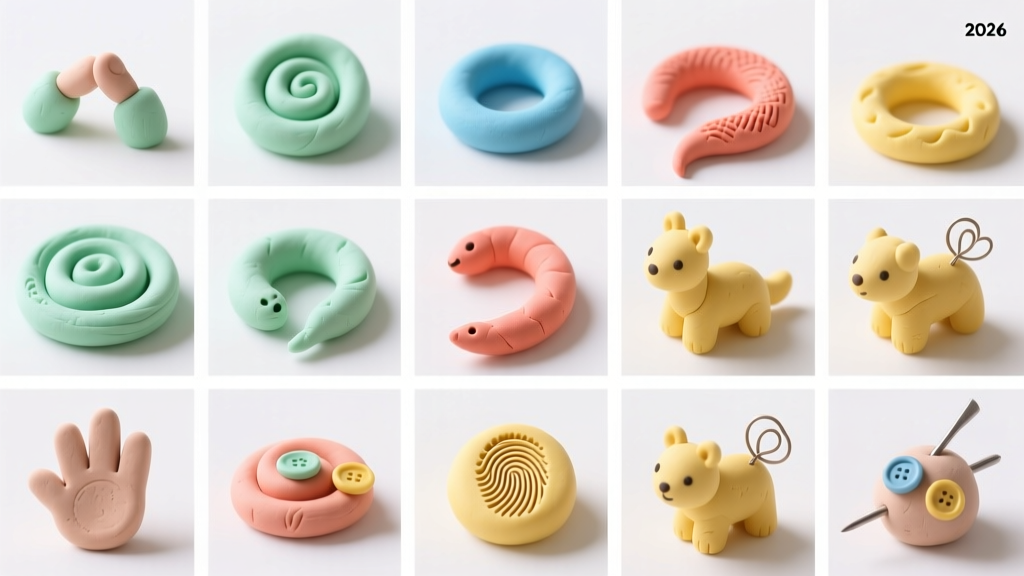
Clay Modeling for Fine Motor Skills (2026)
Fine Motor Skills Targeted by Clay Work
| Skill | Clay Action | Why It Matters |
|---|---|---|
| Hand strength | Squeezing, pressing | Pencil grip endurance |
| Pincer grasp | Pinching small details | Writing, buttoning, zipping |
| Bilateral coordination | Rolling with both hands | Cutting with scissors, tying shoes |
| Finger isolation | Making indentations | Typing, playing instruments |
| Wrist stability | Flattening, smoothing | Writing without fatigue |
15 Projects by Skill Level
Beginner (Ages 2-4): Basic Manipulation
1. Snake Rolling
Roll clay between palms into a long snake. Builds bilateral coordination and hand strength. Challenge: make it as long as possible without breaking.
2. Ball Rolling
Roll clay between palms into a sphere. Then between fingertips for tiny balls. Develops pincer grasp and graded force control.
3. Pancake Pressing
Flatten a ball between palms. Then use a rolling pin. Builds wrist stability and bilateral strength.
4. Pinch Pot
Start with a ball. Push thumb into center. Pinch walls outward while rotating. The classic first pottery project.
5. Cookie Cutter Shapes
Roll flat and use cookie cutters. Press firmly — builds hand strength. Decorate with beads or stamps.
Intermediate (Ages 5-7): Precision Work
6. Coil Pot
Roll multiple snakes. Stack in a spiral to build a pot. Smooth joints with fingers. Requires planning and patience.
7. Animal Figures
Build animals from basic shapes: ball body, snake legs, pinch ears. Develops 3D thinking and finger isolation.
8. Clay Beads
Roll small balls, poke holes with a straw. Let dry and string into necklaces. Precision pincer work.
9. Texture Stamping
Press leaves, shells, or textured fabrics into flat clay. Identifying and creating patterns.
10. Clay Garden
Create flowers (coil petals, ball centers), stems (snakes), and leaves (flattened pinches). Combine multiple techniques.
Advanced (Ages 8-12): Sculptural Thinking
11. Human Figure
Build proportional human forms. Use armature (wire) for support. Teaches anatomy and spatial planning.
12. Relief Sculpture
Build up shapes on a flat base. Create landscapes, scenes, or portraits. 2D-to-3D thinking.
13. Functional Pottery
Create bowls, pencil holders, or ring dishes that actually work. Understanding form follows function.
14. Clay Tiles
Roll flat, cut into squares. Carve designs with tools. Create a mosaic when multiple tiles are combined.
15. Mixed Media Sculpture
Combine clay with wire, fabric, found objects. Pushes creative boundaries and problem-solving.
Clay Types Compared
| Type | Best For | Pros | Cons |
|---|---|---|---|
| Playdough | Ages 2-4 | Soft, reusable, colorful | Dries out, not permanent |
| Air-dry clay | Ages 5+ | No kiln needed, paintable | Takes 24h to dry, can crack |
| Polymer clay | Ages 8+ | Detailed work, oven-baked | Needs baking, not food-safe |
| Ceramic clay | Ages 10+ | Professional results, food-safe | Needs kiln access |
More Articles
 How to Draw a Turtle for Kids (Ages 3–9)
 Draw a Kangaroo for Kids: 5 Simple Steps (2026)
 How Many Kids Did Pablo Picasso Have? (2026)
 How to Draw a Hippo for Kids (2026)
 How to Draw Harriet Tubman for Kids (2026)
 How to Draw a Monkey Easy for Kids (2026)
 Recycled Crafts: Easy Ideas for Kids
 How to Teach Art to Kids Without Burning Out
 Watercolor for Kids: Beginner Techniques Guide
 How to Draw a Snail for Kids: Stress-Free Art Guide