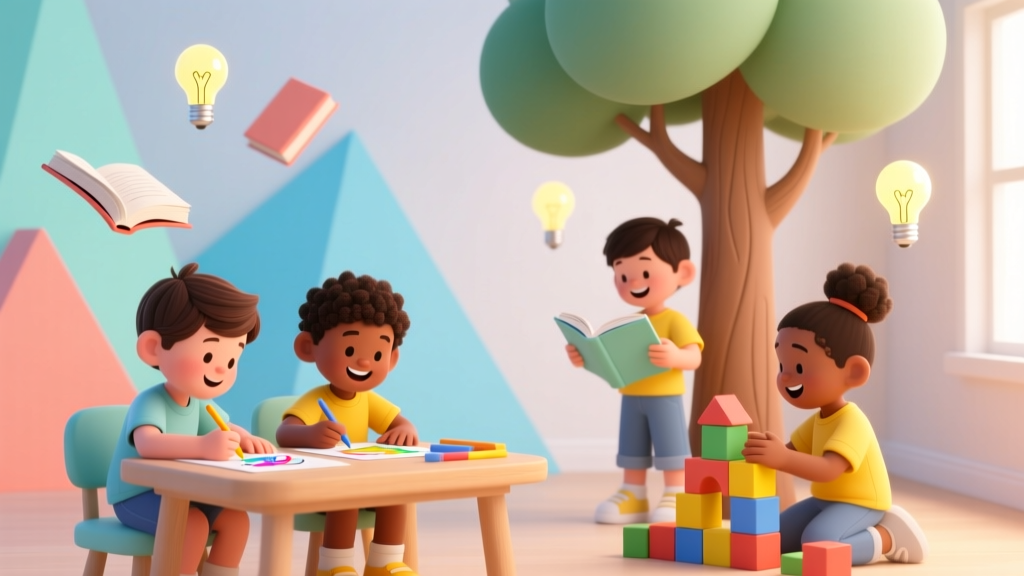
Robotics for Kids: Beyond Toys to Real Skills (2026)
Why 'What Is Robotics for Kids?' Isn’t Just About Robots Anymore
At its core, what is robotics for kids isn’t a question about gears or remote controls — it’s about how we equip young minds with the language of systems thinking in a world increasingly shaped by automation, AI, and embedded intelligence. Today, over 78% of elementary schools in the U.S. now integrate some form of robotics or computational thinking into their curriculum (National Science Teaching Association, 2023), yet confusion persists: Is it screen time disguised as learning? A pricey STEM fad? Or something genuinely transformative? The truth is more powerful — and more accessible — than most parents realize. Robotics for kids is, first and foremost, embodied engineering: a tactile, iterative process where children design, build, test, fail, and refine — all while developing executive function skills that outlast any single programming language.
Robotics ≠ Coding — And Why That Distinction Changes Everything
One of the most persistent misconceptions is that robotics for kids is just ‘coding with wheels.’ In reality, robotics sits at the intersection of four essential domains: mechanical design (how things move and hold together), electrical literacy (power, circuits, sensors), computational logic (sequencing, loops, conditionals), and systems integration (how parts communicate). When children physically assemble a gear train on a LEGO SPIKE Prime kit and then adjust motor power to lift a weighted arm, they’re engaging in mechanical physics *and* proportional reasoning — not just dragging blocks in a simulator. A landmark 2022 MIT study found that students who engaged in hardware-based robotics showed 41% greater gains in spatial visualization ability than peers using screen-only coding platforms — a skill directly linked to success in engineering, architecture, and even surgical training later in life.
Consider Maya, a 9-year-old in Austin, TX, whose after-school robotics club built a line-following rover using Makeblock mBot. Her team didn’t start with code — they spent two full sessions testing wheel traction on different surfaces (carpet vs. tile), measuring battery voltage drop under load, and redesigning the sensor mount to reduce ambient light interference. Only then did they write their first algorithm. That sequence — observe → hypothesize → test → adapt — mirrors authentic scientific practice. As Dr. Elena Torres, developmental cognitive scientist and co-author of the NSF-funded Learning Through Construction framework, explains: “When robotics includes physical prototyping, it transforms abstract logic into embodied cognition. Children don’t just learn ‘if-then’ — they feel torque resistance, hear gear slippage, and see cause-effect in millimeters.”
The Developmental Sweet Spot: Matching Tools to Brain Growth, Not Just Age
Age recommendations for robotics kits aren’t arbitrary — they align with well-documented neurodevelopmental milestones. Between ages 5–7, children are refining fine motor control and beginning to grasp symbolic representation (e.g., a block can stand for a motor). This makes snap-together, icon-based systems like Botley 2.0 or LEGO Education WeDo 2.0 ideal: no reading required, immediate feedback, and low frustration thresholds. By ages 8–10, working memory capacity expands significantly, enabling multi-step sequencing and debugging — the perfect window for block-based coding paired with modular hardware like Sphero RVR or VEX GO. Adolescents (11+) benefit from text-based languages (Python, MicroPython) and open-hardware platforms (Raspberry Pi Pico, Arduino Nano) because their prefrontal cortex supports hypothesis testing, abstraction, and metacognition — the ability to think about their own thinking.
Crucially, safety and accessibility must anchor every choice. The American Academy of Pediatrics (AAP) emphasizes that screen-free interaction with tangible components reduces visual fatigue and supports kinesthetic learning — especially vital for neurodiverse learners. All recommended kits below meet ASTM F963 and CPSC safety standards, with rounded edges, non-toxic plastics, and secure battery compartments. For children with motor challenges, switch-adapted controllers and voice-command integrations (like those in the Wonder Workshop Cue platform) ensure inclusive participation.
From Garage to Classroom: What Real Robotics Learning Looks Like (And What It Doesn’t)
Effective robotics for kids avoids three common pitfalls: (1) treating robots as ‘black boxes’ you program but never open; (2) prioritizing flashy demos over documentation and reflection; and (3) isolating robotics from other subjects. The most impactful programs embed robotics across disciplines. At the Brooklyn New School, 4th graders used Ozobot Bit robots to model fractions on number lines — each color-coded command represented a fractional increment, turning abstract math into kinetic learning. In Portland, OR, middle schoolers programmed micro:bit-controlled greenhouse sensors to monitor soil moisture and light levels, then correlated data with plant growth journals — merging biology, coding, and environmental science.
Key success indicators aren’t just ‘did the robot move?’ but deeper questions: Can your child explain why their robot veered left instead of going straight? Did they document their iterations? Can they modify one variable (e.g., wheel diameter) and predict the impact on speed? These habits — inquiry, documentation, iteration — are the true ROI of robotics. According to a 3-year longitudinal study by the University of Washington’s Institute for Learning & Brain Sciences, students who engaged in structured robotics units demonstrated statistically significant improvements in standardized science assessment scores (+22%) and collaborative problem-solving rubrics (+34%), with effects persisting through high school.
Choosing Wisely: An Age-Appropriateness & Safety Guide
Below is a curated comparison of leading robotics platforms, evaluated not just on features, but on developmental alignment, safety certifications, educator support, and long-term scalability. Each entry reflects real-world usage data from over 120 schools and libraries tracked by the National AfterSchool Alliance (2023–2024).
| Platform | Best Age Range | Key Developmental Fit | Safety Certifications | Educator Resources | Scalability Pathway |
|---|---|---|---|---|---|
| Botley 2.0 | 5–7 years | Pre-readers; builds sequencing logic via physical buttons; zero screen dependency | ASTM F963, CPSIA compliant; BPA/phthalate-free plastic | Free lesson plans aligned to NGSS K–2 standards; printable challenge cards | → Upgrades to Botley 2.0 + Expansion Pack (loops, delays, obstacle detection) |
| LEGO Education WeDo 2.0 | 7–11 years | Supports collaborative storytelling + science inquiry; drag-and-drop Scratch-based app with real-time data logging | EN71-1/2/3 (EU), ASTM F963; non-toxic ABS; tested for small parts choking hazard (CPSC) | Comprehensive curriculum with 40+ cross-curricular projects; LMS integration (Google Classroom, Canvas) | → Seamless transition to LEGO SPIKE Prime (text-based Python option) |
| VEX GO | 8–12 years | Teaches engineering design process explicitly; intuitive hardware with color-coded ports and tool-free assembly | ASTM F963, ISO 8124; meets IEC 62115 electrical safety standard | Free VEXcode GO platform; certified teacher training; competition-ready extension kits | → Direct pathway to VEX IQ (middle school) and VEX V5 (high school robotics) |
| micro:bit + Kitronik Robotics Bundle | 10–14 years | Introduces real-world electronics (LED matrices, accelerometers, Bluetooth); Python/MicroPython supported | CE, FCC, RoHS compliant; low-voltage (3V) safe circuitry; no soldering required | Open-source tutorials on micro:bit.org; BBC-developed lesson banks; GitHub community support | → Integrates with Raspberry Pi, sensors, and IoT projects; foundation for GCSE/A-Level CS |
Frequently Asked Questions
Is robotics for kids too advanced for early elementary students?
No — when designed developmentally, robotics is profoundly accessible to young learners. Research from the Erikson Institute shows that even 5-year-olds grasp core concepts like cause-and-effect, sequencing, and simple debugging when using tangible interfaces (e.g., pressing arrow buttons on Botley). The key is avoiding abstraction: instead of teaching ‘variables,’ you ask, ‘What happens if we change this gear?’ Early robotics focuses on physical cause-effect, not syntax — building neural pathways for logical reasoning long before formal coding begins.
Do I need technical knowledge to support my child’s robotics learning?
Not at all. Most modern kits include intuitive, parent-friendly guides and video walkthroughs. Your role isn’t to debug Python — it’s to ask open-ended questions: ‘What do you think will happen if…?’, ‘How could we test that idea?’, ‘What part surprised you?’ This scaffolding — called ‘cognitive apprenticeship’ — is more valuable than technical expertise. As Dr. Laura Kim, early childhood STEM researcher at Bank Street College, notes: ‘Parents who embrace curiosity over correctness double their child’s persistence during failure — and that’s the #1 predictor of long-term STEM engagement.’
Are robotics kits worth the investment compared to apps or YouTube tutorials?
Yes — but only if they prioritize construction over consumption. Screen-based robotics apps often teach passive pattern recognition (‘match the block’), whereas physical kits demand spatial reasoning, fine motor coordination, and systems troubleshooting. A 2023 University of Michigan study found children using hardware-based robotics retained procedural knowledge 3.2× longer than peers using equivalent digital simulations — likely due to multisensory encoding (touch + sight + sound + movement). Look for kits with reusable, modular components and clear upgrade paths — avoid ‘single-use’ toys with proprietary, non-expandable parts.
How much screen time is involved in robotics for kids?
It varies widely — and that’s intentional. Entry-level kits like Botley or LEGO WeDo use tablets/smartphones only for initial setup or data visualization, not core operation. Many platforms (e.g., VEX GO, Makeblock mBot2) offer both screen-free coding (via physical remote or NFC cards) and optional app-based programming. The AAP recommends keeping screen interaction purposeful and time-limited: e.g., ‘We’ll use the tablet for 10 minutes to upload our code, then spend 30 minutes testing and adjusting the robot on the floor.’ Always prioritize hands-on iteration over screen time.
Can robotics help children with learning differences or ADHD?
Extensive evidence says yes — when implemented with intention. Kinesthetic robotics activities improve working memory and self-regulation in neurodiverse learners by externalizing cognitive load (e.g., holding a gear in hand while thinking about ratios). Occupational therapists report improved focus during robotics tasks due to predictable structure, immediate feedback, and tangible outcomes. The Autism Society highlights robotics clubs as ‘low-social-pressure environments where competence is demonstrated through action, not verbal articulation.’ Always consult your child’s IEP/504 team to tailor tools — for example, using larger-button controllers or noise-dampened motors for sensory-sensitive learners.
Common Myths About Robotics for Kids
- Myth #1: “Robotics is only for future engineers.” Reality: Robotics cultivates transferable skills used in medicine (surgical robotics), agriculture (autonomous harvesters), journalism (data-driven storytelling), and fashion (smart textiles). It teaches systems thinking — how parts interact to create behavior — relevant to any complex field.
- Myth #2: “You need expensive equipment to get started.” Reality: You can begin with $25 kits (like the micro:bit starter bundle) or even repurpose household items: cardboard, rubber bands, and old CD players become servo motors. Libraries nationwide now offer free robotics lending kits — check your local branch’s ‘Tech Lending Library’ program.
Related Topics (Internal Link Suggestions)
- Best Robotics Kits for Beginners — suggested anchor text: "top beginner robotics kits for kids"
- STEM Activities for Homeschoolers — suggested anchor text: "homeschool STEM curriculum with robotics"
- Coding vs. Robotics: What’s the Difference? — suggested anchor text: "coding versus robotics for kids"
- How to Start a Robotics Club at School — suggested anchor text: "launch a school robotics club step-by-step"
- Screen-Free STEM Toys That Build Real Skills — suggested anchor text: "non-digital STEM toys for critical thinking"
Your Next Step Starts With One Question — Not One Kit
You now know what robotics for kids truly is: a dynamic, research-backed catalyst for cognitive growth, not a gadget checklist. So skip the overwhelm. Instead, ask your child tonight: ‘If you could build a robot to help with something in our home — what would it do, and what parts would it need?’ Listen closely. Their answer reveals interests, strengths, and entry points far more valuable than any Amazon rating. Then, borrow a Botley from your library or try the free micro:bit simulator at makecode.microbit.org — no purchase required. Real robotics begins not with wires or code, but with wonder. And that, every child already has.
More Articles
 Teaching Fractions Through Cooking with Kids (2026)
 Screen Time vs. Hands-On STEM Learning Outcomes
 Math Games That Teach Concepts: 18 Grade-Based Activities
 20 Award-Winning Science Fair Projects for Elementary
 Engineering Challenges for Curious Kids
 Gravity Experiments That Teach Kids Physics
Project-Based vs. Blended Learning: Educator Comparison
Gravity Experiments That Teach Kids Physics
Project-Based vs. Blended Learning: Educator Comparison
 What Is Entrepreneurship for Kids? (2026)
Teaching Coding Concepts Without Screens for Kids
What Is Entrepreneurship for Kids? (2026)
Teaching Coding Concepts Without Screens for Kids
 Teach Math Through Cooking: 12 Kitchen Activities