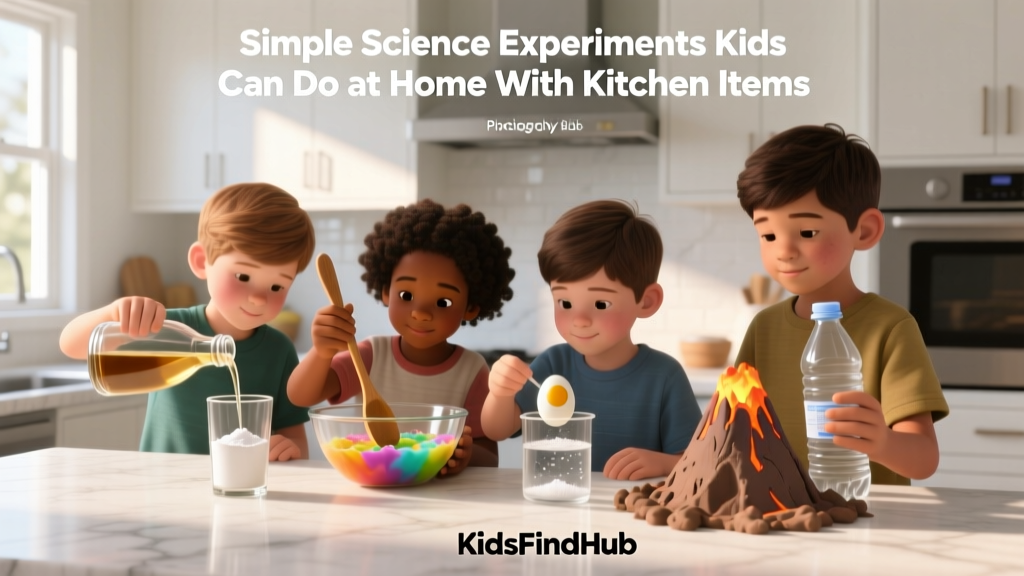
Simple Science Experiments with Kitchen Items
Turn Your Kitchen Into a Science Lab
You don't need expensive equipment or a fancy laboratory to conduct real science experiments. Your kitchen is full of materials that can demonstrate fundamental scientific principles in exciting, hands-on ways. These experiments are safe, affordable, and guaranteed to spark your child's curiosity about how the world works.
Experiment 1: Volcano Eruption (Chemical Reactions)
Combine baking soda and vinegar in a container to create a dramatic volcanic eruption. This demonstrates acid-base reactions and gas production. Add food coloring for visual impact and dish soap for extra foam. Discuss why the reaction occurs and what gas is being produced.
Experiment 2: Rainbow Density Tower (Density and Buoyancy)
Carefully layer different liquids — honey, corn syrup, dish soap, water, and vegetable oil — in a clear glass. Each liquid has a different density, creating beautiful layers. Drop small objects in to see where they settle. This teaches about density and molecular structure.
Experiment 3: Invisible Ink (Oxidation)
Write secret messages with lemon juice on white paper. Let it dry completely, then reveal the message by gently heating the paper with a hair dryer or holding it near a light bulb. The citric acid oxidizes when heated, turning brown. Discuss oxidation reactions in everyday life.
Experiment 4: Non-Newtonian Fluid (States of Matter)
Mix cornstarch with water to create oobleck — a substance that acts as both solid and liquid. Punch it and it feels solid; slowly sink your hand in and it flows like liquid. This challenges children's understanding of states of matter and introduces them to complex fluids.
Experiment 5: Crystal Growing (Solutions and Saturation)
Dissolve sugar or salt in hot water until no more will dissolve. Suspend a string in the solution and watch crystals form over several days. Discuss saturation, evaporation, and crystal structure. Compare crystal shapes from different substances.
The Scientific Method for Young Minds
Teach children to follow the scientific method with every experiment:
- Ask a question about what might happen
- Make a prediction (hypothesis)
- Conduct the experiment carefully
- Observe and record results
- Draw conclusions and discuss
Extending the Learning
After each experiment, ask open-ended questions: What would happen if we changed something? Can you think of other examples of this in real life? How could we test a different idea? This develops critical thinking and encourages independent scientific inquiry.
More Articles
 Fun Engineering Challenges with Household Items
 Hands-On STEM Crafts for Foundational Learning
 Fun Magnet Activities for Kids
 Coding Games for Kids Ages 6-10
 How Volcanoes Form for Kids: Fun NGSS-Aligned Science
 Nuclear Energy for Kids: Simple, Safe & STEM-Ready
 STEM Learning Trends 2026: Real-World, AI & Equity Focus
 Is Sid the Science Kid Autistic? Experts Weigh In
 How Block Play Builds Early Math Skills in Toddlers
 How to Make a Video Game for Kids (2026)