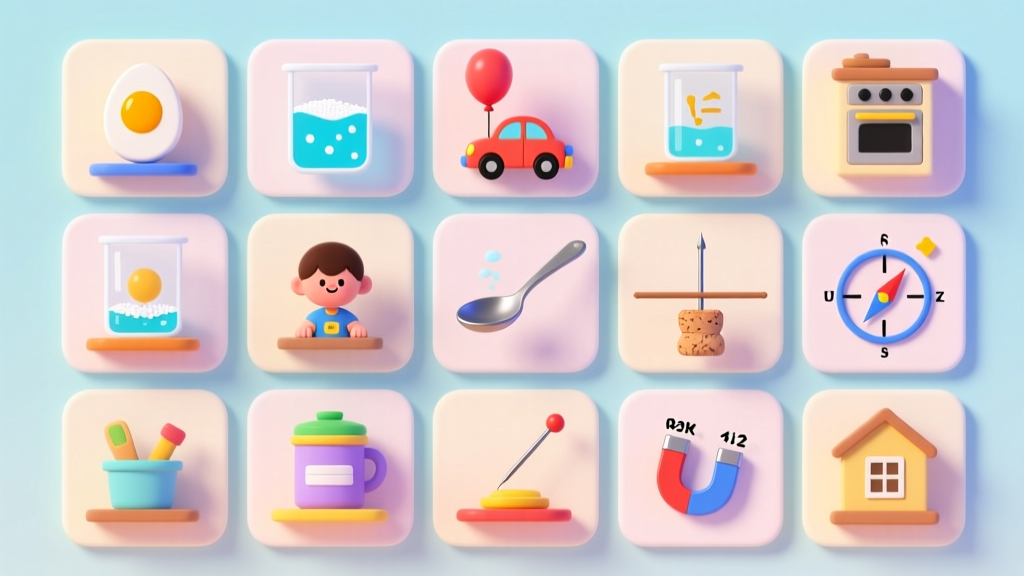
Simple Physics Experiments Kids Can Do at Home
Physics doesn't need a laboratory — your kitchen is already one. As a STEM curriculum designer and dad of three, I've tested hundreds of experiments with kids. The best ones use what you already have and produce results that make children gasp, laugh, and ask "WHY?!" — which is exactly the moment real learning begins.
15 Physics Experiments with Kitchen Items
1. The Unpoppable Balloon (Air Pressure)
Materials: Balloon, skewer, tape. Age: 5+.
Place a piece of tape on the balloon, then push the skewer through the taped area. The tape prevents the rubber from tearing, and the balloon stays inflated. This demonstrates how pressure distributes across a surface.
2. Dancing Raisins (Buoyancy & Gas)
Materials: Clear soda (Sprite/7Up), raisins, glass. Age: 4+.
Drop raisins into carbonated water. Bubbles attach to the rough raisin surface, lifting them to the top. At the surface, bubbles pop, and raisins sink again. Continuous cycle for 10+ minutes of observation.
3. Egg in a Bottle (Air Pressure)
Materials: Hard-boiled egg (peeled), glass bottle with narrow neck, matches. Age: 8+ (adult supervision).
Light a small piece of paper, drop it in the bottle, place the egg on top. As the fire consumes oxygen and air cools, pressure drops and the egg is pushed into the bottle. Classic demonstration of atmospheric pressure.
4. Homemade Lava Lamp (Density & Polarity)
Materials: Vegetable oil, water, food coloring, Alka-Seltzer. Age: 4+.
Fill a glass 2/3 with oil, add water, drop in food coloring (it passes through oil to water). Add Alka-Seltzer for bubbling "lava" action. Teaches density and oil-water immiscibility.
5. Straw Oboe (Sound Waves)
Materials: Plastic straw, scissors. Age: 5+.
Flatten one end of a straw and cut it into a V-shape. Blow through the flattened end to create sound. Cut the straw shorter to change pitch. Demonstrates how vibrating air columns produce sound at different frequencies.
The Science Behind Each Experiment
| Experiment | Physics Concept | Real-World Application |
|---|---|---|
| Unpoppable balloon | Pressure distribution | Snowshoes, building foundations |
| Dancing raisins | Buoyancy, gas solubility | Submarines, deep-sea diving |
| Egg in bottle | Atmospheric pressure | Vacuum sealers, suction cups |
| Lava lamp | Density, polarity | Oil spills, salad dressing |
| Straw oboe | Sound waves, frequency | Musical instruments, acoustics |
Frequently Asked Questions
Are these experiments safe for young children?
All experiments listed are safe with basic supervision. The egg-in-bottle experiment requires adult help with matches. Always supervise children with small items (raisins, marbles) for choking risk under age 3.
How do I extend learning beyond the experiment?
Ask prediction questions: "What do you think will happen if we use salt water instead?" Change one variable at a time and observe differences. This is the scientific method in action.
The Bottom Line
Physics is the study of how the universe works, and your kitchen is the perfect laboratory. These experiments create "aha!" moments that textbooks can't match. The goal isn't memorizing formulas — it's developing a habit of asking "why?" and finding answers through experimentation.
More Articles
 Kitchen Science Experiments for Kids (Safe DIY)
 12 Low-Cost STEM Activities Under $5 Per Student
 STEM Learning Platforms for K-12 Educators
 How to Make Volcano for Kids: Safe, Real Science (2026)
 Fun Facts for Kids: 27 Mind-Blowing Truths (2026)
 Is Sid the Science Kid Autistic? Experts Weigh In
 Is Wild Kratts Good for Kids? (2026)
 Make a Compass for Kids: 5 Safe, Science-Backed Methods
 Popsicle Stick Bridge Building for Kids
 Safe Physical Interaction in Education Settings