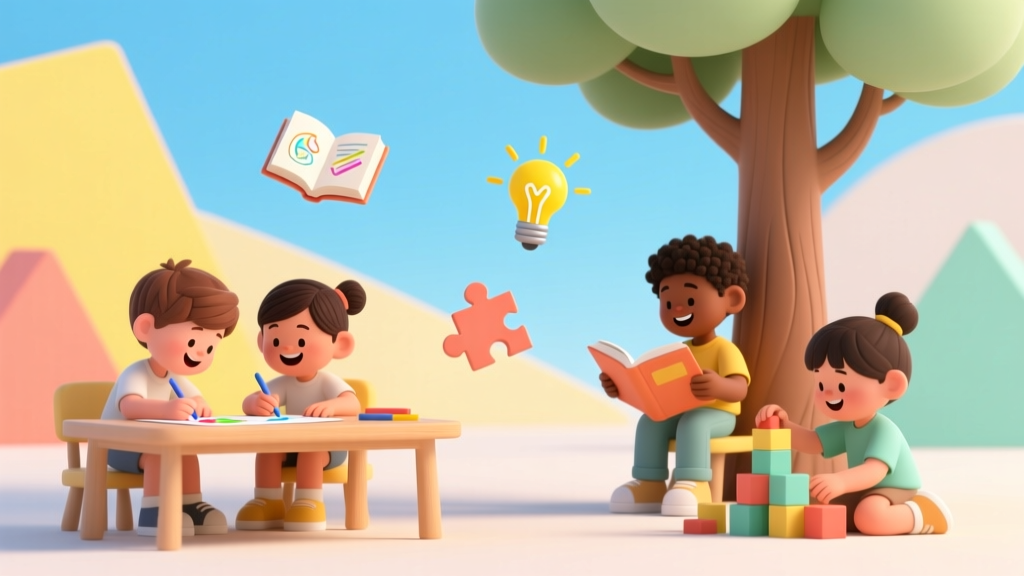
When Do Kids Start Asking Why? (2026)
Why That First 'Why?' Changes Everything
The exact moment when do kids start asking why isn’t just a cute anecdote—it’s one of the most significant inflection points in early cognitive development. Most children utter their first genuine 'why?' between 24 and 30 months, though some begin as early as 21 months and others wait until 36 months. This isn’t random babble; it’s the audible emergence of causal reasoning—the foundational skill behind scientific thinking, moral judgment, and problem-solving. In today’s world—where misinformation spreads faster than facts and critical thinking is increasingly rare—how parents respond to those relentless 'whys' directly shapes whether a child grows into someone who seeks evidence or accepts authority blindly. And yet, many caregivers feel unprepared: overwhelmed by repetition, unsure if answers are 'good enough,' or worried they’re accidentally shutting down curiosity. This guide gives you what textbooks and parenting blogs often miss: not just the 'when,' but the 'why behind the why'—and exactly how to turn every question into a relationship-building, brain-building opportunity.
The Developmental Science Behind the 'Why' Explosion
That first 'why?' isn’t about vocabulary—it’s about metacognition in embryo. According to Dr. Alison Gopnik, developmental psychologist and author of The Scientist in the Crib, toddlers’ 'why' questions mark the shift from learning what is (e.g., 'dog,' 'ball') to learning how things work. Brain imaging studies show a surge in activity in the prefrontal cortex and anterior cingulate cortex between 22–30 months—regions tied to hypothesis testing, error detection, and causal inference. At this stage, children aren’t seeking textbook answers; they’re running mental experiments: 'If I drop this cup, will it always break? Why did Mommy say no *this time* but yes *last time*?'
A landmark longitudinal study published in Child Development (2021) tracked 187 children from 18–48 months and found that frequency of 'why' questions at 28 months strongly predicted vocabulary growth at age 5 and executive function scores at age 7—even after controlling for socioeconomic status and parental education. Crucially, the *quality* of adult responses mattered more than quantity: children whose caregivers used explanatory language ('The water boils because heat makes molecules move faster') outperformed peers whose caregivers gave only descriptive answers ('It’s hot') by 22% on analogical reasoning tasks at age 6.
Here’s what’s happening beneath the surface:
- Language scaffolding: 'Why' requires understanding cause-effect syntax—a grammatical leap beyond labeling or requesting.
- Epistemic trust building: Each answered 'why' teaches the child whether adults are reliable sources of knowledge.
- Social calibration: Kids test boundaries by asking 'why' about rules—'Why can’t I eat candy now?' is really 'How much power do I have in this relationship?'
What to Say (and What to Skip) in the Heat of the Moment
When your 2.5-year-old asks 'Why is the sky blue?' for the 17th time while you’re trying to pack lunches, instinct says: 'Because light bends!' or 'Just because!' Neither works long-term. Research from the University of Michigan’s Early Childhood Communication Lab shows that effective responses follow three non-negotiable principles: accuracy scaled to age, invitation to co-inquiry, and emotional containment.
Try this instead:
"That’s such a smart question—I love how you notice things! Let’s look together. See how sunlight has tiny colors inside it? When it hits the sky, the blue part bounces around more than red. Want to try mixing paints to see which colors make blue?"
This response does four things at once: validates effort ('smart question'), names the skill being used ('notice things'), offers a simplified but truthful mechanism ('blue part bounces more'), and transfers agency ('want to try?'). It avoids two common pitfalls: oversimplification ('it just is') and overcomplication ('Rayleigh scattering occurs when…').
Here’s what to skip—and why:
- 'I don’t know' without follow-up: Signals knowledge gaps are dead ends. Instead: "I’m not sure—let’s find out together tomorrow at the library."
- Answering with another question: 'Why do you think?' frustrates young children who lack abstract reasoning. Better: "Let’s test it!" followed by a concrete experiment.
- Shutting down with 'because I said so': Undermines epistemic trust. AAP guidelines explicitly warn against using authority as explanation before age 5—it correlates with lower academic motivation later.
Real-world case study: Maya, a preschool teacher in Portland, implemented 'Why Response Cards' for her staff—color-coded prompts for different scenarios (e.g., blue card = science question, green card = social rule, yellow card = emotion question). After 3 months, teacher-reported stress during inquiry moments dropped 41%, and parent surveys showed 68% noted increased child-initiated explanations at home.
Turning 'Why' Into Lifelong Learning Habits
Repetition isn’t redundancy—it’s reinforcement. A child asking 'Why do leaves fall?' 12 times isn’t being difficult; they’re consolidating neural pathways. The goal isn’t to 'answer all questions' but to build a curiosity infrastructure: routines, tools, and rituals that make inquiry self-sustaining.
Start with these evidence-backed habits:
- Create a 'Wonder Jar': Decorate a jar where anyone can drop written or drawn questions. Review weekly—choose 1–2 to investigate together using books, nature walks, or simple experiments. This teaches question curation and delayed gratification.
- Model intellectual humility: Verbally narrate your own learning: "I thought bees made honey from flowers—but actually, they make it from nectar! I learned that from a documentary. Isn’t it cool how we get to change our minds?"
- Introduce 'question ladders': Teach kids to level up questions: Level 1 (What is it?) → Level 2 (How does it work?) → Level 3 (What if…?). Use picture books like Ada Twist, Scientist to show characters climbing this ladder.
Importantly, protect space for unanswered questions. Dr. Roberta Golinkoff, child language expert at the University of Delaware, emphasizes: "The most powerful response to 'why' is sometimes silence—followed by 'What do you think?' That pause builds neural stamina for uncertainty, a critical skill in an AI-driven world."
| Age Range | Typical 'Why' Patterns | Developmental Purpose | Parent Action Plan | Risk If Unsupported |
|---|---|---|---|---|
| 22–27 months | 1–3 'whys' per day; often about immediate sensory experiences ('Why wet?', 'Why loud?') | Testing cause-effect in physical world; linking words to mechanisms | Use gesture + simple cause phrases ('Water spills because cup tipped') | Delayed language development; reduced exploratory play |
| 28–36 months | 10–50+ 'whys' daily; questions about rules, emotions, and social norms ('Why cry?', 'Why bedtime?') | Building theory of mind; mapping internal states to external causes | Label feelings + causes ('You’re sad because your tower fell. That’s frustrating!') | Emotional dysregulation; difficulty with transitions |
| 37–48 months | Chains of 'why' ('Why sky blue?' → 'Why light bend?' → 'Why sun shine?'); hypotheticals ('What if no sun?') | Developing counterfactual reasoning; integrating multiple causal systems | Introduce 'sometimes/always' language; use storybooks with cause chains | Black-and-white thinking; anxiety about uncontrollable events |
| 4–6 years | Questions about morality, identity, and existence ('Why am I me?', 'Why do people die?') | Forming personal philosophy; seeking existential coherence | Validate emotion first; offer age-appropriate metaphors; admit complexity ('Some questions grown-ups still wonder about too') | Existential anxiety; withdrawal from conversation |
Frequently Asked Questions
Is it normal for my 2-year-old to ask 'why' 200 times a day?
Absolutely—and it’s a brilliant sign. Research from the University of Washington shows peak 'why' frequency occurs at 32 months, averaging 107 questions per hour during waking hours. While exhausting, this flood indicates robust language processing, working memory development, and secure attachment (children ask more questions with caregivers they trust). Track patterns: if questions cluster around transitions (meals, bedtime) or involve distress cues (crying, clinging), it may signal unmet needs—not just curiosity. Try naming the underlying need: "You’re asking 'why bedtime?' because you want more time with me. How about 3 extra minutes of snuggles?"
My child stopped asking 'why' suddenly at age 4. Should I be concerned?
Sudden cessation warrants gentle exploration—but isn’t automatically alarming. Possible causes include: hearing issues (ask your pediatrician for a screening), language processing fatigue (common after speech therapy milestones), or environmental shifts (new sibling, school transition). More concerning is if questioning stops alongside reduced eye contact, loss of vocabulary, or social withdrawal. Per AAP guidelines, consult a developmental pediatrician if 'why' disappears AND there’s regression in other domains. Often, it’s temporary: one mom reported her daughter paused questioning for 6 weeks after starting preschool—then returned with sophisticated 'how' and 'what if' questions.
Are 'why' questions less common in bilingual children?
No—bilingual children ask 'why' at the same developmental timeline, but may code-switch or use simpler grammar initially. A 2023 study in Journal of Child Language found bilingual 3-year-olds asked 15% more 'why' questions overall, distributing them across both languages. Key insight: Don’t translate questions—respond in the language the child used. If they ask '¿Por qué el cielo es azul?' answer in Spanish, even if you’re more fluent in English. This reinforces that both languages are valid knowledge vehicles. Bonus: Bilingual 'why' askers show stronger cognitive flexibility on standardized tests by age 7.
How do I handle 'why' questions about scary topics (death, divorce, violence)?
First, breathe. Children’s 'why' about hard topics seeks safety—not encyclopedic detail. AAP recommends the '3 Cs': Clear (use concrete terms—'Grandpa’s body stopped working'), Consistent (repeat key facts calmly), and Connected (reaffirm love and routine: 'We’ll still read stories every night'). Avoid euphemisms ('sleeping forever')—they create confusion and fear. For media-induced questions, limit exposure and co-view: 'That news story was scary. Let’s talk about what’s true and what helps us feel safe.' One therapist’s script: 'That’s a heavy question. My job is to keep you safe. Right now, we’re safe here together.'
Does screen time reduce 'why' questioning?
Yes—but context matters. Passive streaming (background TV, autoplay videos) correlates with 34% fewer spontaneous questions in toddlers (JAMA Pediatrics, 2022). However, interactive video calls with grandparents or educational apps that prompt 'What do you think happens next?' show neutral or positive effects. The critical factor is joint attention: if screens displace conversational turns, curiosity suffers. Try the '20-20-20 rule': every 20 minutes of screen time, spend 20 seconds asking 'What surprised you?' and 20 seconds listening without correcting.
Common Myths
Myth 1: 'Why' questions mean the child is being defiant or manipulative.
Reality: Neuroimaging confirms 'why' activates reward centers—not rebellion circuits. Defiance involves refusal to comply; 'why' involves active engagement with logic. Labeling curiosity as defiance teaches children to suppress questions—and research links this suppression to lower academic achievement by middle school.
Myth 2: Answering 'why' too much will spoil a child's independence.
Reality: The opposite is true. A longitudinal study tracking 120 families found children whose caregivers consistently explained 'why' were 2.3x more likely to independently solve novel problems at age 8. Explanation builds mental models—tools for independent thinking—not dependency.
Related Topics (Internal Link Suggestions)
- How to Respond to 'I Don't Know' Questions — suggested anchor text: "helpful responses when you truly don't know the answer"
- Best Books to Nurture Curiosity in Toddlers — suggested anchor text: "science-backed picture books that spark 'why' thinking"
- When Do Kids Understand Cause and Effect? — suggested anchor text: "the developmental timeline for causal reasoning"
- Screen Time Guidelines by Age (AAP) — suggested anchor text: "evidence-based limits for digital media use"
- Signs of Advanced Language Development — suggested anchor text: "beyond vocabulary: what true linguistic precocity looks like"
Your Next Step Starts With One Question
That first 'why?' isn’t the beginning of a long road—it’s the opening of a door. Every time you pause, kneel to their eye level, and say 'Tell me more about what you’re wondering,' you’re doing far more than answering a question. You’re wiring their brain for resilience, building trust that lasts decades, and modeling how to engage with complexity without fear. So tonight, when your child asks 'Why do stars twinkle?' for the fifth time, try this: 'I love that question. Let’s look at the stars together after dinner—and I’ll tell you what scientists discovered about twinkling light.' Then keep the jar open. Because the real magic isn’t in having all the answers—it’s in nurturing the courage to keep asking.
More Articles
 What Age Do Kids Start Writing? (2026)
 How Many Kids Does Katy Perry Have? (2026)
 Can Kids Go to Twin Peaks? (2026) — Parent Guide
 How Many Kids Does Ciara Have? Family Insights (2026)
 How Many Kids Does Amber Portwood Have? (2026)
 How Old Are P Diddy’s Kids in 2026? Parenting Insights
 How Much Caffeine Is Safe for Kids? (2026)
 When Do Kids Stop Going to Pediatrician?
 Object Permanence in Babies: What to Watch For (2026)
 What Does 67 Mean? Gen Alpha Slang Guide (2026)