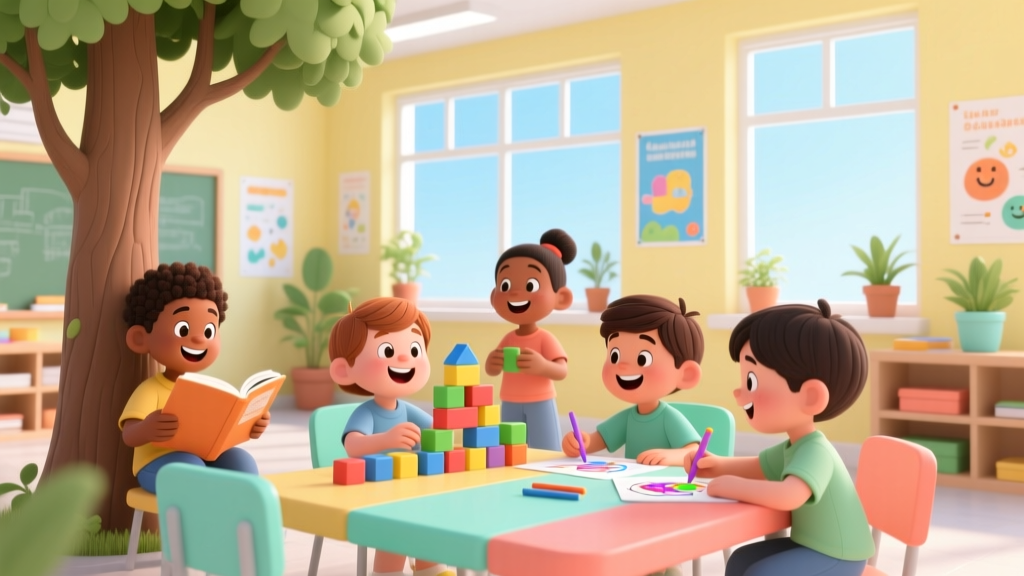
When Do Kids Learn to Write Their Name? (2026)
Why This Milestone Feels So Big (And Why It Shouldn’t Keep You Up at Night)
When do kids learn to write their name is one of the most frequently searched questions among parents of preschoolers—and for good reason. That first shaky signature on a birthday card, a labeled cubby at preschool, or a proudly displayed 'M-Y N-A-M-E' on the fridge feels like a tangible marker of readiness: for kindergarten, for independence, for 'being a big kid.' But here’s what most online resources don’t tell you: there’s no universal calendar date when this skill clicks—and obsessing over timing can unintentionally undermine the very skills your child needs to thrive. According to the American Academy of Pediatrics (AAP), name writing emerges from a complex interplay of visual-motor integration, hand strength, letter knowledge, and intrinsic motivation—not memorization or pressure. In fact, research published in Early Childhood Research Quarterly found that children who were encouraged through play-based practice (not drill-and-kill worksheets) demonstrated stronger long-term handwriting fluency and spelling confidence—even if they wrote their names six months later than peers.
What’s Really Happening Between Ages 2–6: A Developmental Roadmap
Name writing isn’t a single ‘aha!’ moment—it’s a layered progression built on foundational skills most parents don’t realize they’re already nurturing. Let’s break down what’s unfolding neurologically and physically at each stage:
- Ages 2–3: Your child isn’t ‘learning to write’ yet—they’re building the engine. Scribbling with purpose (vertical/horizontal lines, circles), stacking blocks, turning pages, and using child-safe scissors all strengthen the small muscles in the hand and wrist needed for pencil control. At this stage, ‘writing their name’ may look like a confident swirl labeled “That’s my name!”—and that counts. Dr. Jane Williams, pediatric occupational therapist and co-author of Handwriting Without Tears: Early Foundations, emphasizes: “If a 3-year-old points to their scribble and says, ‘This is me,’ they’re demonstrating symbolic understanding—the cognitive bedrock of literacy.”
- Ages 3–4: Letter recognition begins to merge with motor planning. Children often start with the first letter of their name (especially if it’s simple—‘A’, ‘T’, ‘L’) or letters with straight lines. They may reverse ‘b’/‘d’ or write ‘M’ backward—this is neurotypical, not a sign of dyslexia. What matters more is whether they attempt consistently, hold the pencil with a dynamic tripod grasp (thumb + index + middle finger), and show interest in copying marks.
- Ages 4–5: This is the ‘sweet spot’ where most children begin forming recognizable letters—though order varies wildly. Some write uppercase only; others mix upper/lowercase. Spacing is inconsistent, and ‘E’ might look like an ‘F’. Crucially, many children at this age self-correct when shown a model—proof their visual-motor system is integrating.
- Ages 5–6: By kindergarten’s end, ~75% of U.S. children can write their full name legibly in uppercase or mixed case, per data from the National Center for Education Statistics (2023). But 25% still need support—and that’s completely within typical development. What predicts long-term success isn’t speed or neatness, but whether the child can sustain attention during writing tasks and self-advocate (“My hand hurts—I need a break”).
3 Evidence-Based Strategies That Work (And 2 That Don’t)
Forget tracing dotted lines or endless alphabet drills. Real progress happens when writing feels meaningful, playful, and physically accessible. Here’s what pediatric OTs and early literacy specialists actually recommend:
- Make It Spatially Concrete: Use tactile materials that engage multiple senses. Try writing names in shaving cream on a tray, forming letters with pipe cleaners, or stamping initials with foam letters. A 2022 University of Washington study showed children who practiced letter formation with multi-sensory input retained letter shapes 40% longer than those using paper-only methods.
- Anchor to Identity & Purpose: Instead of “Write your name,” try “Let’s label YOUR water bottle so no one takes it!” or “Sign the birthday card for Grandma—you’re the artist!” When writing serves a real function, motivation skyrockets. One Montessori preschool in Portland tracked 12 children who struggled with name writing; after introducing personalized name tags for lunch boxes and art portfolios, 11 independently wrote their names within 3 weeks.
- Focus on Hand Strength First: If your child fatigues quickly or grips too tightly, skip pencil work for 2 weeks. Build endurance with play-dough pinch rolls, clothespin games, tearing paper into strips, or using spray bottles to water plants. As Dr. Elena Ruiz, a board-certified pediatric occupational therapist, explains: “You wouldn’t ask someone to run a marathon before they could walk a block. Same logic applies to the hand.”
Strategies to avoid:
- Correcting every letter reversal: Reversals are normal until age 7. Constant correction signals ‘you’re doing it wrong,’ which dampens risk-taking—a key ingredient in learning.
- Comparing to siblings or classmates: Neurodiversity means timelines vary widely. A 2021 longitudinal study in Pediatrics found children whose parents avoided comparisons developed significantly higher self-efficacy in academic tasks by Grade 2.
When to Pause and Pivot: Red Flags vs. Normal Variation
It’s natural to wonder, “Is my child behind?” But context matters more than chronology. Below is a clear, clinically validated distinction between expected variation and signs warranting gentle professional consultation:
| Age | Typical Behavior | Consider Gentle Support If… | Action Step |
|---|---|---|---|
| 3 years | Scribbles with intent; copies vertical/horizontal lines; imitates circle | No imitation of lines/circles by 36 months; avoids all mark-making; extreme grip tension (white knuckles, clenched jaw) | Consult pediatrician for sensory-motor screening; introduce play-dough, finger painting, and resistive activities |
| 4 years | Copies square; draws person with 2–4 body parts; attempts first letter of name | No interest in drawing/writing despite modeling; cannot hold crayon with thumb/index/middle; struggles with buttons/zippers | Request OT evaluation through school district (free under IDEA) or private pediatric OT |
| 5 years | Prints some letters; writes first name with help; copies triangle | Cannot copy any letters; reverses >50% of letters consistently; avoids writing tasks entirely; complains of hand pain during short tasks | Comprehensive OT assessment + vision screening (some ‘handwriting issues’ stem from undetected convergence insufficiency) |
| 6 years | Writes full name legibly; prints most letters correctly; uses dominant hand consistently | Still writing entire name in mirror-image; cannot write own name after repeated modeling; significant fatigue after 2 minutes of writing | Full educational evaluation including fine motor, visual processing, and phonological awareness testing |
Frequently Asked Questions
Can handwriting difficulties be a sign of dyslexia?
Not necessarily—and this is a critical misconception. Dyslexia primarily affects phonological processing (sound-letter mapping), not motor skills. While some children with dyslexia also have dysgraphia (a writing-specific learning difference), many struggle with spelling or reading fluency while writing their name beautifully. Conversely, poor handwriting alone doesn’t indicate dyslexia. According to Dr. Sally Shaywitz, co-director of the Yale Center for Dyslexia & Creativity, “Dyslexia is diagnosed through oral language tasks—rhyming, blending sounds—not penmanship.” If spelling, decoding words, or remembering sight words is consistently harder than writing, that’s the stronger signal.
Should I teach uppercase or lowercase letters first?
Uppercase—especially for name writing—is developmentally smarter. Letters like ‘L’, ‘T’, ‘H’, and ‘F’ have straight lines and right angles, making them easier to form with emerging hand control. Lowercase letters require more complex curves, ascenders (b, d), and descenders (g, p)—skills that mature later. The AAP recommends starting with uppercase for names and transitioning to lowercase once children demonstrate consistent control (usually mid-kindergarten). Bonus: Most preschool name labels, classroom charts, and library cards use uppercase—so it’s immediately functional.
My child writes their name perfectly on a whiteboard but not on paper—why?
This is extremely common and reveals something important: surface resistance matters. Whiteboards offer smooth, low-friction movement; paper creates drag, requiring more controlled pressure and finger isolation. It’s not ‘laziness’ or ‘not trying’—it’s physics meeting neurology. Try ‘medium-resistance’ surfaces: chalkboards, sandpaper letters, or even writing on a slightly textured placemat. A 2020 study in American Journal of Occupational Therapy found children improved pencil control 3x faster when alternating between high- and low-resistance writing surfaces.
Does typing replace the need to learn handwriting?
No—and here’s why: Handwriting activates unique neural pathways linked to memory encoding and idea generation. Brain imaging studies (e.g., Mueller & Oppenheimer, 2014) show students who take handwritten notes retain conceptual information better than typists. For young children, the act of forming letters by hand strengthens letter recognition, spelling, and even reading fluency. That said, keyboarding is a vital 21st-century skill. Best practice? Integrate both: use handwriting for creative expression and learning new concepts; use typing for longer compositions or accessibility needs.
What if my child refuses to write their name—even with fun tools?
First, rule out physical discomfort: Is the chair too tall? Is the pencil too thin? Does the paper slip? Next, consider emotional barriers: Has writing been associated with criticism? Does your child feel ‘watched’? Try covert practice: ‘Let’s draw a map to the cookie jar’ (with initials as landmarks) or ‘Help me write the grocery list—what should we get?’ Often, removing the spotlight on ‘your name’ removes the pressure. If refusal persists for >8 weeks alongside avoidance of other fine-motor play, consult an OT—they’ll assess for underlying sensory sensitivities or motor planning challenges.
Debunking Common Myths
- Myth #1: “If they’re not writing their name by 4, they’ll fall behind in kindergarten.” Reality: Kindergarten curricula are designed for wide developmental ranges. Teachers expect variability—and focus on growth, not benchmarks. The National Association for the Education of Young Children (NAEYC) states that ‘rigid adherence to age-based writing milestones contradicts developmentally appropriate practice.’
- Myth #2: “Handwriting practice must be daily and structured to ‘stick.’” Reality: Short, joyful bursts (3–5 minutes) integrated into play are more effective than 20-minute drills. A landmark study tracking 300+ preschoolers found children who engaged in spontaneous writing (e.g., menus for pretend restaurants, signs for block towers) developed stronger orthographic knowledge than those completing daily worksheets.
Related Topics (Internal Link Suggestions)
- Fine Motor Skills Activities for Preschoolers — suggested anchor text: "fine motor activities for 3 year olds"
- When Do Kids Learn Letters and Sounds? — suggested anchor text: "alphabet recognition timeline"
- Best Pencils and Writing Tools for Little Hands — suggested anchor text: "ergonomic pencils for preschoolers"
- Signs of Dysgraphia in Early Elementary — suggested anchor text: "dysgraphia symptoms in kindergarten"
- Montessori-Inspired Name Writing Activities — suggested anchor text: "Montessori name writing trays"
Your Next Step: Observe, Celebrate, and Scaffold—Not Compare
When do kids learn to write their name isn’t about hitting a finish line—it’s about honoring the invisible work happening beneath the surface: the neural rewiring, the muscle strengthening, the growing sense of self. Your role isn’t to rush the process, but to notice the tiny victories: the way your child holds a crayon differently today, how they proudly point to the ‘J’ they made, or how they ask to ‘write the list’ for your next errand. Start this week by choosing one strategy from this article—maybe setting up a sensory tray with rice and letter stamps, or labeling their backpack with their name and photograph. Then, pause and ask yourself: ‘Did they feel capable? Did they choose to engage? Did they laugh?’ If yes, you’ve done the most important work of all. Ready to go deeper? Download our free Developmental Writing Tracker—a printable guide with age-based check-ins, sensory tool recommendations, and OT-vetted activity cards.
More Articles
 Do Dog Dads Know Their Dogs? The Science Behind Bonding
 Gaines Kids’ Colleges: Where They Went & Why (2026)
 Where to Watch Kids Safely in 2026
 What Is an Emo Kid? A Parent’s Compassionate Guide
 Tonsil Stones in Kids: Causes & Prevention (2026)
 Culver’s Kids Meal: What’s Inside & Healthier Swaps
 Are Kids Out of School on Columbus Day? (2026)
 Leaving Kids Home Alone: State Laws & Readiness Guide
 How to Strengthen Kids Immune System (2026)
 When Can Kids Have Lollipops? Safety & Age Guide