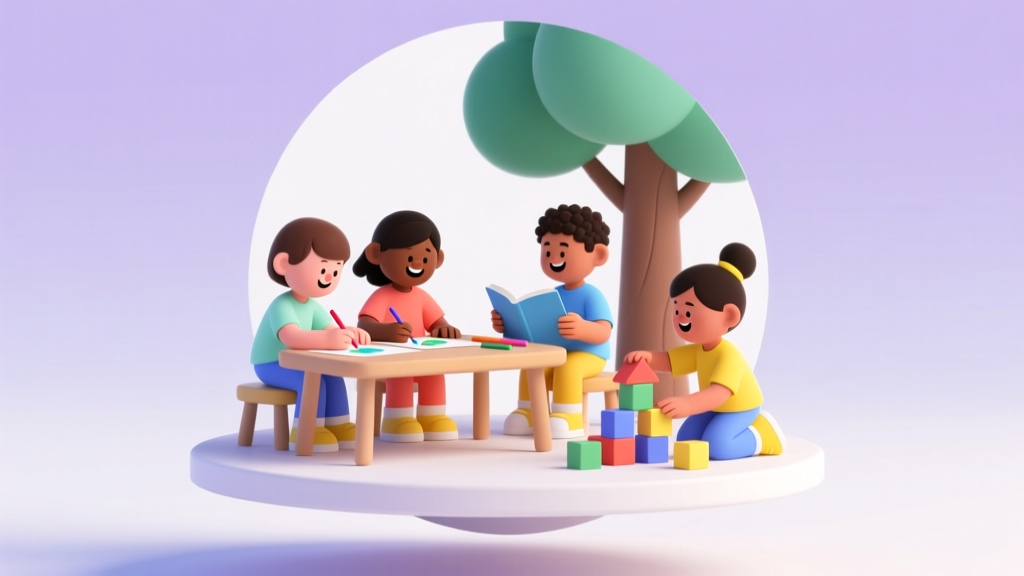
Is My Child Gifted? 7 Signs Parents Miss
Why This Question Matters More Than Ever Right Now
If you're asking how do i know if my kid is gifted, you're likely not just curious—you're quietly observing something remarkable: your 4-year-old dismantling a toaster 'to see how light gets made,' your 7-year-old crying over climate injustice while other kids play tag, or your toddler correcting your grammar mid-sentence. These aren't just 'smart moments'—they may signal asynchronous development, heightened neurodivergence, or cognitive intensity that demands thoughtful support. And yet, most parents hesitate to explore this further—not because they doubt their child, but because they fear labeling, elitism, or misreading normal variation as exceptionality. The truth? Giftedness isn’t about IQ scores alone. It’s a neurodevelopmental profile rooted in brain wiring, emotional depth, and information processing speed—and recognizing it early helps prevent burnout, anxiety, and school disengagement before they take root.
What Giftedness Really Looks Like (Beyond the 'Genius' Stereotype)
Contrary to pop-culture portrayals of gifted children as socially awkward prodigies solving differential equations at age eight, modern research from the National Association for Gifted Children (NAGC) and longitudinal studies at Johns Hopkins’ Center for Talented Youth show giftedness manifests in at least five overlapping domains: intellectual, creative, artistic, leadership, and academic. Crucially, it often appears unevenly—what psychologists call asynchronous development. A 6-year-old might read at a 9th-grade level but struggle with shoe-tying or emotional regulation. That mismatch isn’t a flaw—it’s a hallmark.
Dr. Miraca Gross, a pioneering researcher in gifted education, documented this pattern across decades: gifted children frequently develop cognitively 2–4 years ahead of peers, emotionally 1–2 years behind, and physically on schedule. This creates real-world friction—like a 5-year-old debating ethics during circle time while classmates are still mastering sharing. When adults misread this as defiance or immaturity, the child internalizes shame instead of confidence.
Here’s what to observe—not test scores:
- Intellectual intensity: Not just knowing more, but asking layered 'why' questions that spiral outward ('Why do magnets work?' → 'What makes force fields possible?' → 'Could gravity be turned off?')
- Advanced empathy & moral reasoning: Distress over global suffering, outrage at unfairness in preschool rules, or guilt after accidentally hurting an insect
- Unusual memory patterns: Recalling complex sequences (e.g., grocery lists, weather reports, historical timelines) verbatim—but forgetting where they left their coat
- Sensory or emotional oversensitivity: Covering ears at hand dryers, refusing clothing tags, or sobbing uncontrollably after a minor disappointment
- Self-directed learning bursts: Spending hours researching volcanoes after one library book—or teaching themselves piano by watching YouTube tutorials at age 5
The 7 Evidence-Based Signs Pediatric Psychologists Watch For
Based on clinical assessments used by board-certified pediatric neuropsychologists and endorsed by the American Academy of Pediatrics’ 2023 developmental screening update, these seven indicators carry high predictive validity when observed consistently—not just once, but across settings (home, school, playdates) and over time (3+ months):
- Early and complex language acquisition: First words before 9 months; combining 4+ words into original sentences by age 2; using adult syntax and abstract terms ('justice,' 'infinite,' 'hypothetically') before age 4
- Exceptional pattern recognition: Spotting inconsistencies in stories ('That dragon couldn’t breathe fire underwater—water puts out fire'), predicting plot twists, or noticing tiny changes in room layout after brief absence
- Deep focus on self-chosen topics: Sustaining attention for 45+ minutes on intricate tasks (building gear systems, mapping constellations, coding simple games) while ignoring hunger or bathroom needs
- Advanced metacognition: Talking about their own thinking ('I’m stuck because I’m trying to remember the rule, but my brain feels fuzzy') or critiquing teaching methods ('You said ‘all birds fly,’ but penguins don’t—so that’s not true')
- Existential questioning: Asking about death, infinity, consciousness, or the meaning of life before age 6—and expressing distress when answers feel inadequate
- High frustration tolerance with challenge + low tolerance for repetition: Persisting through difficult puzzles for hours, yet melting down when asked to copy spelling words they already know
- Asynchronous motor-emotional-cognitive alignment: Reading chapter books at 5 while needing help tying shoes; solving logic puzzles at 6 while struggling with peer conflict resolution
Note: No single sign confirms giftedness—and many appear in neurodivergent profiles like ADHD or autism. That’s why context matters. As Dr. Sally Reis, former NAGC president and gifted education researcher, emphasizes: 'Giftedness isn’t a diagnosis. It’s a learning profile requiring differentiated support—not a trophy to win.'
What NOT to Do (And Why These Common Mistakes Backfire)
Well-meaning parents often rush toward solutions that unintentionally harm their child’s development:
- Pushing grade-skipping without social-emotional readiness: Research from the University of Iowa’s Belin-Blank Center shows acceleration works best when paired with mentorship and peer connection—not just academic placement. Skipping 2nd grade without helping a child navigate friendships with older kids often leads to isolation.
- Over-testing too early: Standardized IQ tests (WPPSI, Stanford-Binet) have limited reliability before age 6. A 4-year-old’s score can shift 20+ points by age 8 due to rapid neural pruning. Instead, use observational checklists validated by NAGC and the Davidson Institute.
- Withholding accommodations 'to keep them humble': Telling a child 'everyone has to do the same worksheet' ignores neurobiological reality. Just as we wouldn’t deny glasses to a nearsighted child, withholding enrichment to 'teach grit' confuses challenge with irrelevance.
- Ignoring intensity as 'just personality': When a child cries for 90 minutes over a broken crayon, it’s not manipulation—it’s emotional dysregulation tied to heightened limbic system reactivity. Gifted brains process stimuli more deeply, and suppressing that intensity teaches shame, not resilience.
Instead, start with low-stakes, high-impact strategies: co-create a 'wonder journal' for big questions, introduce tiered assignments at school ('Choose 3 of these 5 math challenges'), and normalize intensity with phrases like 'Your brain notices so much—that must feel overwhelming sometimes. How can I help hold space for that?'
Practical Next Steps: From Observation to Support
You don’t need a formal evaluation to begin supporting your child. Here’s what top-tier gifted education specialists recommend—backed by 15+ years of classroom and clinical data:
| Step | Action | Tools/Resources | Expected Outcome (Within 4–8 Weeks) |
|---|---|---|---|
| 1. Document Patterns | Keep a 2-week 'intensity log': note dates/times of advanced questions, emotional reactions, focus bursts, and sensory responses. Include context (who was present, setting, preceding event). | Free printable PDF from Davidson Institute; Notes app with voice memos | Clearer recognition of triggers, rhythms, and strengths—not isolated incidents |
| 2. Request Differentiation | Email your child’s teacher: 'We’re exploring ways to honor [Child]’s learning pace. Could we co-design 1–2 extension options for upcoming units? I’m happy to provide resources.' | NAGC’s Parent Toolkit; sample email templates from Supporting Emotional Needs of the Gifted (SENG) | Teacher identifies 1–2 low-effort, high-impact adaptations (e.g., choice boards, passion projects) |
| 3. Build Cognitive Flexibility | Introduce 'thinking routines' daily: 'What’s another way to solve this?', 'How might someone else see this?', 'What’s the simplest version of this idea?' | Harvard’s Project Zero Thinking Routines; Mindset Mathematics (Boaler et al.) | Reduced frustration during novel challenges; increased willingness to revise ideas |
| 4. Normalize Intensity | Read aloud books featuring neurodiverse protagonists (Alfie Runs Away, The Girl Who Thought in Pictures) and discuss feelings without fixing. | Booklist curated by SENG; local librarian partnerships | Child names emotions accurately and seeks co-regulation instead of masking |
| 5. Connect With Peers | Seek interest-based groups (robotics camp, nature journaling, storytelling circles) where ability differences fade in shared passion. | Davidson Young Scholars application; local university Saturday programs; Meetup.com search 'gifted kids [city]' | Authentic friendships built on mutual curiosity—not performance |
Frequently Asked Questions
Does giftedness mean my child will succeed academically?
No—giftedness increases risk for underachievement when needs go unmet. Studies show up to 20% of gifted students drop out of high school, often due to boredom, perfectionism, or undiagnosed learning differences (like dyslexia co-occurring with high verbal IQ). Success hinges less on innate ability and more on environmental fit: curriculum match, teacher training, and emotional safety. As Dr. James Webb, founder of SENG, warns: 'The greatest danger to gifted children isn’t failure—it’s invisibility.'
Can giftedness be 'taught' or developed?
While intellectual potential has strong genetic components (heritability estimates range 50–80% per twin studies), the expression of giftedness is profoundly shaped by environment. Rich language exposure before age 3, access to open-ended materials (blocks, art supplies, nature), and responsive adult dialogue all amplify cognitive growth. But crucially: you cannot 'create' giftedness. You can nurture it—and you must protect it from conditions that suppress it (rigid pacing, punitive grading, social isolation).
My child excels in art/music but struggles in math—could they still be gifted?
Absolutely. Giftedness is domain-specific. The NAGC defines five areas: intellectual, creative, artistic, leadership, and academic. A child might compose symphonies at 9 but need concrete manipulatives for fractions. Schools often miss this because standardized testing prioritizes academic domains. Look for signs of exceptional depth, originality, or technical mastery in their passion area—even if it’s outside traditional subjects.
Is there a 'best age' to seek formal assessment?
Formal IQ testing is most reliable between ages 6–8, when neural pathways stabilize enough for consistent measurement. Before then, rely on qualitative assessment: portfolios of work, teacher interviews, and behavioral checklists (like the Gifted Rating Scales–Preschool/Kindergarten). If concerns persist, consult a pediatric neuropsychologist specializing in giftedness—not just general testing. Avoid online 'IQ quizzes'; they lack validity and can cause unnecessary stress.
How do I talk to family members who dismiss my concerns?
Frame observations neutrally: 'I’ve noticed [Child] asks really complex questions about time and space—have you seen that too?' Share research (e.g., AAP’s 2023 statement on neurodiversity-informed pedagogy) rather than labels. Suggest small experiments: 'Could we try letting [Child] choose their own science topic for the next project? I’ll share what happens.' Focus on collaboration, not correction.
Debunking Two Common Myths
Myth 1: 'Gifted kids don’t need help—they’ll figure it out.'
Reality: Without appropriate challenge, gifted children experience chronic boredom that rewires attention systems. fMRI studies show under-stimulated gifted brains activate default-mode networks (linked to mind-wandering and anxiety) instead of task-positive networks. This isn’t laziness—it’s neurological mismatch.
Myth 2: 'If they’re gifted, they’ll get straight A’s.'
Reality: Perfectionism, asynchronous development, and co-occurring learning differences (like ADHD or dysgraphia) make consistent high grades unlikely without targeted support. Many gifted students earn Cs—not from lack of ability, but from refusing to complete repetitive work they deem meaningless.
Related Topics (Internal Link Suggestions)
- Supporting Twice-Exceptional Children — suggested anchor text: "twice-exceptional learning strategies"
- Gifted Education Advocacy for Parents — suggested anchor text: "how to request gifted services at school"
- Emotional Regulation Tools for Intense Kids — suggested anchor text: "calming techniques for gifted children"
- Free Enrichment Resources for Curious Kids — suggested anchor text: "no-cost gifted learning activities"
- When to Consider Private Gifted Testing — suggested anchor text: "reputable gifted assessment near me"
Your Next Step Starts With One Small Act of Witnessing
You’ve already done the hardest part: paying deep attention to your child’s unique mind and heart. That curiosity—asking how do i know if my kid is gifted—is itself an act of love and advocacy. Don’t wait for a label to begin supporting them. Tonight, try this: ask one open-ended question about something they’re fascinated by ('What makes that interesting to you?'), listen without solving, and write down their exact words. That record—of their voice, their logic, their wonder—is more valuable than any test score. And if you’d like personalized next-step guidance, download our free Giftedness Observation Kit (includes NAGC-aligned checklists, teacher collaboration scripts, and a directory of vetted neuropsychologists)—no email required.
More Articles
 Camp Mystic Safety Record: Facts, Not Rumors (2026)
 Is Santa Real for Kids? Evidence-Based Answer (2026)
 Trump Account for Kids? What Parents Should Do Instead
 Sour Patch Kids Ingredients: Hidden Allergens & Dyes (2026)
 College Return: Parent Reconnection Guide (2026)
 Paul Hollywood Kids: Fatherhood, Privacy & Values
 Gen Alpha Connection: What Actually Works
 “In Your Dreams” for Kids? Pediatrician-Backed Age Guide
 How Many Kids Died in Hurricane Katrina? (2026)
 What Is Down Syndrome for Kids? (2026)