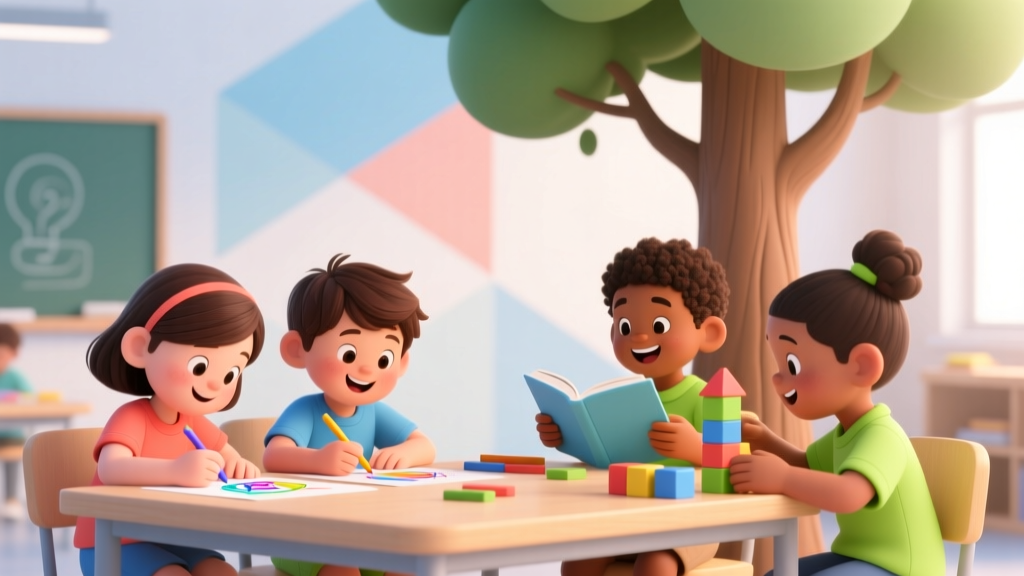
When Do Kids Learn to Count? The Real Timeline
Why This Question Matters More Than Ever Right Now
When do kids learn to count isn’t just curiosity—it’s quiet parental anxiety disguised as a simple question. In an era where preschools advertise ‘pre-K math readiness’ and apps promise ‘early numeracy boosts,’ many parents wonder: Is my child behind? Am I doing enough? Is screen time helping—or harming? The truth is far gentler—and more powerful—than pressure or panic. Counting isn’t a switch that flips on a birthday; it’s a layered cognitive skill built through sensory play, language exposure, and responsive adult interaction. And according to the American Academy of Pediatrics (AAP), early number sense—not rote recitation—is the strongest predictor of later math success, yet 68% of parents focus only on memorization, missing critical windows for meaningful concept-building.
The 4-Stage Developmental Arc (Backed by Decades of Research)
Developmental psychologists like Dr. Kelly Mix and researchers at the University of Chicago’s Spatial Intelligence & Learning Center have mapped counting mastery into four non-negotiable, sequential stages—each requiring specific types of support. Skipping or rushing any stage creates fragile foundations that crumble in kindergarten. Here’s what actually happens—and why ‘just practicing numbers’ often backfires:
- Stage 1: Rote Recitation (Ages 2–3) — Children chant ‘one-two-three-four-five’ like a nursery rhyme, with no connection to objects. This is normal—and necessary—but not evidence of understanding. Think of it as building the ‘sound track’ for math.
- Stage 2: One-to-One Correspondence (Ages 3–3.5) — They can point to each object while saying a number word—but often double-count or skip items. Success here depends heavily on fine motor development and visual tracking practice (e.g., sliding beads, placing blocks).
- Stage 3: Cardinality Principle (Ages 3.5–4.5) — The ‘aha!’ moment: they grasp that the last number said represents the total quantity. This is the single most important milestone—and the one most frequently missed in rushed instruction. A child who counts five apples but says ‘there are three’ when asked ‘how many?’ hasn’t yet internalized cardinality.
- Stage 4: Abstraction & Conservation (Ages 4.5–6) — They understand that rearranging objects doesn’t change the count (e.g., five scattered buttons = five in a line), and can count invisible sets (‘How many fingers am I holding up behind my back?’). This signals readiness for addition concepts.
A real-world example: Maya, a speech-language pathologist and mom of twins, noticed her daughter recited numbers flawlessly at 2 years 8 months—but couldn’t reliably give ‘three’ crackers when asked. Instead of drilling, she embedded counting into snack prep: ‘Let’s count each cracker as we put it on your plate—1… 2… 3! Now you have THREE.’ By age 4, her daughter spontaneously grouped toys in sets of two and four during play—proof of emerging abstraction.
What NOT to Do (And Why It Backfires)
Well-intentioned strategies often sabotage progress. Here’s what developmental science warns against—and what to do instead:
- Avoid isolated number drills: Worksheets, flashcards, and apps that isolate digits ignore how children learn math—through embodied, multisensory experiences. The National Council of Teachers of Mathematics (NCTM) states that ‘symbolic manipulation before conceptual grounding correlates with math anxiety by Grade 2.’
- Don’t correct ‘wrong’ counting mid-flow: Interrupting a child who skips ‘seven’ while pointing at toys teaches them counting is about adult approval—not meaning. Instead, model correctly *after* they finish: ‘You counted: one, two, three, four, five, six, eight! Let’s try together: one, two, three, four, five, six, seven, eight.’
- Never compare siblings or peers: A 2023 longitudinal study in Child Development found that parental comparisons reduced children’s willingness to attempt counting tasks by 41% over 6 months—even when praise followed.
Instead, lean into ‘math talk’: narrating quantities naturally in daily life. ‘We need two spoons—one for you, one for me.’ ‘You stacked four blocks—tall tower!’ ‘This banana has three brown spots.’ These micro-interactions build neural pathways faster than any app.
7 Everyday, No-Cost Strategies That Actually Work
Forget expensive kits or screen time. The most effective counting support happens in ordinary moments—with intention. These are all validated by early childhood research and classroom-tested by Montessori and Reggio Emilia educators:
- Count while moving: March, clap, or hop while saying numbers. Kinesthetic input strengthens memory encoding—especially for children with auditory processing differences.
- Use ‘counting collections’: Fill jars with buttons, pasta, or pinecones. Invite sorting, grouping, and estimating first (‘How many do you think are in this jar?’), then counting. Estimation builds number sense faster than rote counting alone.
- Introduce subitizing daily: Flash small groups (1–5) of objects for 2 seconds—then ask ‘How many?’ Subitizing (instant recognition) is the brain’s gateway to addition and is best developed with dot cards, dice, or finger patterns—not digital screens.
- Play ‘Which has more?’ with unequal sets: Place 4 grapes and 6 blueberries side-by-side. Ask ‘Which group looks bigger?’ Then count together. This builds comparison logic—the foundation for inequalities and measurement.
- Embed counting in routines: Count stairs while climbing, scoops while baking, or socks while folding. Consistency matters more than duration—30 seconds, 5x/day beats one 10-minute ‘lesson.’
- Ask ‘How did you know?’ not ‘What’s the answer?’: When a child says ‘five,’ respond with ‘Tell me how you figured that out.’ This reinforces metacognition—the #1 predictor of long-term math confidence.
- Read number-rich books aloud: Not ‘123 ABC’ primers—but stories like Quack and Count (7 ducklings splitting/recombining) or The Doorbell Rang (division concepts via cookies). Narrative context makes numbers meaningful.
Age-Appropriateness Guide: What to Expect (and When to Gently Seek Support)
While all children develop at their own pace, these benchmarks—endorsed by the AAP and Zero to Three—help distinguish typical variation from potential delays needing gentle support. Note: ‘Support’ means playful intervention, not remediation.
| Age Range | Typical Counting Behaviors | Supportive Actions | When to Gently Explore Further |
|---|---|---|---|
| 2–2.5 years | Rote recites 1–10 (often skipping or repeating); points randomly at objects while saying numbers; may match ‘one’ to a single item | Sing counting songs with gestures; count steps, toys, bites of food; use consistent number words (avoid ‘a couple’ or ‘a few’) | Doesn’t imitate counting sounds by 2.5 years; shows no interest in matching numbers to objects |
| 2.5–3.5 years | Points accurately to 1–5 items while saying number words; may recount same item twice; understands ‘more’ vs. ‘less’ in concrete contexts | Play ‘give me X’ games (‘Give me three crayons’); sort objects by size/quantity; use comparative language (‘Your tower is taller! How many blocks?’) | Cannot consistently count 3 items correctly by age 3.5; confuses ‘four’ and ‘five’ daily; avoids counting games entirely |
| 3.5–4.5 years | Demonstrates cardinality (knows last number = total); counts 10+ objects accurately; begins recognizing numerals 1–5; groups objects in pairs or fives | Introduce simple board games with dice; count ingredients while cooking; ask ‘How many would we have if we added one more?’ | No cardinality understanding by age 4.5; cannot recognize numerals 1–3; struggles to count beyond 5 without skipping |
| 4.5–6 years | Counts backward from 10; solves simple addition/subtraction with objects; writes numerals 1–10; understands zero as ‘none’ | Play storekeeper with play money; measure ingredients with cups/spoons; estimate and verify (‘How many spoonfuls to fill this cup?’) | Cannot solve ‘3 + 2’ with physical objects by age 5.5; confuses numerals (e.g., writes 6 as ‘9’ consistently); avoids all number-related tasks |
Frequently Asked Questions
My child counts to 20 perfectly at age 3—but can’t tell me how many blocks are in a pile of 5. Is that normal?
Absolutely normal—and incredibly common. Rote recitation and cardinality are separate brain processes developing on different timelines. Your child has mastered the verbal sequence (Stage 1), but hasn’t yet linked it to quantity (Stage 3). Keep modeling: ‘Let’s count them together—1, 2, 3, 4, 5. So there are FIVE blocks!’ Emphasize the last word. Most children bridge this gap between ages 3.5 and 4.5 with consistent, low-pressure exposure.
Should I teach my toddler to write numbers?
Not yet—and definitely not before age 4. Writing numerals requires fine motor control and symbol-recognition skills that typically mature after counting concepts are solid. Pushing writing too early leads to frustration and negative associations with math. Focus first on meaning: ‘What does “3” represent?’ Once your child confidently counts 10 objects and identifies ‘3’ in a group, introduce numeral writing through play—tracing in sand, forming with pipe cleaners, or stamping with foam numbers.
Are counting apps or YouTube videos helpful?
Most are not—and some are actively counterproductive. A 2022 study in Pediatrics found toddlers who used number apps for >15 mins/day showed lower growth in number sense over 6 months versus peers who engaged in hands-on play. Why? Screens lack tactile feedback, responsive interaction, and real-world referents. If you use digital tools, co-view and narrate: ‘Look—they’re putting three apples in the basket! Let’s count them: 1, 2, 3!’ Then immediately replicate it with real apples.
My child is bilingual. Will that delay counting?
No—bilingualism supports executive function and cognitive flexibility, both vital for math. However, children may mix languages initially (e.g., ‘uno, two, tres’) or take slightly longer to master cardinality in both languages. That’s expected. Prioritize consistency: use one language for counting at home, another at school—or choose one language for math concepts and stick with it until mastery, then introduce the second. Research shows bilingual kids reach all counting milestones within the same overall window as monolingual peers.
What’s the biggest red flag for potential learning differences?
Consistent difficulty with subitizing (recognizing small quantities instantly) and number comparison (identifying which of two groups is larger) by age 5—especially when paired with trouble remembering sequences (like days of week or alphabet)—may signal foundational number processing differences. This isn’t ‘bad at math’—it’s a different learning pathway. Consult a pediatrician or early childhood specialist for play-based screening. Early, joyful intervention (not drill) yields exceptional outcomes.
Common Myths About Early Counting
- Myth 1: ‘If they can’t count to 20 by age 4, they’ll fall behind in math.’ — Truth: Counting to 20 is rote memory—not math understanding. A child who deeply grasps cardinality with 5 objects at age 4 will outperform a peer who chants to 100 but can’t apply it. Depth trumps range every time.
- Myth 2: ‘More practice = faster mastery.’ — Truth: Forced repetition without conceptual anchoring creates math anxiety. The NCTM recommends spaced, playful exposure: brief, joyful interactions spread across the day—not marathon sessions. One 90-second ‘count the forks’ conversation at dinner builds more neural connectivity than a 20-minute worksheet.
Related Topics (Internal Link Suggestions)
- How to Teach Number Recognition — suggested anchor text: "number recognition activities for toddlers"
- Best Counting Books for Preschoolers — suggested anchor text: "top math-readiness picture books"
- Signs of Math Anxiety in Young Children — suggested anchor text: "early math anxiety symptoms"
- Montessori-Inspired Counting Materials — suggested anchor text: "hands-on counting tools for home"
- When Do Kids Learn Colors? — suggested anchor text: "color recognition developmental timeline"
Next Steps: Start Small, Stay Consistent
When do kids learn to count isn’t answered in weeks—it’s woven into thousands of tiny, joyful moments: counting raindrops on the window, arranging crackers in rows, singing ‘Five Little Monkeys’ with exaggerated finger movements. Your role isn’t to teach—it’s to notice, narrate, and wonder alongside them. Pick one strategy from the list above—maybe subitizing with dot cards at breakfast or counting stairs every time you go upstairs—and commit to it for just 5 minutes a day for the next 10 days. Track nothing. Praise nothing. Just be present with the numbers. You’ll likely spot their ‘cardinality click’ before you expect it—and when you do, you’ll recognize it not by a test score, but by the quiet certainty in their voice when they say, ‘There are FOUR.’ That’s not memorization. That’s understanding. And that’s where real math begins.
More Articles
 Do Kids Eat Free at Disney in 2026? Truth & Savings
 Diane Keaton’s Adoption Journey: What Parents Need to Know
 Debbie Gibson Kids: Truth About Her Family Choices (2026)
 Why Kids Lie: What It Reveals & How to Respond (2026)
 Hibiscus Tea for Kids: Safe Ages, Risks & Serving Tips
 Marilyn Monroe Kids: Truth About Her Pregnancies (2026)
 Is It a Sin to Not Want Kids? Faith, Science & Stories
 Does Keanu Reeves Have Kids? The Truth Behind His Choice
 Respect for Kids: How to Teach It Without Lecturing
 Best Coding Toys for Kids Ages 4-12 (2026 Guide)