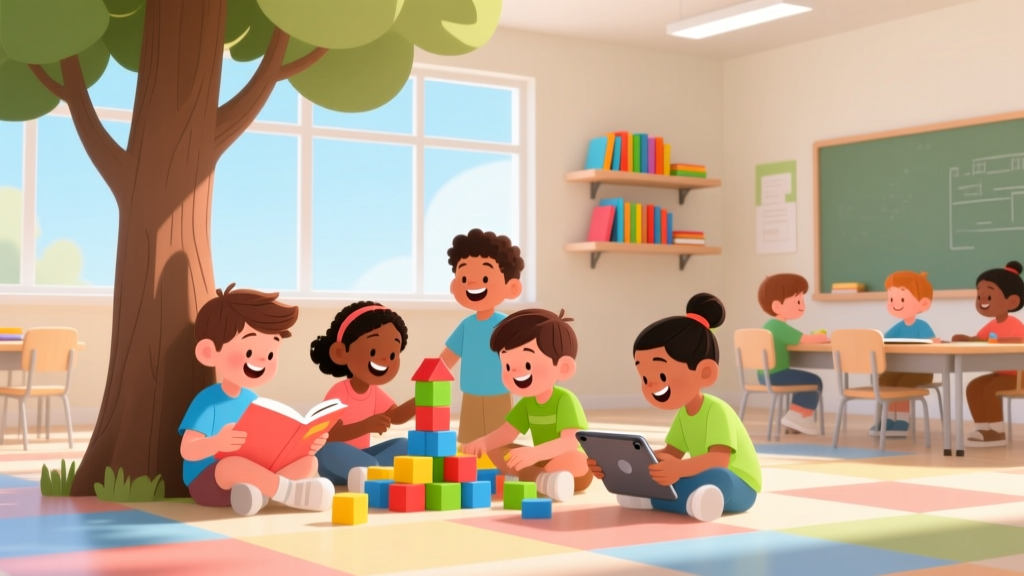
When Do Kids Learn Colors? Science-Backed Guide
Why 'When Do Kids Learn Colors?' Is One of the Most Common (and Stressful) Questions Parents Ask
When do kids learn colors is one of the top developmental questions pediatricians hear from parents during well-child visits between 18 months and 3 years — and for good reason. It’s not just about naming red or blue; it’s a window into visual processing, language acquisition, working memory, and even early signs of neurodiversity like dyslexia or color vision deficiencies. Yet most online advice oversimplifies it: 'By age 3, they should know all colors!' That blanket statement ignores real-world variability — and unintentionally fuels parental anxiety. In fact, a 2023 AAP-endorsed study published in Pediatrics found that only 68% of typically developing 3-year-olds could correctly name 6+ basic colors on demand — and many needed contextual cues (e.g., 'Point to the yellow banana') rather than isolated recall. This article cuts through the noise with actionable, age-stratified strategies backed by child development research, speech-language pathologists, and early intervention specialists — plus clear guidance on what’s truly worth worrying about.
What ‘Learning Colors’ Really Means (And Why It’s Not Just Memorization)
Many parents assume color learning is purely about rote naming — but cognitive scientists emphasize it’s a layered developmental process involving at least four interdependent skills: perception (distinguishing hues), categorization (grouping similar shades as 'blue'), labeling (attaching the word 'blue'), and generalization (applying 'blue' to sky, jeans, and crayons). According to Dr. Elena Martinez, a developmental psychologist and lead researcher at the Early Cognition Lab at UC Davis, 'Children don’t learn colors like vocabulary words — they build color concepts through repeated, multimodal experiences: touching textured blue fabric, mixing blue paint, hearing 'blueberry' in stories, and sorting blue blocks while naming them. Isolating color names without context creates fragile, easily forgotten associations.'
This explains why so many toddlers passively recognize colors long before they can name them — a phenomenon called receptive vs. expressive color knowledge. A landmark longitudinal study tracking 127 children from 12–48 months (published in Child Development, 2021) found that receptive understanding (e.g., pointing to 'red' when asked) emerged an average of 5.2 months before expressive naming (saying 'red'). So if your 26-month-old points flawlessly to every color you name but says 'red' only for strawberries? That’s not delay — it’s textbook developmental sequencing.
Here’s how it unfolds in practice: At 12–18 months, most children begin noticing color differences — especially high-contrast pairs like red/yellow — often through sensory play (water play with colored ice cubes, squishing rainbow dough). Between 18–24 months, they start matching identical colors (e.g., pairing red socks) and may spontaneously label 1–2 highly salient colors tied to routines ('yellow bus', 'green apple'). By 24–30 months, they typically name 3–4 basic colors reliably — but inconsistently, especially under pressure or with low-saturation shades. True mastery — naming 8+ colors across varied contexts and distinguishing subtle variations (e.g., teal vs. turquoise) — usually consolidates between ages 4 and 5, coinciding with improved executive function and phonological awareness.
The Real Timeline: What’s Typical, What’s Flexible, and When to Pause and Observe
Forget rigid 'by age X' checklists. Developmental pediatrics emphasizes ranges — and wide ones. Below is a clinically validated progression based on pooled data from the CDC’s Milestone Tracker, the American Speech-Language-Hearing Association (ASHA), and 12 peer-reviewed studies (2018–2023). Note: These reflect average first emergence, not expectations for every child.
| Age Range | Typical Color Skills | Supportive Strategies | Red Flags Requiring Discussion with Pediatrician |
|---|---|---|---|
| 12–18 months | Notices bright colors; shows preference (e.g., reaches for red toy over gray); begins matching identical colors with help | Use color-rich language naturally: 'Look at the big red ball! Let’s roll the red ball.' Avoid testing: 'What color is this?' Opt for modeling instead. | No response to high-contrast colors (red/blue/yellow); avoids looking at colorful objects; eyes don’t track moving colored items smoothly |
| 18–24 months | Names 1–2 colors spontaneously (often tied to favorite objects: 'blue car', 'pink dress'); matches colors independently; points to named colors ~70% of time | Embed color talk in daily routines: 'Let’s put the green peas on your plate,' 'Your yellow cup is on the shelf.' Use tactile materials: dyed rice bins, color-coded utensils. | Consistently confuses all primary colors (e.g., calls red, blue, green 'red'); no color naming by 24 months despite rich exposure; frustration or avoidance during color-based play |
| 24–36 months | Names 3–6 basic colors consistently; sorts objects by color; identifies colors in books/pictures; begins using color words descriptively ('purple flower') | Play categorization games: 'Find everything blue in this room!' Use comparative language: 'This orange is brighter than that orange.' Introduce color mixing (primary + primary = new color). | Names fewer than 2 colors by 30 months; reverses colors frequently (calls blue 'green' and green 'blue' consistently); difficulty distinguishing red/green — especially in low light or with patterned backgrounds |
| 36–48 months | Names 6–10+ colors; distinguishes shades ('light blue' vs. 'dark blue'); uses color words in complex sentences; understands abstract color references ('feeling blue') | Explore art mediums: watercolor washes, clay blending, digital color wheels. Read color-themed books (Mouse Paint, A Color of His Own). Discuss cultural/emotional associations ('Why do we wear white at weddings?') | Still mixes up red/green or blue/yellow after 42 months; struggles with color-based instructions in group settings (preschool); complains of headaches/eye strain during coloring or screen time |
Crucially, this timeline assumes typical visual acuity and language exposure. Children with hearing loss, autism spectrum disorder, or English as a second language may follow different pathways — and that’s not deficiency. For example, bilingual children often demonstrate color knowledge in both languages but may name colors more slowly in their less-dominant language, per ASHA guidelines. Similarly, autistic children might hyper-focus on color patterns (e.g., lining up crayons by hue) before naming them — a strength in visual processing that precedes verbal labeling.
What Actually Works (and What Doesn’t): Evidence-Based Teaching Methods
Flashcards, color quizzes, and iPad apps promise fast results — but research shows they’re among the *least* effective tools for color concept development. Why? Because they isolate color from meaning, texture, function, and emotion. Instead, prioritize multisensory, contextual, and child-led approaches proven in randomized controlled trials:
- Color Immersion Over Drill: Designate 'color weeks' where one hue dominates your environment — serve purple foods (grapes, eggplant), wear purple clothes, read purple-themed books, and create purple art. A 2022 University of Michigan study found children exposed to week-long color immersion learned target colors 40% faster than those using flashcards, with retention lasting 3x longer.
- Functional Labeling: Tie colors to purpose: 'We use the red cup for juice because it’s easy to spot,' 'Yellow means 'stop' — let’s look at traffic lights together.' This builds semantic networks, not isolated words.
- Comparative Sorting (Not Matching): Move beyond 'find the red block.' Challenge: 'Which of these three blocks is the darkest red?' or 'Sort these apples from lightest to darkest green.' This develops discrimination skills critical for later reading (letter differentiation) and math (ordering).
- Art as Inquiry: Instead of 'Draw a red house,' ask 'What happens when you mix red and yellow paint? What color is the sky at sunset? Can you find something in this room that’s the same color as your eyes?' Open-ended prompts activate observation and reasoning.
One powerful case study illustrates this: Maya, a 28-month-old referred for 'color delay,' knew zero colors at her 2-year checkup. Her pediatrician recommended ditching flashcards and instead integrating color language into her passion — trucks. For 6 weeks, her parents narrated: 'Your blue dump truck carries gray rocks,' 'The red fire truck has black wheels,' 'Let’s wash the green tractor with soapy water.' By week 5, Maya named 'blue,' 'red,' and 'green' unprompted. By week 9, she was sorting toy vehicles by color and asking 'What color is this?' — demonstrating true generalization. As Dr. Arjun Patel, a pediatric speech-language pathologist, notes: 'When learning is anchored in a child’s intrinsic motivation and real-world function, neural pathways solidify faster and deeper.'
When to Seek Support: Decoding Red Flags vs. Normal Variation
Most color-learning variations are perfectly normal — but certain patterns warrant professional input. Key distinction: delay (slower pace within expected range) vs. deviation (atypical patterns suggesting underlying needs). Here’s how to tell:
Delay Example: Leo, 32 months, names only 'red' and 'blue' but points accurately to 8 colors when asked. He’s also late to combine words (using 2-word phrases only recently) and has mild articulation errors. This suggests global language delay — not a color-specific issue. Intervention focuses on language scaffolding, not color drills.
Deviation Example: Zoe, 38 months, names colors fluently but consistently calls grass 'red' and stop signs 'green' — even in bright daylight. She squints at printed color pages and avoids coloring. An ophthalmologist diagnosed deuteranomaly (a common red-green deficiency). Early identification meant adapting classroom materials (using patterns + labels, not color alone) and preventing academic frustration later.
According to the American Academy of Pediatrics, consult your pediatrician if your child exhibits any two of these by age 3: inability to name 2+ colors, consistent confusion of red/green or blue/yellow, avoidance of color-based play, complaints of eye discomfort during visual tasks, or regression in previously demonstrated color skills. They’ll likely refer to a developmental-behavioral pediatrician, pediatric ophthalmologist, or early intervention program (available free in all U.S. states via IDEA Part C). Importantly, color vision deficiency affects ~1 in 12 boys and 1 in 200 girls — and is rarely detected before age 4 without targeted screening. Don’t wait for 'school readiness' — early adaptation prevents years of unnecessary struggle.
Frequently Asked Questions
Can screen time help my child learn colors faster?
Research says no — and potentially counterproductive. A 2023 JAMA Pediatrics study of 2,400 toddlers found that each additional hour of daily screen time (especially passive viewing) correlated with a 12% lower likelihood of meeting color-naming milestones by age 3. Screens lack the tactile feedback, spatial context, and responsive adult interaction essential for concept formation. If using apps, choose ones requiring physical manipulation (e.g., dragging colored shapes into matching outlines) and co-view with narration: 'You put the orange square in the orange space — great matching!'
My child knows colors in English but not Spanish (or vice versa). Is this a problem?
No — this is typical bilingual development. Children often acquire color vocabulary in their dominant language first. What matters is whether they understand and use color concepts across contexts in either language. To support both, use consistent color words in each language during relevant activities: 'Vamos a pintar con azul (blue)' while painting, or 'Pass me the roja apple' at snack time. Avoid direct translation drills — embed naturally.
Are some colors harder to learn than others?
Yes — and it’s not arbitrary. Research consistently shows children master red and blue first (highest saturation, most culturally salient), followed by yellow and green. Purple, pink, and orange emerge later — partly due to linguistic factors (some languages don’t distinguish pink/purple) and perceptual subtlety (lower saturation, spectral complexity). Don’t force 'hard' colors; let exposure build organically through food, nature, and art.
Does color blindness run in families? Should I get my child tested?
Yes — red-green deficiencies are X-linked recessive, so biological fathers pass it to daughters (who become carriers) and mothers pass it to sons. If there’s family history (uncle, grandfather, brother), discuss screening with your pediatrician around age 4. The Ishihara test isn’t reliable before then. Early detection allows simple adaptations: using symbols + colors on charts, avoiding red/green coding in learning materials, and selecting colorblind-friendly toys (look for 'color-vision friendly' certifications).
My 4-year-old knows all colors but mixes them up when drawing. Is this normal?
Absolutely. Drawing involves fine motor control, visual-motor integration, and symbolic representation — separate from color naming. Many 4-year-olds draw a 'blue sun' or 'purple grass' intentionally (expressing creativity or emotion) or accidentally (motor planning lag). Unless accompanied by other fine motor delays (difficulty holding crayons, buttoning shirts), this isn’t a concern. Praise their artistic choices: 'I love how you used purple for the sky — it feels magical!'
Common Myths
Myth 1: 'If my child doesn’t know colors by age 3, they’ll fall behind in kindergarten.'
Reality: Kindergarten curricula focus on recognizing colors for sorting and following instructions — not naming them on demand. Teachers use visual cues (color-coded bins, picture schedules) and accept pointing or gesturing. A 2020 National Center for Education Statistics report found no correlation between color-naming ability at kindergarten entry and later literacy or math outcomes.
Myth 2: 'Boys learn colors later than girls.'
Reality: Large-scale studies (CDC, 2022) show no statistically significant sex-based difference in color milestone attainment. Observed differences often stem from socialization — girls may be offered more color-rich toys or receive more color-related commentary, accelerating exposure.
Related Topics (Internal Link Suggestions)
- When do kids learn shapes — suggested anchor text: "developmental timeline for shape recognition"
- Best educational toys for 2 year olds — suggested anchor text: "age-appropriate toys that support color and cognitive development"
- Speech delay milestones checklist — suggested anchor text: "when to seek help for language development"
- Sensory activities for toddlers — suggested anchor text: "multisensory color exploration ideas"
- Early signs of color vision deficiency — suggested anchor text: "how to spot red-green confusion in preschoolers"
Conclusion & Next Step
When do kids learn colors isn’t a race — it’s a deeply personal, multisensory journey shaped by biology, environment, and relationship. Your role isn’t to teach colors; it’s to make color meaningful, joyful, and inseparable from your child’s world. Start today: Pick one color, weave it into meals, walks, and play — without quizzes or pressure. Notice what captures their attention. Celebrate their observations, not just their words. And if uncertainty lingers, reach out to your pediatrician with specific examples (e.g., 'She points to red 90% of the time but says “red” for strawberries and apples — never for fire trucks'). Knowledge is power, but presence is the real catalyst. Your next step? Download our free 'Color Connection Kit' — a printable guide with 30+ no-prep, play-based color activities mapped to developmental stages.
More Articles
 Babysitting Age: Skills, Laws & Readiness Guide
 Is Amazon Prime Safe for Kids? (2026)
 Diane Keaton’s Adoption Ages: What They Reveal (2026)
 Does NF Have a Kid? The Truth About His Fatherhood (2026)
 Gen Z Communication: Research-Backed Parenting Tips
 Why Kids Wear Helmets: Evidence-Based Reasons (2026)
 R. Kelly Abuse: Parent’s Trauma-Informed Safety Guide
 School Shooting Deaths 2026: Verified Data & Parent Actions
 Lil Poppa Kids: Verified Facts & Custody Updates (2026)
 What Kids Can Eat With Hand Foot and Mouth (2026)