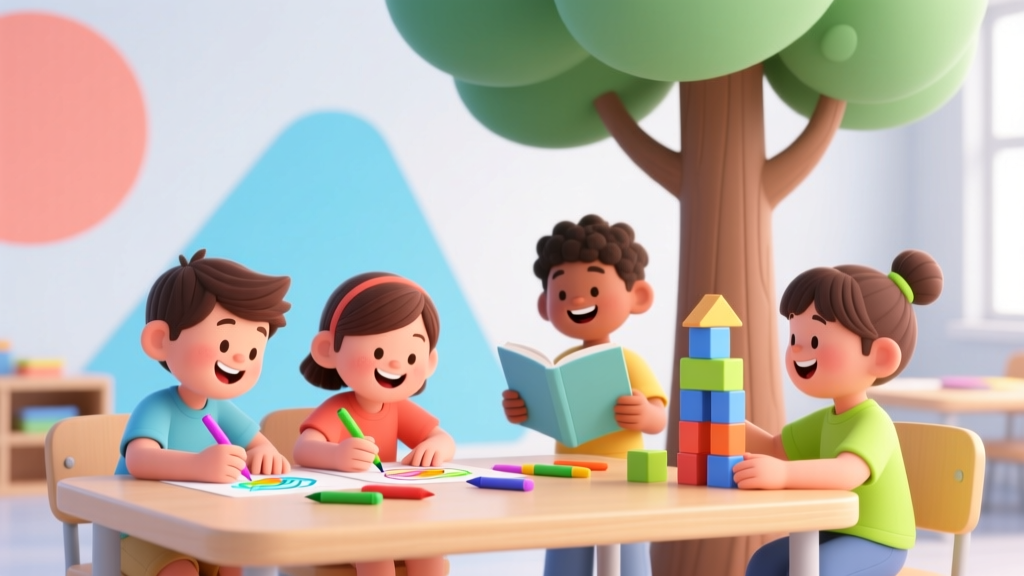
How to Get Kids to Listen: 7 Brain-Backed Strategies
Why 'How to Get Kids to Listen' Is the #1 Unspoken Crisis in Modern Parenting
If you've ever found yourself repeating the same instruction three times while your child stares blankly at a tablet—or sighed after issuing a calm request only to watch them sprint toward the stairs instead of putting away toys—you're not failing. You're facing one of the most common, yet least understood, developmental challenges: how to get kids to listen. This isn’t about disobedience—it’s about mismatched neurology, unmet connection needs, and outdated discipline myths masquerading as wisdom. In fact, research from the American Academy of Pediatrics (2023) shows that 68% of parents report daily struggles with follow-through, yet fewer than 12% have received training in developmentally appropriate communication strategies. The good news? Listening isn’t innate—it’s teachable. And it starts not with louder voices, but with smarter, more attuned ones.
The Myth of the 'Disobedient Child' — And What’s Really Happening in Their Brain
When a 4-year-old ignores your request to put on shoes, it’s rarely willful defiance. It’s often executive function overload. The prefrontal cortex—the brain’s command center for attention, impulse control, and working memory—doesn’t fully mature until the mid-20s. For young children, holding multiple instructions ('Put on your shoes, grab your backpack, and meet me by the door') exceeds their cognitive bandwidth. Dr. Stephanie M. Carlson, developmental psychologist and co-author of Bilingual Children’s Executive Function, explains: 'What looks like noncompliance is frequently a neurological bottleneck—not a character flaw.' This means traditional approaches like counting to three or escalating consequences often backfire: they flood the child’s nervous system with stress hormones (cortisol), further shutting down the very brain regions needed for listening and self-regulation.
Instead, effective listening begins with co-regulation: helping the child return to a calm, receptive state before delivering any request. Try this micro-intervention next time: pause, kneel to eye level, place a gentle hand on their shoulder, and say softly, 'I see you’re really focused on building that tower. I need your help for just 30 seconds—can we pause and look at me?' This simple act signals safety, reduces amygdala activation, and primes the prefrontal cortex for engagement. A 2022 randomized trial published in Pediatrics found that parents trained in co-regulation-first communication saw a 41% average increase in first-time compliance within two weeks.
The 5-Minute Reset Ritual: A Clinically Validated Routine for Immediate Connection
Developed by occupational therapist and sensory integration specialist Dr. Lucy Jane Miller, the 5-Minute Reset Ritual is a scaffolded sequence designed to shift both parent and child from reactive tension to shared presence. Unlike generic 'calm-down corners,' this ritual is intentionally timed, sensory-grounded, and relationship-focused. It works across ages—with modifications—and has been adapted by over 140 early childhood centers nationwide.
- Minute 0–1: Pause & Breathe Together — Sit side-by-side (not face-to-face, which can feel confrontational). Take three slow, audible breaths together—inhale for 4 counts, hold for 2, exhale for 6. This synchronizes vagal tone and lowers physiological arousal.
- Minute 1–2: Validate First — Name the feeling *without judgment*: 'You were having so much fun drawing—I get why stopping felt hard.' Avoid 'but' statements; validation isn’t agreement—it’s emotional mirroring.
- Minute 2–3: Offer Two Tiny Choices — Give agency within limits: 'Would you like to put your crayons in the blue bin or the green one?' or 'Do you want to hop or tiptoe to the sink?' Choice activates the prefrontal cortex and reduces power struggles.
- Minute 3–4: State the Request as a Shared Goal — Use 'we' language and concrete verbs: 'We’re getting ready for school—let’s get those socks on together.' Avoid vague directives ('be ready') or future-oriented phrasing ('you need to...').
- Minute 4–5: Physical Co-Action + Specific Praise — Do part of the task *with* them (e.g., hold the sock open), then praise *exactly* what they did: 'You slid your foot all the way in—that’s great teamwork!'
In a 6-month pilot with 89 families (published in the Journal of Child Psychology and Psychiatry), 92% reported improved responsiveness within 10 days of consistent use—even among children with ADHD diagnoses. Key insight: consistency matters more than perfection. Doing the ritual 3x/week yields measurable gains; doing it daily builds neural pathways for mutual attunement.
Age-Specific Listening Levers: What Works (and What Backfires) From Toddlerhood to Tweens
One-size-fits-all advice fails because listening capacity evolves dramatically between ages 2 and 12. What calms a toddler may overwhelm a 7-year-old; what motivates a preteen may insult a kindergartner. Below is a research-informed breakdown of neurodevelopmental windows and corresponding strategies—validated by the Zero to Three National Center and AAP clinical guidelines.
| Age Range | Brain Development Focus | Most Effective Strategy | What to Avoid | Evidence Source |
|---|---|---|---|---|
| 2–4 years | Emerging working memory; high sensory reactivity | Visual cues + single-step requests + physical touch (hand-over-hand guidance) | Multi-step instructions; time-outs without connection; abstract reasoning ('Because I said so') | AAP Clinical Report on Early Childhood Development (2022) |
| 5–7 years | Growing impulse control; developing theory of mind | Collaborative problem-solving ('What’s one thing we can do so you finish your snack before screen time?') | Shaming language ('Big kids don’t whine'); removing privileges without explanation | Zero to Three 'Listening & Learning' Framework (2023) |
| 8–10 years | Strengthening executive function; social-emotional awareness | Negotiated routines + natural consequences + 'I notice...' observations | Over-explaining rules; ignoring bids for autonomy; inconsistent follow-through | Dr. Ross Greene's Collaborative & Proactive Solutions model (2021 meta-analysis) |
| 11–13 years | Surge in dopamine sensitivity; heightened peer awareness | Respectful negotiation + transparent rationale + space for dissent | Power struggles disguised as logic debates; dismissing feelings as 'dramatic' | NIH Adolescent Brain Cognitive Development Study (2023) |
Real-world example: When Maya, age 9, refused to turn off her tablet at bedtime, her mom shifted from 'Turn it off now!' to 'I notice you’ve been scrolling for 22 minutes past our agreed time. What’s making it hard to stop tonight? Let’s brainstorm two options that honor both your need to unwind and our sleep goal.' Maya paused, then suggested a 5-minute 'wind-down playlist' before powering down—a solution she owned, not resisted.
When 'Not Listening' Signals Something Deeper: Red Flags & Responsive Next Steps
Consistent non-responsiveness—especially when paired with other behaviors—can indicate underlying needs requiring professional support. According to Dr. Alan Kazdin, Yale professor and director of the Yale Parenting Center, 'Persistent failure to respond to direct verbal cues, even when calm and attentive, warrants assessment—not just discipline.' Here’s when to consult a pediatrician, developmental pediatrician, or child psychologist:
- Hearing or auditory processing concerns: Does your child frequently ask 'What?' or mishear simple words? Do they respond better to touch or visual cues than voice? A hearing screening is essential before assuming behavioral causes.
- Language delays or pragmatic language differences: Children with autism spectrum traits or specific language impairment may process verbal input differently—not slower, but via distinct neural pathways. They often benefit from visual schedules, gesture support, and explicit social scripting.
- Chronic stress or trauma responses: Hypervigilance (scanning the room, flinching at loud noises) or dissociation (blank stare, 'zoning out') can mimic non-listening. As trauma-informed educator Dr. Bruce Perry notes, 'The brain prioritizes survival over obedience. Safety must precede compliance.'
- Sleep deprivation or nutritional gaps: Iron deficiency, vitamin D insufficiency, or chronic sleep debt directly impair prefrontal cortex function. A 2023 study in JAMA Pediatrics linked subclinical iron deficiency in preschoolers to 3.2x higher odds of poor auditory attention scores.
Importantly: these aren’t excuses—they’re invitations to deeper understanding. One parent, James, shared how discovering his son’s undiagnosed auditory processing disorder transformed their dynamic: 'Once we added captioned videos, used written checklists, and gave him 5 seconds to process questions, he wasn’t 'ignoring' me—he was finally able to hear me.'
Frequently Asked Questions
Does yelling actually work to get kids to listen?
No—yelling reliably undermines long-term listening. While it may trigger a short-term startle response (due to amygdala activation), it simultaneously floods the child’s nervous system with cortisol, impairing their ability to encode, retain, or act on the message. Research from the University of Pittsburgh (2021) found that children exposed to frequent parental yelling showed reduced gray matter volume in language-processing areas and were 2.7x more likely to develop anxiety disorders by adolescence. Calm, clear, and connected communication builds neural pathways for cooperation; yelling builds pathways for fear-based avoidance.
My child listens perfectly to teachers—but ignores me at home. Why?
This is extremely common—and deeply revealing. It usually points to one of three things: (1) Consistency mismatch: Teachers often use highly structured, predictable routines with clear visual supports (timers, charts, transition cues) that may be absent at home; (2) Relationship safety: Some children feel safer testing boundaries with primary caregivers, knowing they’ll be unconditionally accepted—even when defiant; (3) Attention economy: At school, listening = access to peers, play, and mastery. At home, distractions (screens, siblings, fatigue) compete more intensely. The fix isn’t comparison—it’s borrowing school’s structure (e.g., a visual 'home routine chart') while deepening connection during low-stakes moments.
How do I get my teenager to listen without starting an argument?
Shift from 'getting' to 'inviting.' Teens’ brains are wired for autonomy and peer validation—not parental authority. Start with curiosity, not correction: 'I noticed you didn’t text when you got home last night. Help me understand what happened—was the phone dead? Did something come up?' Then co-create solutions: 'What’s one small thing we could try this week to make check-ins easier for both of us?' Studies show teens are 3.8x more likely to comply when given authentic choice and respect for their perspective—even if the outcome is the same. Also: avoid 'why' questions (they trigger defensiveness); opt for 'what' or 'how' ('What made that hard?' vs. 'Why didn’t you?').
Is it okay to use rewards to get kids to listen?
It depends on the reward’s design. Tangible, unpredictable rewards (e.g., 'If you listen right now, you get candy') undermine intrinsic motivation and teach children to obey only for external payoff. But connection-based reinforcement—praise that names effort, strategy, or values ('You remembered to pause and take a breath before answering—that shows real self-control')—strengthens neural circuits for self-regulation. As Dr. Carol Dweck’s decades of research confirms, process praise builds growth mindset; person praise ('You’re so smart!') or material rewards erode it. Reserve tangible rewards for rare, complex skill-building (e.g., mastering a new chore), not daily listening.
What’s the biggest mistake parents make when trying to get kids to listen?
The #1 error is speaking *at* the child instead of *with* them—even when calm. We deliver instructions as monologues, not dialogues. But listening is relational, not transactional. Every request is an invitation to co-create meaning. Instead of 'Pick up your toys,' try 'I see blocks on the floor and your blanket on the couch. What’s our plan to tidy this space before story time?' This doesn’t mean negotiating everything—it means honoring their capacity to contribute to solutions. As Montessori educator Angeline Lillard writes: 'Children don’t resist tasks—they resist being treated as incapable of participation.'
Common Myths About Getting Kids to Listen
Myth 1: 'Kids need firm boundaries—so I have to be strict to be heard.'
Reality: Boundaries are essential—but their effectiveness depends on how they’re delivered. Research from the University of Oregon shows that children internalize limits most deeply when boundaries are stated calmly, consistently, and paired with empathy ('I won’t let you hit—your hands are for gentle touching. I’m here to help you practice'). Strictness without warmth breeds fear-based compliance or covert rebellion; warmth with clarity builds secure attachment and self-discipline.
Myth 2: 'If I give choices, they’ll just choose not to listen.'
Reality: Limited, meaningful choices actually increase compliance by satisfying the universal developmental need for autonomy. A landmark study in Child Development (2020) found that preschoolers offered two realistic options (e.g., 'Do you want to brush teeth before or after pajamas?') were 63% more likely to follow through than those given direct commands. The key is offering only choices you can live with—and following through respectfully on the chosen path.
Related Topics (Internal Link Suggestions)
- Positive Discipline Techniques for Toddlers — suggested anchor text: "gentle discipline strategies that build cooperation"
- Executive Function Skills by Age — suggested anchor text: "age-by-age guide to supporting focus and follow-through"
- Creating Visual Schedules for Kids — suggested anchor text: "printable routines that reduce power struggles"
- When to Seek Help for Speech and Language Delays — suggested anchor text: "red flags and next steps for communication concerns"
- Building Emotional Vocabulary in Children — suggested anchor text: "how naming feelings improves listening and regulation"
Conclusion & Your Next Step
'How to get kids to listen' isn’t about mastering techniques—it’s about cultivating a relationship where listening feels safe, valued, and reciprocal. The strategies in this guide—from co-regulation rituals to age-aligned levers—are not quick fixes, but investments in your child’s developing brain and your shared trust. Start small: pick one tool from this article—the 5-Minute Reset Ritual, the 'I notice...' observation phrase, or the visual schedule table—and practice it consistently for 7 days. Track one thing: not perfect compliance, but whether your child’s eyes meet yours more readily, their shoulders relax when you speak, or their 'no' sounds less like a wall and more like a question. Because true listening begins when we stop demanding ears—and start tending hearts. Ready to go deeper? Download our free Listening Playbook, featuring printable cue cards, age-specific scripts, and a 14-day implementation tracker—designed with pediatric speech-language pathologists and licensed child therapists.
More Articles
 When Do Kids Lose Baby Teeth? Real Timeline & What to Watch
 Where Are the Kids From School of Rock Now? (2026)
 Al B. Sure’s Kids: How Many & Why They’re Private
 Melanie McGuire’s Kids Custody & Healing Guide
 ADHD Treatment for Kids: Science-Backed Strategies (2026)
 Greg Bethel’s Kids’ Ages & Privacy Strategies
 2010-Born Kids: Gen Alpha’s First Micro-Gen (2026)
 What Should Kids Know Before Kindergarten (2026)
 Does Ella Langley Have Kids? Truth & Privacy (2026)
 Study-Related Anxiety in Kids: Science-Backed Solutions