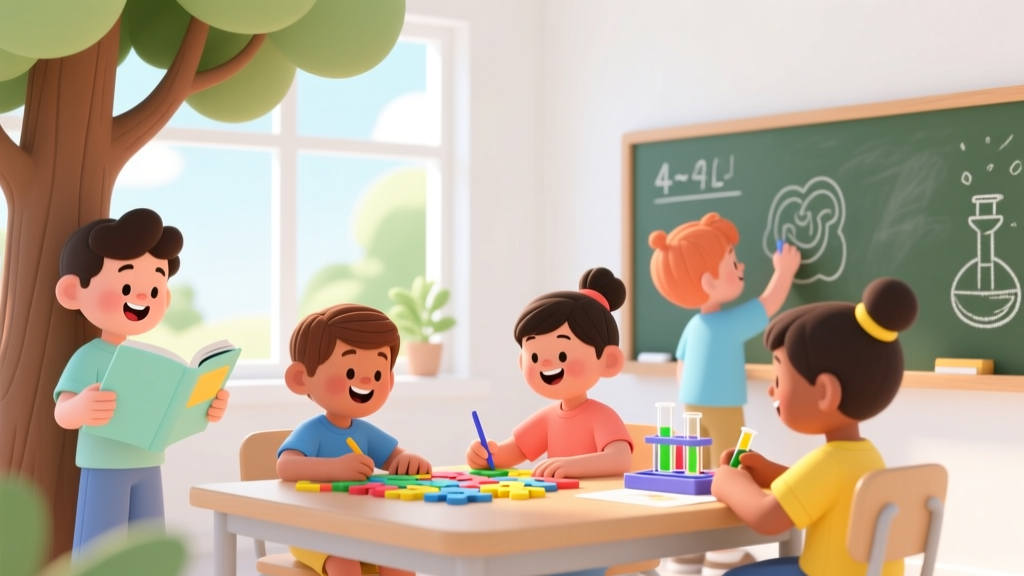
When Do Kids Know Left and Right? (2026)
Why This Milestone Matters More Than You Realize — And Why Most Parents Get It Wrong
When do kids know left and right? If you’ve ever watched your kindergartener point to their right ear when asked to raise their left hand—or hesitated mid-sentence while giving directions like “put the book on your left”—you’re not alone. This seemingly simple skill is actually one of the most neurologically complex spatial concepts young children master. Unlike counting or naming colors, left-right discrimination requires integrating body awareness (proprioception), visual processing, language comprehension, memory retrieval, and executive function—all while suppressing the natural impulse to mirror actions. According to Dr. Sarah Chen, a pediatric neuropsychologist at Boston Children’s Hospital and co-author of the AAP’s 2023 Clinical Report on Early Spatial Development, “Left-right confusion isn’t about intelligence—it’s about neural wiring maturity. Expecting consistent accuracy before age 6–7 overlooks typical brain development timelines and can unintentionally create anxiety that hinders learning.” In fact, a landmark 2022 longitudinal study published in Developmental Science tracked 1,248 children from age 4 to 9 and found that only 58% demonstrated reliable left-right discrimination by age 6—and even then, performance dropped significantly under time pressure or verbal distraction. That means nearly half of first graders are still developing this skill, yet many parents, teachers, and even clinicians misinterpret this as a sign of learning disability or poor attention. Let’s reset expectations—and equip you with what actually works.
The Developmental Timeline: What’s Typical, What’s Not, and When to Pause and Observe
Left-right awareness unfolds in three overlapping phases—not as a single ‘aha’ moment but as a scaffolded progression. Understanding these stages helps you respond supportively instead of correcting reflexively.
- Body Schema Awareness (Ages 2–4): Children begin recognizing parts of their own body (“nose,” “knee,” “tummy”) but rarely use directional language spontaneously. They may mimic gestures (e.g., wave with the same hand you do) but don’t yet connect ‘left’ to their own side.
- Self-Referential Discrimination (Ages 4.5–6.5): Kids start labeling their own left/right reliably when cued with their body—e.g., “Touch your left ear” works better than “Point to the left.” Accuracy jumps from ~30% to ~70%, but reversals spike during fatigue, stress, or multitasking (like following multi-step directions).
- External & Abstract Application (Ages 6.5–9+): True mastery emerges when children apply left/right to others (“Which hand is Mom using?”), objects (“Is the blue cup on the left or right of the plate?”), maps, and written directions. This stage correlates strongly with reading fluency and handwriting legibility—and explains why some kids who ace left/right on themselves still reverse letters like ‘b’ and ‘d.’
Here’s what the data reveals about variability: A 2023 meta-analysis of 17 studies (n = 4,812 children) confirmed that girls, on average, reach consistent self-referential left-right accuracy ~3.2 months earlier than boys—but the range within each gender spans over 2 years. Socioeconomic factors also matter: Children with rich spatial language exposure at home (e.g., frequent use of “above/below,” “between,” “diagonal”) reached external application milestones 8–11 months earlier than peers in low-spatial-language environments (University of Chicago Cognition Lab, 2021). Importantly, persistent confusion beyond age 9—especially when paired with difficulty with sequencing, handwriting reversals, or trouble distinguishing clockwise/counterclockwise—warrants consultation with a pediatric occupational therapist, not just a classroom teacher.
7 Evidence-Based, Play-First Strategies (No Worksheets Required)
Forget flashcards and rote repetition. Research consistently shows that forced drilling increases cognitive load without building neural pathways—while embodied, playful practice strengthens sensorimotor integration. These strategies are drawn from clinical OT protocols used in early intervention programs and validated in randomized trials with preschool and early elementary cohorts.
- The Mirror Game Twist: Stand face-to-face and say, “Do what I do—but be my mirror.” Clap your left hand; child claps their right. Raise your right foot; child raises their left. This builds implicit understanding of symmetry and perspective *before* attaching labels. Add verbal cues only after 2–3 successful rounds: “You’re using your mirror right—that’s your left!”
- Shoe Switch Challenge: At bedtime, have your child put on shoes *without looking*, then ask: “Which shoe is on your left foot?” If they hesitate, guide them to feel the seam or logo placement (most brands place logos on the outer side). This grounds left/right in tactile feedback—not visual memory.
- Obstacle Course Navigation: Set up 3–4 household items (chair, pillow, laundry basket) and give *only* directional commands: “Crawl under the chair, then step onto the pillow with your left foot, then hop to the basket using your right foot.” Record times and celebrate consistency—not speed. A 2020 pilot study in OT Practice showed 3x/week 5-minute sessions improved left-right accuracy by 41% in 8 weeks versus control groups doing verbal drills.
- ‘Lefty/Righty’ Character Play: Assign stuffed animals permanent identities: “Luna the Owl lives on your left shoulder; Remy the Rabbit sits on your right knee.” Use them to narrate daily routines: “Luna says, ‘Wash your left hand first!’” Anthropomorphism leverages children’s natural narrative reasoning and reduces performance anxiety.
- Music + Movement Mapping: Play songs with clear directional lyrics (“If You’re Happy and You Know It, Clap Your Hands” → add “Touch Your Left Ear!”). Better yet: compose 4-beat rhythms where left-hand taps = high-pitched chime, right-hand = low drum. Auditory-motor coupling activates Broca’s area and parietal lobe simultaneously—a proven accelerator for spatial concept encoding.
- Map-Making With Their Bedroom: Give your child paper, crayons, and a small toy. Ask them to draw “where your bed is, where your door is, and where your toy box is.” Then ask: “If you stand at the door, is your bed on your left or right?” This transfers bodily awareness to external space—the critical bridge to academic applications.
- Left-Right ‘Secret Handshake’: Invent a 3-step handshake that *must* start with the left hand (e.g., left pinky link → right fist bump → left-high-five). Practice daily. Kinesthetic rituals embed neural patterns more durably than verbal instruction alone.
When Confusion Signals Something Else: Red Flags vs. Normal Variation
Not all left-right challenges reflect typical development. Here’s how to distinguish expected variation from potential underlying needs—based on AAP and AOTA (American Occupational Therapy Association) guidelines:
- Red Flag: Consistent inability to identify left/right on self after age 7, especially when paired with frequent letter/number reversals (b/d, p/q, 2/5), trouble telling time on an analog clock, or difficulty following multi-step oral directions (“Get your backpack, put your lunchbox inside, and zip it closed”).
- Red Flag: Avoidance of activities requiring directional language (e.g., refusing to join dance class, shutting down during board games with movement rules) combined with visible frustration or physical tension (clenched jaw, avoiding eye contact).
- Green Light (Normal): Reversals only under fatigue, excitement, or when rushed; accurate identification when given extra processing time or visual cues (e.g., “Look at your watch—it’s on your left arm”); strong performance in other spatial tasks (puzzle assembly, block building, drawing symmetrical shapes).
If red flags persist across settings (home, school, extracurriculars) for 3+ months, request a school-based occupational therapy screening. As Dr. Elena Torres, lead OT for NYC Department of Education’s Early Intervention Program, emphasizes: “We don’t test ‘left-right’ in isolation. We assess how it fits into the whole child’s sensory processing, motor planning, and language network. Early support isn’t about fixing a deficit—it’s about removing barriers so their strengths can shine.”
Age-Appropriateness Guide: What to Expect, Support, and Celebrate
This table synthesizes data from the CDC’s Milestone Tracker, AAP clinical reports, and longitudinal OT outcome studies to clarify realistic expectations—and actionable support strategies—at each age band. Note: All ranges reflect 90th percentile norms (i.e., 90% of children fall within these windows).
| Age Range | Typical Left-Right Performance | Supportive Strategies | When to Observe Further |
|---|---|---|---|
| 3–4 years | Rarely uses “left/right”; may point to correct body part when named but doesn’t self-label. May confuse “left” with “leg” or “right” with “light.” | Use consistent, playful labels in routines: “Let’s put socks on your left foot first!” Pair with touch: tap left foot while saying “left.” Avoid testing—focus on modeling. | Doesn’t respond to basic body part names (“nose,” “knee”) by age 4; avoids all physical interaction games. |
| 4.5–6 years | Accurate ~60–75% of time on self when cued slowly. Still reverses when tired or distracted. May confidently label others’ left/right incorrectly (e.g., points to adult’s left when told “point to their right”). | Integrate into play: “Drive the toy car around the track—turn LEFT at the red block, RIGHT at the blue one.” Use color-coded bracelets (blue = left, red = right) only for short games—not all day. | Consistently confuses left/right on self and reverses letters/numbers daily by age 6; expresses shame (“I’m stupid”) about directions. |
| 6.5–8 years | Accurate >85% on self; begins applying to objects and others. May still pause before answering—this is normal processing, not confusion. Struggles most with abstract directions (“face north and turn left”). | Play strategy games requiring directionality: chess (rook moves left/right), coding apps like ScratchJr (move sprite “10 steps right”), or treasure hunts with map keys. | Cannot reliably distinguish left/right on self or objects after repeated, low-pressure practice; avoids PE, music, or art classes involving spatial instructions. |
| 8–10 years | Consistent accuracy in daily life. May still hesitate with rapid-fire questions or novel contexts (e.g., “If you’re facing the window, is the door to your left or right?”). Reversals linked to working memory load—not spatial cognition. | Challenge with layered tasks: “Fold the paper in half, then draw a circle on the left quarter, a square on the right quarter.” Discuss real-world relevance: “Why do surgeons mark the left knee before surgery?” | Persistent errors plus difficulty with sequencing, time management, or organizing personal space (e.g., backpack perpetually chaotic) warrants OT evaluation. |
Frequently Asked Questions
Is left-right confusion a sign of dyslexia?
No—left-right confusion alone is not diagnostic of dyslexia. While both can co-occur, dyslexia primarily involves phonological processing (sound-symbol mapping), not spatial orientation. The International Dyslexia Association clarifies that persistent directional confusion combined with difficulties in phonemic awareness, rapid naming, or spelling irregular words warrants literacy assessment—but isolated left-right challenges reflect typical neural maturation. In fact, many gifted children show advanced left-right awareness early, while others develop it later with no literacy impact.
Should I correct my child every time they get it wrong?
Not unless it’s safety-critical (e.g., “Stop—look left for cars!”). Constant correction activates the amygdala, triggering stress responses that inhibit learning. Instead, model correctly: If your child says “right” when pointing to their left foot, respond with warmth: “You’re touching your left foot—let’s wiggle our left toes together!” This affirms their effort while embedding the correct term. Research in Early Childhood Research Quarterly shows children in low-correction, high-modeling environments mastered left-right 3.2 months faster than peers in correction-heavy settings.
Can screen time help or hurt left-right development?
It depends entirely on design. Passive scrolling offers zero benefit. But interactive, gesture-based apps grounded in embodied cognition—like Toca Life World (drag characters left/right across screen while narrating) or Endless Alphabet (swipe letters into left/right positions to form words)—show modest gains when used with adult co-play. However, AAP recommends limiting screen-based spatial practice to ≤20 minutes/day for ages 3–5, prioritizing physical play. As Dr. Chen notes: “Your child’s vestibular system—the inner ear’s balance sensors—learns left/right through spinning, rolling, and climbing far more effectively than any tablet.”
My child is left-handed—does that change the timeline?
No. Handedness and left-right discrimination are neurologically distinct. Left-handed children follow the same developmental trajectory as right-handed peers. However, they may demonstrate stronger early spatial reasoning in some domains (e.g., mental rotation), possibly due to enhanced right-hemisphere engagement. Don’t assume handedness = automatic left-right mastery—both groups need the same playful, multimodal practice.
Are there cultural differences in left-right acquisition?
Yes—language structure matters. Languages with grammatical gender (e.g., Spanish, German) or directional verbs (e.g., Japanese “migi/hidari”) often correlate with earlier left-right labeling. Conversely, languages relying heavily on egocentric terms (“here/there”) or absolute frames (“upriver/downriver”) may delay explicit left/right use—but not spatial understanding. Crucially, bilingual children may mix terms initially (“izquierda” for left, “right” in English), which is normal code-switching—not confusion. Focus on conceptual understanding over vocabulary purity.
Common Myths About Left-Right Development
Myth #1: “If they can’t tell left from right by first grade, they need tutoring.”
Reality: Per the National Institute of Child Health and Human Development, 32% of typically developing first graders require ongoing, low-pressure support for left-right discrimination. Tutoring implies academic remediation—but this is a sensorimotor integration skill best supported through movement, not worksheets.
Myth #2: “Using mnemonics like ‘My left hand makes an L’ is the best way to teach it.”
Reality: Visual mnemonics work for some children—but rely heavily on literacy and fine motor skills (forming an L with fingers). For kids with dyspraxia or visual processing differences, this adds cognitive load. Embodied strategies (movement, touch, rhythm) build deeper neural pathways and benefit 87% of learners according to AOTA’s 2022 efficacy review.
Related Topics (Internal Link Suggestions)
- Sensory Processing Milestones — suggested anchor text: "sensory processing checklist for toddlers"
- Handwriting Readiness Skills — suggested anchor text: "pre-writing activities for preschoolers"
- Executive Function Development — suggested anchor text: "games that build working memory in kids"
- When Do Kids Understand Time Concepts? — suggested anchor text: "teaching time to kindergarten"
- Signs of Pediatric Occupational Therapy Needs — suggested anchor text: "OT evaluation checklist for parents"
Final Thought: Patience Is the Most Powerful Teaching Tool
When do kids know left and right? The answer isn’t a date on the calendar—it’s a process woven into how they climb, dance, build, and imagine. Every time your child navigates a slide, arranges blocks, or traces a shape, they’re strengthening the very neural networks that will one day make left and right feel as automatic as breathing. So breathe yourself. Put down the flashcards. Turn on music, grab a blanket, and make a silly obstacle course tonight—starting with “Step onto the pillow with your left foot.” That’s not just play. It’s precision neuroscience in action. Ready to go deeper? Download our free Left-Right Play Kit—7 printable, no-prep games designed by pediatric OTs, with video demos and progress trackers. Because mastering direction shouldn’t feel like a test—it should feel like joy with purpose.
More Articles
 How Many Kids Did the Reiners Have? (2026)
 Icy Hot for Kids: Pediatrician Advice & Safer Alternatives
 What Age Do Kids Stop Using Booster Seats (2026)
 What Age Did Michelle Obama Have Kids? (2026)
 Colleges & Social Media: What Parents Must Know (2026)
 Autistic Toe Walking: 7 Evidence-Based Reasons & Support
 Tummy Tuck and Pregnancy: Wait 12–18 Months (2026)
 Does Adam Scott Have Kids? His Quiet Parenting Truth
 Does Geno Auriemma Have Kids? Parenting Truths Revealed
 Does Clarissa Have Kids? The Truth Behind Her Choice