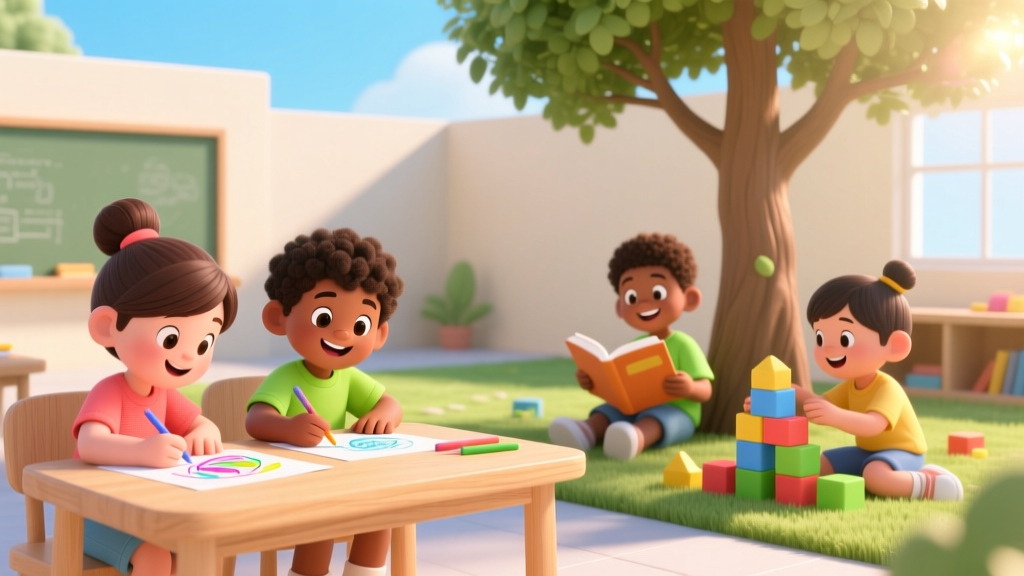
What Should A Kid Know Going Into Kindergarten
Why This Question Isn’t About ‘Academic Head Starts’—It’s About Lifelong Learning Confidence
If you’ve ever scrolled through Pinterest at 2 a.m. wondering what should a kid know going into kindergarten, you’re not behind—you’re human. In fact, the American Academy of Pediatrics (AAP) explicitly warns against overemphasizing rote academic skills at the expense of social-emotional development, noting that children who enter kindergarten with strong self-regulation, communication, and curiosity outperform peers academically by third grade—even if they couldn’t write their name on day one. This isn’t about checking off a list to impress teachers. It’s about equipping your child with the invisible scaffolding that makes learning joyful, resilient, and sustainable. And the good news? Almost every skill here is built through ordinary, low-pressure moments: folding laundry together, narrating grocery trips, or patiently waiting for a turn on the slide.
Social-Emotional Readiness: The Bedrock No Curriculum Teaches (But Every Teacher Relies On)
Kindergarten classrooms are microcosms of democracy in action—20+ children negotiating space, sharing materials, managing frustration, and interpreting nonverbal cues. Yet most parents focus on letters and numbers while overlooking the deeper architecture of readiness. According to Dr. Laura Jana, pediatrician and co-author of The Toddler Brain, “Self-regulation—the ability to calm down after disappointment, wait for a turn, or shift attention—is the single strongest predictor of kindergarten success, surpassing early reading or math skills.” That means helping your child name emotions (“You feel frustrated because the tower fell”), model coping strategies (“Let’s take three deep breaths together”), and practice simple conflict resolution (“Can you ask Sam if you can have a turn when he’s done?”) matters more than reciting the alphabet backward.
Here’s what’s truly essential—and how to nurture it:
- Emotion vocabulary: By age 5, kids should recognize and name at least 6 core feelings (happy, sad, angry, scared, surprised, tired). Try labeling emotions during storytime (“How do you think Goldilocks felt when the bears came home?”).
- Flexible thinking: Can your child adapt when plans change? Practice gentle transitions: “We’ll read two more pages, then brush teeth”—and follow through consistently.
- Peer interaction stamina: Observe playdates. Can your child engage in cooperative play (building a fort together) for 15+ minutes without adult mediation? If not, scaffold with structured games like “Pass the Ball” or “Simon Says.”
A real-world example: Maya, a kindergarten teacher in Portland, shared that last year, her most academically advanced student struggled daily with tantrums during circle time—until they introduced a visual “feelings chart” and taught him to use a “break card” to step aside quietly. Within three weeks, his participation soared. It wasn’t about fixing behavior—it was about giving him tools to navigate overwhelm.
Self-Care Independence: Why Dressing, Wiping, and Opening Lunchboxes Are Academic Skills Too
Think of self-care as the unsung curriculum of kindergarten. Teachers spend an estimated 45–60 minutes daily assisting children with bathroom trips, lunch unpacking, coat zippers, and handwashing. When a child can independently manage these tasks, they reclaim precious cognitive bandwidth for listening, questioning, and creating—not just surviving the routine.
The National Association for the Education of Young Children (NAEYC) emphasizes that mastery of self-help skills directly correlates with executive function development—specifically working memory and inhibitory control. Consider this: choosing which shoes to wear strengthens decision-making; remembering the steps to wash hands (soap, scrub 20 seconds, rinse, dry) builds sequential memory; opening a thermos lid requires fine motor planning and persistence.
Practical benchmarks to aim for by August:
- Uses the toilet independently—including wiping (front-to-back), flushing, and handwashing with soap and water.
- Zips, buttons, and snaps clothing; manages Velcro shoes without assistance.
- Opens common lunch containers (thermos lids, sandwich baggies, yogurt cups) and uses utensils neatly.
- Carries and organizes personal belongings (backpack, jacket, lunchbox) with minimal reminders.
Pro tip: Turn practice into playful ritual—not pressure. Let your child “be the teacher” and show you how to zip their backpack. Use songs (“The Handwashing Song” to the tune of “Happy Birthday,” twice through) to embed timing. And ditch the juice box with the impossible straw—opt for spill-proof bottles with push-button lids that build hand strength gradually.
Foundational Literacy & Numeracy: Beyond Flashcards—What Research Says Actually Sticks
Let’s debunk a myth upfront: Kindergarten isn’t first grade in disguise. Per the AAP’s 2023 School Readiness Guidelines, expectations center on foundational awareness, not mastery. That means recognizing that print carries meaning—not memorizing sight words; understanding that sounds make up words—not spelling “cat” correctly; grasping that numbers represent quantity—not counting to 100.
What does evidence-based readiness look like?
- Phonological awareness: Hearing and playing with sounds—rhyming (“cat, hat, bat”), clapping syllables (“el-e-phant = 3 claps”), identifying beginning sounds (“What sound does ‘sun’ start with?”). This predicts reading success more strongly than letter naming alone (National Institute of Child Health and Human Development).
- Print concepts: Knowing books have front/back covers, text reads left-to-right, words are separated by spaces. Try tracing sentences with your finger while reading aloud.
- Number sense: Counting objects accurately (one-to-one correspondence), comparing groups (“Which has more: 3 blocks or 5 blocks?”), recognizing small quantities without counting (subitizing—e.g., instantly knowing 4 dots on a die).
Crucially, these skills thrive in context—not isolation. A child who counts blueberries while helping bake muffins internalizes quantity better than one drilling flashcards. A child who spots “STOP” and “EXIT” signs on walks builds environmental print awareness far more meaningfully than tracing letters on worksheets.
Developmental Milestones vs. Readiness: Why Age Is Just One Data Point
Here’s where many parents get stuck: comparing their child to arbitrary checklists or siblings. But readiness isn’t linear—and it’s rarely uniform across domains. A child might tie shoes flawlessly but struggle to wait their turn; another may count to 30 but need support naming emotions. That’s neurotypical development. As Dr. Claire Lerner, child development specialist at ZERO TO THREE, explains: “Readiness is dynamic, not static. It’s shaped by temperament, language exposure, family routines, and even sleep quality—not just chronological age.”
That’s why pediatricians now use a holistic “readiness assessment” approach—not pass/fail testing. They consider:
- Attention span: Can your child sustain focus on a puzzle, story, or art project for 10–15 minutes without constant redirection?
- Oral language: Does your child speak in full sentences (4–5+ words), ask questions (“Why do leaves fall?”), retell simple stories (“First we went to the park, then we had ice cream…”)?
- Gross & fine motor coordination: Can they hop on one foot, cut along a line with scissors, copy a cross or circle, and hold a pencil with a mature tripod grasp?
If concerns arise in multiple areas—or significantly lag peers—consult your pediatrician. But remember: late bloomers are common. A 2022 longitudinal study in Pediatrics found that 87% of children identified as “developmentally delayed” at age 4 caught up to peers by second grade—with supportive, play-based intervention.
| Skill Domain | What’s Realistic by Late Summer | What’s Not Expected (Yet) | Low-Pressure Way to Support It |
|---|---|---|---|
| Social-Emotional | Names 3+ emotions; takes turns in simple games; seeks adult help when overwhelmed | Resolves peer conflicts independently; stays calm during all transitions | Create a “calm corner” with soft lighting, stress balls, and emotion cards—use it together during calm moments, not just meltdowns |
| Self-Care | Washes hands thoroughly; opens lunchbox; manages zipper/button on jacket | Writes full name legibly; ties shoes; manages complex multi-step hygiene | Assign one “independence job” per week (e.g., “You’re in charge of packing your snack bag”) and celebrate effort—not perfection |
| Literacy | Recognizes own name in print; rhymes spontaneously; understands stories have a beginning/middle/end | Reads CVC words (cat, dog); writes full sentences; knows all letter sounds fluently | Play “sound scavenger hunts”: “Find something that starts with /b/!” while walking to school |
| Numeracy | Counts 10 objects accurately; compares sizes (“bigger/smaller”); recognizes numerals 0–10 | Adds/subtracts mentally; writes numbers 1–20; understands place value | Count stairs, silverware, or pets—always pair number words with touching objects |
Frequently Asked Questions
Should my child know how to read before kindergarten?
No—and expecting it can backfire. The National Early Literacy Panel found no long-term academic advantage for children who learned to read early. In fact, pushing formal instruction too soon may increase anxiety and reduce intrinsic motivation. Focus instead on phonological awareness, vocabulary, and love of stories. Most kindergarteners learn letter-sound connections and blending in the first semester—with developmentally appropriate methods like songs, movement, and tactile letter tracing.
What if my child isn’t potty trained yet?
It’s more common than you think—and schools are prepared. According to the National Center for Education Statistics, ~3% of incoming kindergarteners are still mastering toileting. Work closely with your school’s nurse or teacher: share your child’s routine, provide extra underwear and wipes, and agree on discreet signals (e.g., a green/red card on their desk). Avoid shaming—frame it as “learning a new skill,” like riding a bike. Consistency between home and school is key.
Is kindergarten really necessary—or can I delay enrollment?
While not legally mandatory in all states, delaying kindergarten (“redshirting”) shows mixed outcomes. A landmark 2020 study in JAMA Pediatrics tracked 15,000 children and found redshirted kids had slightly higher test scores in early elementary—but no advantage by fifth grade. More importantly, they were 30% more likely to be diagnosed with ADHD later, possibly due to mismatched expectations. Unless there’s a documented developmental delay or medical recommendation, starting on time—with robust support—yields the best social and academic trajectory.
How much time should we spend “prepping” each day?
Zero minutes of formal prep needed. Integration is everything. Sing counting songs while brushing teeth. Describe shapes while cutting sandwiches. Narrate your own emotions (“I’m feeling impatient in this line—I’ll take a deep breath”). These micro-moments, repeated daily, build neural pathways more effectively than 20-minute drills. Aim for connection, not curriculum.
What supplies actually matter—and what’s just marketing noise?
Focus on function over flash: a backpack with wide, padded straps (not cartoon characters); scissors with blunt tips and spring-action handles (Fiskars brand meets ASTM safety standards); a lunchbox with simple latches (no tiny magnets or complicated locks). Skip “kindergarten workbooks”—they’re unnecessary and often developmentally inappropriate. Instead, invest in open-ended materials: playdough, building sets, blank notebooks, and diverse picture books.
Common Myths
Myth #1: “If they can’t write their name, they’re not ready.”
False. Name-writing is a fine-motor milestone—not a readiness gatekeeper. Many children develop this skill mid-kindergarten. What matters more is whether they understand that letters represent sounds and can attempt to “write” using scribbles, invented spelling, or drawing symbols with intention.
Myth #2: “Kindergarten is mostly play—so no prep is needed.”
Misleading. While play is the engine of learning, modern kindergarten curricula (aligned with Common Core and state standards) include structured literacy blocks, math centers, and science exploration. Without foundational self-regulation and oral language skills, children can’t access that play meaningfully. Play isn’t the absence of rigor—it’s the highest form of rigorous learning.
Related Topics (Internal Link Suggestions)
- Kindergarten supply checklist 2024 — suggested anchor text: "essential kindergarten supplies that actually matter"
- How to choose the right kindergarten program — suggested anchor text: "public vs. Montessori vs. Waldorf kindergarten comparison"
- Separation anxiety before school starts — suggested anchor text: "gentle strategies to ease kindergarten drop-off stress"
- Screen time guidelines for 5-year-olds — suggested anchor text: "healthy digital boundaries before kindergarten"
- Speech and language milestones at age 5 — suggested anchor text: "when to seek evaluation for speech delays"
Your Next Step Isn’t More Prep—It’s Presence
You don’t need flashcards, apps, or expensive tutors to prepare your child for kindergarten. You need presence: the quiet confidence that comes from knowing your child is loved, capable, and supported—not perfect. Start this week by doing one thing: sit down with your child and ask, “What are you most excited about in kindergarten?” Then listen—without correcting, adding, or redirecting. Their answer tells you more about their readiness than any checklist ever could. And if uncertainty lingers? Schedule a 15-minute call with your child’s future teacher before school starts. Ask: “What does a successful first month look like for a new kindergartener?” Their answer will ground you in reality—not rumor. You’ve got this. Your child’s journey begins not with perfection—but with possibility.
More Articles
 Pataday for Kids: Safety Tips from Pediatric Eye Doctors
 Can Parents Give Kids Alcohol? What Research Says
 7 Craft Mistakes Parents Make and How to Fix Them
 Marty Supreme for Kids: Safety & Development Review
 Explaining Addiction to Kids: 5 Gentle, Evidence-Based Steps
 Brad Pitt Co-Parenting: Real Strategies for Divorced Parents
 Women’s 7 to Kids Shoe Size: Exact Conversion (2026)
 Nelly’s Kids: Co-Parenting, Custody & Fatherhood (2026)
 Can Kids Take Unisom? Pediatrician-Reviewed Facts
 Alexis Bledel Kids: What We Know (2026)