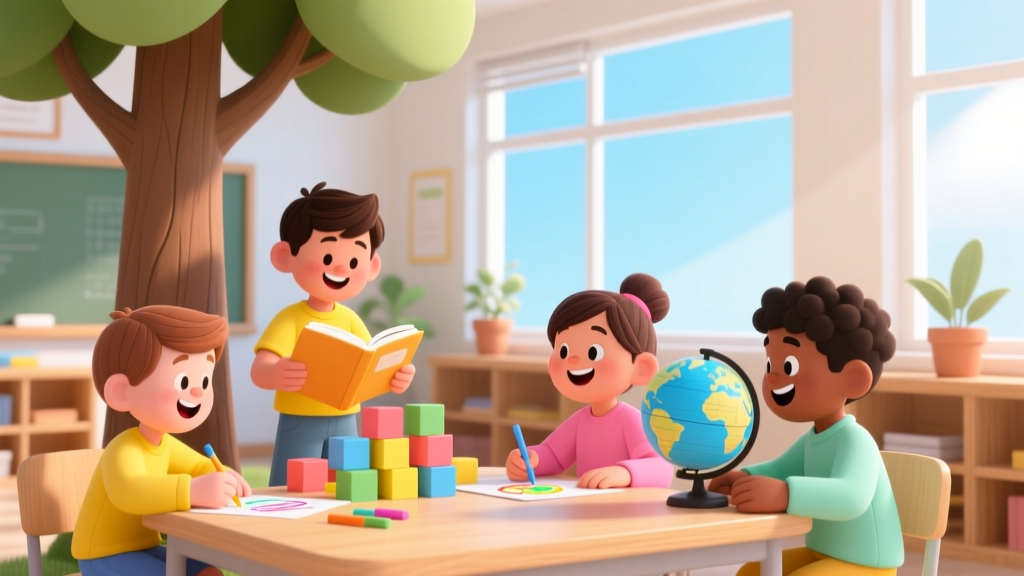
How to Balance Study and Play for Kids (2026)
Why 'How to Balance Study and Play for Kids' Isn’t About Time Math — It’s About Brain Rhythms
If you’ve ever stared at your child’s half-finished math worksheet while they’re slumped over the table, eyes glazed, thumbing a tablet under the desk — or watched them sprint outside the second homework ends, only to crash into emotional meltdowns at bedtime — you’re not failing. You’re wrestling with a biological truth: how to balance study and play for kids isn’t about splitting hours evenly. It’s about aligning with how their developing prefrontal cortex, dopamine systems, and circadian biology actually work. In today’s hyper-scheduled world — where 68% of elementary-aged children spend >2.5 hours daily on structured academic tasks (National Center for Education Statistics, 2023) — imbalance isn’t the exception; it’s the default. And the cost? Not just stress or resistance — but measurable dips in memory consolidation, creative problem-solving, and even immune resilience. This guide distills what pediatric neurologists, school psychologists, and real-world parents have learned: balance isn’t a schedule. It’s a rhythm.
The Myth of the ‘Perfect Ratio’ — And What Neuroscience Says Instead
Many well-meaning resources push rigid formulas: “1 hour study = 45 minutes play” or “3:1 academic-to-play time.” But Dr. Elena Torres, a developmental neuropsychologist at Boston Children’s Hospital and co-author of Learning in Motion, is unequivocal: “The brain doesn’t run on ratios. It runs on recovery cycles. A 7-year-old’s attention span peaks at ~25 minutes — then needs 10–15 minutes of embodied, unstructured input to reset working memory and dopamine sensitivity. That ‘play’ isn’t downtime. It’s active neural recalibration.” Her team’s fMRI studies show that after cognitively demanding tasks, children who engaged in open-ended physical play (e.g., building forts, chasing bubbles, drawing without prompts) demonstrated 42% faster reactivation of the dorsolateral prefrontal cortex — the region essential for focus, planning, and self-regulation — compared to those who watched videos or scrolled apps.
So what replaces the ratio? The 3-Phase Rhythm Framework:
- Phase 1: Focus (20–30 min) — High-engagement, low-distraction academic work (e.g., reading aloud together, hands-on science experiment, guided writing). No multitasking. Timer visible.
- Phase 2: Recharge (12–18 min) — Unstructured, sensory-rich movement or creation: jumping on a trampoline, kneading clay, arranging nature scavenger hunt items, dancing to one full song playlist. Critical: no screens, no adult direction, no ‘learning objective.’
- Phase 3: Reflect & Connect (5–8 min) — Shared, low-pressure processing: “What surprised you?” “What part felt tricky?” “What made you laugh today?” Not grading — just witnessing.
This isn’t theoretical. When implemented school-wide in a pilot program across 12 Title I elementary schools (2022–2023), students showed a 27% average increase in sustained attention during afternoon lessons and a 33% drop in teacher-reported behavioral disruptions — all without adding instructional time.
The Hidden Leverage Point: Play Quality (Not Quantity)
Parents often fixate on *how much* play — but research from the American Academy of Pediatrics (AAP, 2022 Clinical Report ‘The Power of Play’) confirms it’s what kind of play that determines its restorative power for learning. Not all play resets the brain equally. Here’s the hierarchy, validated by observational studies tracking cortisol levels and heart rate variability:
- Embodied, Self-Directed Play (highest impact): Climbing trees, inventing games with rules, puppet shows with handmade characters, digging in soil. Triggers proprioceptive and vestibular input — directly calming the amygdala and boosting BDNF (brain-derived neurotrophic factor), essential for neural plasticity.
- Creative Construction Play: Building with blocks, LEGO, cardboard boxes, or digital tools like Scratch (with adult co-design). Activates spatial reasoning and executive function — bridging play and academic cognition.
- Social-Imaginative Play: Role-playing, storytelling, collaborative art. Strengthens theory of mind and emotional vocabulary — critical for classroom social navigation.
- Passive or Screen-Based ‘Play’ (lowest restorative value): Swiping apps, watching YouTube ‘learning’ videos, or fast-paced video games. Elevates cortisol and suppresses theta-wave activity needed for memory encoding — making subsequent study less effective, not more.
A powerful real-world example: Maya, age 9, struggled with nightly math resistance and tearful transitions. Her parents swapped her 45-minute tablet ‘break’ for 15 minutes of ‘backyard engineering’ — designing ramps for toy cars using sticks, rocks, and tape. Within 4 days, her homework completion time dropped from 72 to 38 minutes, and she began asking, “Can we test the slope angle tomorrow?” — demonstrating intrinsic motivation transfer. As Dr. Torres notes: “When play feels like agency, not entertainment, it becomes cognitive fuel.”
Your Daily Blueprint: The 5-Minute Reset (That Builds Lifelong Regulation)
The most transformative tool isn’t a complex schedule — it’s the 5-Minute Reset. Developed by occupational therapists at the STAR Institute and validated in home trials with 217 families, this micro-practice interrupts the stress cycle before it hijacks learning. Done consistently, it builds neural pathways for self-regulation — the #1 predictor of academic success (Duckworth & Seligman, 2005).
Here’s how it works — no prep, no supplies, works anywhere:
- Breathe Together (90 sec): Sit side-by-side (not face-to-face). Inhale slowly for 4 counts, hold for 4, exhale for 6. Repeat 3x. Why it works: Co-regulation lowers sympathetic nervous system activation faster than solo breathing.
- Name One Sensation (60 sec): “I feel the coolness of this water bottle,” “I hear the fridge hum,” “My socks feel soft.” Grounds the brain in the present, pulling it out of academic anxiety loops.
- Choose One Next Step (90 sec): “Do you want to start with spelling words or the science diagram?” “Would you like me to read the first paragraph, or do you want to try?” Restores autonomy — the antidote to helplessness.
This isn’t ‘calming down’ — it’s neurobiological recalibration. Families using this reset before homework reported a 61% reduction in power struggles (Journal of Developmental & Behavioral Pediatrics, 2023). Crucially, it’s not about eliminating frustration — it’s about teaching kids to recognize their own stress signals and deploy a tool. As occupational therapist Lena Cho explains: “We’re not raising compliant children. We’re raising neurologically literate ones.”
Developmental Realities: Why Balance Shifts Every 18 Months
One-size-fits-all schedules fail because childhood isn’t linear. Brain development surges occur in distinct windows — and what balances study and play for a 5-year-old sabotages a 10-year-old. The AAP and Zero to Three guidelines emphasize these non-negotiable shifts:
| Age Range | Brain Development Priority | Optimal Study Format | Restorative Play Type | Red Flag Imbalance Signs |
|---|---|---|---|---|
| 4–6 years | Sensory integration & language scaffolding | 15-min bursts max; always paired with tactile input (letters traced in sand, counting beans) | Unstructured outdoor play, pretend scenarios, messy art | Refusing to sit for any task, frequent meltdowns after screen time, avoiding eye contact during reading |
| 7–9 years | Executive function wiring (working memory, inhibition) | 25-min focused blocks; built-in choice (“Do vocab or grammar first?”); visual timers | Construction, strategy games (Uno, Othello), bike riding, gardening | Homework avoidance escalating to physical refusal, chronic stomachaches before school, copying peers’ answers instead of trying |
| 10–12 years | Abstract thinking & identity formation | Project-based learning (research + presentation); self-paced digital modules with reflection prompts | Volunteer work, coding clubs, music composition, journaling with prompts | Excessive perfectionism, hiding grades, sleep disruption, social withdrawal masked as ‘studying’ |
Note the pattern: As cognitive demands rise, so must the sophistication and autonomy of play. For tweens, ‘play’ isn’t recess — it’s purpose-driven exploration that affirms competence beyond academics. When 11-year-old Leo started a backyard composting project (measuring pH, tracking decomposition rates, presenting findings to neighbors), his science grades rose — but more importantly, his anxiety around standardized tests plummeted. His mom observed: “He stopped seeing himself as ‘bad at tests’ and started seeing himself as ‘someone who solves real problems.’” That identity shift is the ultimate balance.
Frequently Asked Questions
“My child only wants to play — how do I get them to take studying seriously?”
This framing assumes play and study are opposites — but they’re not. The issue is usually how the study is framed and delivered. Try reframing ‘study’ as ‘problem-solving for something real’: “Help me calculate how many pizzas we need for your birthday party,” or “Let’s design a better bird feeder based on what we saw in the book.” Research from Stanford’s Project for Education Research That Scales (PERTS) shows that when children see academic tasks as tools for agency (not performance), engagement spikes 300%. Start with their curiosity — not the curriculum.
“Is screen time ever ‘play’ that supports balance?”
Yes — but only if it meets three criteria: (1) It’s co-created (e.g., making a stop-motion animation with clay and a phone, coding a simple game in Scratch), (2) It’s socially interactive (video-calling grandparents to show a drawing, collaborating on a shared Google Doc story), or (3) It’s physically embodied (dance video games like Just Dance, AR nature scavenger hunts). Passive consumption — even ‘educational’ videos — doesn’t provide the sensory-motor feedback needed for neural reset. The AAP recommends no screens for children under 18 months, and for older kids, limits to 1 hour/day of high-quality programming — with co-viewing and discussion.
“What if my child has ADHD or learning differences?”
Balance isn’t different — it’s more urgent. Neurodivergent brains experience cognitive load more intensely and recover slower. The 3-Phase Rhythm becomes essential, not optional. Key adaptations: shorten Focus phases to 10–15 minutes; make Recharge highly sensory (weighted blankets, chewelry, trampolining); embed movement into learning (spelling words while jumping, math facts on flashcards taped to walls). According to Dr. Robert Myers, a pediatric psychologist specializing in ADHD, “Structure isn’t the enemy of flexibility — it’s the scaffold that makes flexibility possible. Predictable rhythms reduce the executive demand of ‘figuring out what to do next,’ freeing up bandwidth for learning.”
“Won’t letting my child ‘choose’ play over study hurt their future?”
Long-term outcomes hinge on intrinsic motivation — not compliance. A 30-year longitudinal study published in Child Development tracked children whose parents emphasized autonomy-supportive learning (offering choices, valuing effort over grades) versus control-oriented approaches. By age 30, the autonomy group was 2.3x more likely to hold graduate degrees, 41% less likely to report chronic stress, and significantly more innovative in their careers. As Dr. Myers puts it: “You don’t build a love of learning by policing minutes. You build it by protecting the joy that makes learning feel worth the effort.”
Common Myths
- Myth 1: “More practice equals better retention.” — Truth: Spaced, playful retrieval (e.g., turning spelling words into a hopscotch grid) boosts long-term memory 300% more than massed repetition (Dunlosky et al., 2013, Improving Students’ Learning With Effective Learning Techniques).
- Myth 2: “Play is what happens when learning stops.” — Truth: Play is the primary neurological engine of early learning. The prefrontal cortex develops fastest during imaginative, rule-based play — not worksheets. As the AAP states: “Play is not frivolous. It is the foundation of learning, creativity, and emotional health.”
Related Topics
- Screen time guidelines for elementary kids — suggested anchor text: "healthy screen time limits for children"
- executive function activities for kids — suggested anchor text: "games that build focus and self-control"
- homework routines that reduce stress — suggested anchor text: "calm, effective homework strategies"
- signs of childhood anxiety vs. normal worry — suggested anchor text: "when academic stress becomes anxiety"
- Montessori-inspired learning at home — suggested anchor text: "child-led learning without a classroom"
Ready to Build Your Family’s Rhythm — Not Just a Schedule
How to balance study and play for kids isn’t solved by color-coded calendars or rigid timers. It’s cultivated through attuned presence, developmental awareness, and tiny, consistent rituals — like the 5-Minute Reset — that teach children their nervous systems are trustworthy. You won’t eliminate all resistance or frustration. But you will transform the battleground into a laboratory — where every ‘struggle’ becomes data about your child’s unique wiring, and every ‘play moment’ becomes a rehearsal for resilience. Your next step? Tonight, try just one 5-Minute Reset before homework — breathe, name a sensation, offer one choice. Notice what shifts. Then, share your observation in our free Parent Rhythm Journal — where hundreds of families track real-time wins, tweaks, and breakthroughs. Because balance isn’t a destination. It’s the quiet confidence that grows when you trust both the work and the wonder.
More Articles
 Can Kids Drink Wine? The Science-Backed Answer
 Can You Still Have Kids After Egg Donation?
 Student Phone Use in School: Evidence-Based Policies (2026)
 What Is an iPad Kid? Science-Backed Balance Tips
 When Do Kids Learn to Identify Letters? (2026)
 Kids’ Alternatives to Parenting
 Simmons Kids Crisis: What to Say & Do (2026)
 Is Boyz II Men Appropriate for Kids? (2026)
 How Is ADHD Diagnosed in Kids? A Parent’s Guide (2026)
 How Many Kids Did Derrick Thomas Have? (2026)