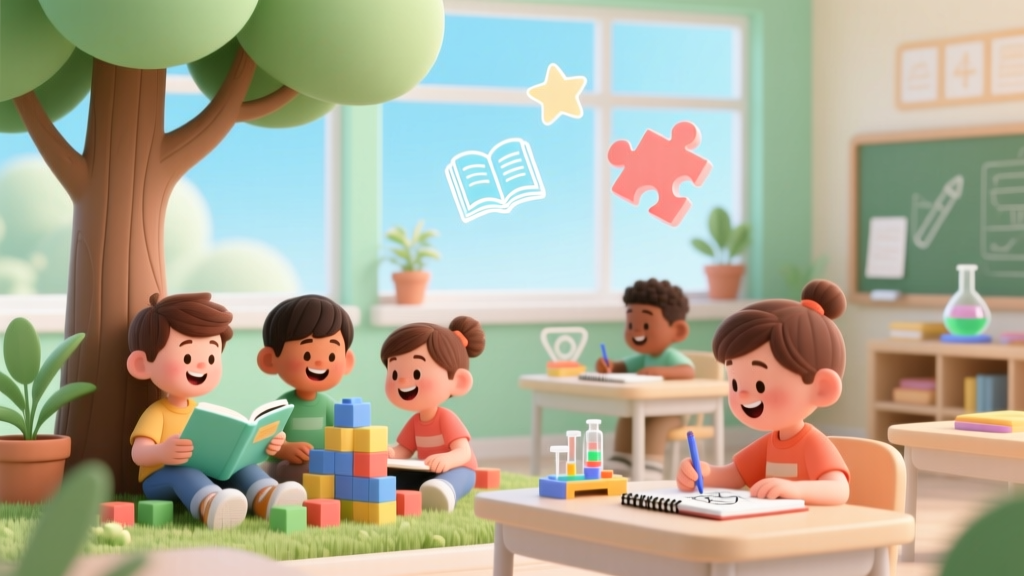
What Kids Learn in Pre-K: Skills for Lifelong Success
Why Understanding What Kids Learn in Pre-K Matters More Than Ever
If you’ve ever stared at a preschool application deadline, scrolled through conflicting Pinterest boards labeled 'pre-k readiness,' or wondered whether your child is 'on track' before kindergarten—what do kids learn in pre k isn’t just a curiosity. It’s the quiet foundation shaping everything from reading fluency at age 8 to executive function in middle school. With over 60% of U.S. 4-year-olds enrolled in some form of pre-K—and wide variation in program quality—the gap between 'play-based' and 'pedagogically intentional' isn’t semantic. It’s measurable. According to the National Institute for Early Education Research (NIEER), children in high-fidelity pre-K programs demonstrate 8–12 month gains in language and math skills by kindergarten entry—and those gains persist through 3rd grade when curricula are aligned and teachers are trained in early childhood development. This article cuts through the buzzwords to show you exactly what evidence-based pre-K delivers—and how to spot it.
The Four Pillars of Pre-K Learning (Backed by Developmental Science)
Pre-K isn’t about accelerating academics—it’s about scaffolding the cognitive, social, emotional, physical, and linguistic architecture that makes formal learning possible. Dr. Laura Jana, pediatrician and co-author of The Toddler Brain, emphasizes: 'Pre-K is where we build the neural “highways” for attention, impulse control, and symbolic thinking—not the “destination” of reading chapter books.' Drawing on decades of longitudinal research—including the landmark Abecedarian Project and more recent Head Start Impact Study—here are the four non-negotiable domains intentionally cultivated in high-quality programs:
- Cognitive & Early Academic Foundations: Not rote memorization, but pattern recognition (sorting shapes by multiple attributes), number sense (counting with one-to-one correspondence up to 20, understanding 'more/less'), and scientific inquiry (‘What happens if we mix water + cornstarch?’). These aren’t ‘pre-math’ or ‘pre-science’—they’re authentic, hands-on cognition.
- Language & Emergent Literacy: Far beyond ABCs, this includes phonological awareness (clapping syllables, rhyming games), vocabulary expansion (introducing 5–7 new rich words weekly—like ‘enormous,’ ‘frustrated,’ ‘predict’), and narrative skills (retelling stories with beginning-middle-end structure). A 2023 study in Early Childhood Research Quarterly found children who engaged in daily shared book reading + oral language extension activities gained 3x the vocabulary growth of peers in passive listening-only settings.
- Social-Emotional Development: This is where pre-K has its most profound, underappreciated impact. Children practice co-regulation (using teacher-supported breathing strategies during frustration), perspective-taking (“How do you think Maya felt when her tower fell?”), and collaborative rule-making (“What should our block center rules be?”). As Dr. Ross Thompson, developmental psychologist and AAP advisor, states: ‘Self-regulation at age 4 is a stronger predictor of high school graduation than IQ or early reading scores.’
- Fine & Gross Motor Integration: Cutting with scissors isn’t ‘art’—it’s bilateral coordination training. Balancing on a beam isn’t ‘gym class’—it’s vestibular system calibration critical for visual tracking in reading. Stringing beads strengthens pincer grasp needed for pencil control. These aren’t ‘extras’—they’re neurodevelopmental prerequisites.
What a High-Quality Pre-K Day *Actually* Looks Like (Not Just a Schedule)
Many parents imagine pre-K as structured lessons back-to-back. In reality, the most effective programs use ‘intentional teaching within play’—a model endorsed by the National Association for the Education of Young Children (NAEYC). Here’s how 90 minutes of ‘free choice centers’ becomes rigorous learning:
Case Study: Ms. Chen’s Classroom (Urban Public Pre-K, 22 students)
During ‘Water Table Exploration,’ children weren’t just splashing. They used droppers to compare volume (“Which cup holds more drops?”), predicted sink/float outcomes with varied materials (foam vs. metal washers), recorded results on a simple chart, and negotiated turn-taking using a visual timer. This single 25-minute activity wove math (measurement, prediction), science (properties of matter), literacy (symbolic recording), and social-emotional learning (delayed gratification, collaborative problem-solving).
Key differentiators of high-fidelity programs include:
- Teacher-child ratios no higher than 1:8 (AAP recommends 1:7 for 4-year-olds)
- Minimum 45+ minutes of uninterrupted outdoor play daily—not recess, but curriculum-integrated exploration (e.g., measuring shadow length at 10am vs. 2pm to introduce time/weather concepts)
- Formative assessment cycles every 6–8 weeks—not standardized tests, but portfolio-based documentation: photos of block structures showing spatial reasoning, audio recordings of storytelling, work samples annotated with developmental benchmarks
- Family engagement built into the curriculum—not just newsletters, but ‘home connection kits’ with bilingual vocabulary cards and guided questions (“Ask your child: What was tricky today? How did you solve it?”)
The Hidden Curriculum: What Pre-K Teaches That No One Talks About
Beyond the obvious domains, pre-K quietly cultivates three ‘stealth skills’ critical for lifelong adaptability—skills rarely listed on program brochures but consistently observed in longitudinal studies:
- Metacognition for Beginners: Children learn to name their own thinking processes (“I used my memory to remember the steps!”) and evaluate strategies (“That puzzle piece didn’t fit—I tried turning it, and now it works!”). This lays groundwork for growth mindset before the term exists in their vocabulary.
- Navigating Ambiguity: Unlike kindergarten’s fixed schedules, pre-K often uses visual routines with flexible transitions (“When the chime sounds, finish your work and join the rug”). Children practice shifting attention, tolerating uncertainty, and self-initiating next steps—essential for project-based learning later.
- Identity as a Learner: Through consistent, strengths-based feedback (“You kept trying even when the glue was slippery—that’s persistence!”), children internalize themselves as capable, curious agents—not passive recipients of instruction. This identity buffers against early academic discouragement.
As Dr. Kathy Hirsh-Pasek, Temple University psychologist and co-author of Becoming Brilliant, notes: ‘We don’t teach pre-K kids to be “ready for kindergarten.” We help them become people who know how to learn—how to ask, test, revise, and connect. That’s the real curriculum.’
Developmental Milestones vs. Curriculum Expectations: What’s Realistic (and What’s Red Flag)
Confusion arises when parents conflate developmental milestones (what most children *can* do by age 4) with curriculum expectations (what a program *aims to support*). Here’s the crucial distinction:
| Skill Area | Typical Developmental Milestone (Age 4) | High-Quality Pre-K Curriculum Goal | Red Flag Indicator |
|---|---|---|---|
| Literacy | Recognizes some letters; may write name; enjoys being read to | Builds phonemic awareness through games; introduces letter-sound links contextually (e.g., “S” for “snake” during reptile unit); encourages invented spelling as risk-free writing | Worksheets requiring letter tracing without meaningful context; pressure to read CVC words independently |
| Math | Counts to 20; matches numerals to quantities up to 10; sorts by color/size | Uses manipulatives to explore part-whole relationships (“If I have 5 buttons and give 2 to you, how many left?”); compares objects using descriptive language (“taller/shorter,” “heavier/lighter”) | Timed flashcard drills; emphasis on memorizing addition facts; no hands-on materials |
| Social-Emotional | Plays cooperatively with 2–3 peers; expresses feelings with words 50% of the time | Explicitly teaches emotion vocabulary & regulation tools (e.g., “calm-down corner” with breathing visuals); guides peer conflict resolution using “I-statements” | Punitive behavior charts (“clip down” systems); isolation for emotional outbursts; no adult modeling of emotional labeling |
| Motor Skills | Can hop on one foot; copies cross & square; uses scissors to cut straight lines | Integrates movement across subjects (e.g., “jump 3 times for each syllable in ‘butterfly’”); provides varied tools (thick crayons, tweezers, clay) to strengthen hand muscles | Long seated desk time (>20 mins); limited outdoor access; no fine motor tools beyond pencils/crayons |
Frequently Asked Questions
Is pre-K necessary if my child already knows their ABCs and numbers?
Knowing letters and numbers is a helpful starting point—but pre-K’s core value lies in *how* children learn to use that knowledge. A child who recites the alphabet may not yet hear individual sounds in words (phonemic awareness), which is the strongest predictor of later reading success. Similarly, counting to 20 doesn’t guarantee understanding of quantity conservation (that 5 blocks spread out = 5 blocks stacked). Pre-K builds these conceptual foundations through play, conversation, and guided discovery—not just recall. As NAEYC states: ‘It’s not what children know, but how they think, communicate, and persist that determines school readiness.’
How much academic instruction should pre-K include?
Zero minutes of direct academic instruction—when defined as teacher-led worksheets, drills, or whole-group lecturing. Instead, high-quality pre-K embeds academic concepts authentically: measuring ingredients while cooking (math), documenting plant growth in a journal (literacy + science), creating maps of the classroom (spatial reasoning). The National Academy of Sciences confirms: ‘Explicit, isolated skill instruction before age 5 shows no long-term academic benefit—and can reduce motivation and creativity.’ What matters is intentionality: every activity should serve a clear developmental goal, even if it looks like play.
My child attends a play-based preschool. Is that the same as pre-K?
Not necessarily. ‘Play-based’ describes methodology; ‘pre-K’ denotes a specific age group (typically 4–5 years) and developmental focus. Many play-based preschools serve younger children (2–3 year olds) with different goals—primarily sensory exploration and separation skills. True pre-K programs for 4-year-olds must align with state early learning standards and emphasize kindergarten transition competencies: sustained attention (15–20 min), task initiation, and multi-step direction-following. Ask: Does your program use formative assessments tied to kindergarten readiness indicators? Do teachers have specialized early childhood credentials? If not, it may be excellent preschool—but not pre-K.
What if my child has delays or I suspect a learning difference?
High-quality pre-K is often the first setting where subtle learning differences become observable—and the ideal place for early, low-stakes support. Look for programs with embedded specialists (speech-language pathologists, occupational therapists) who consult *within* the classroom—not pull-out services. According to the American Speech-Language-Hearing Association, children receiving integrated, play-based language support in pre-K show 2.3x greater gains in communication skills than those in clinic-only models. Request observation: Do teachers use visual schedules? Offer choices to build autonomy? Modify materials (e.g., textured letters for tactile learners)? These aren’t accommodations—they’re universal design principles that benefit all children.
How can I reinforce pre-K learning at home without “schooling” my child?
Focus on interaction—not instruction. Describe what you’re doing (“I’m chopping the carrots into small pieces so they cook faster”), ask open-ended questions (“What do you think will happen when we add yeast to warm milk?”), and narrate their thinking (“You tried the red block first, then the blue—you were testing which one balanced better!”). The Harvard Center on the Developing Child calls this ‘serve-and-return’ interaction—the single most powerful driver of brain architecture. Bonus: Sing songs with changing verses (builds working memory), play ‘I Spy’ using adjectives (“I spy something bumpy and brown”), and let them lead pretend play (develops narrative sequencing and perspective-taking). No flashcards required.
Common Myths
Myth 1: “Pre-K is just daycare with a fancier name.”
Reality: Licensed pre-K programs require state-mandated hours of professional development in child development, use evidence-based curricula (e.g., Creative Curriculum, HighScope), and undergo regular quality ratings (like QRIS). Daycare focuses on care and supervision; pre-K focuses on intentional, scaffolded learning experiences—even during snack time (“Let’s count how many apple slices you have. Can you share half with your friend?”).
Myth 2: “Learning through play isn’t ‘real’ learning.”
Reality: Neuroscientists confirm play is the brain’s dominant learning mode before age 7. MRI studies show heightened activity in the prefrontal cortex—the seat of executive function—during complex sociodramatic play. When children negotiate roles in a pretend restaurant (“You be the chef, I’ll be the customer who wants gluten-free food”), they’re practicing perspective-taking, symbolic representation, and flexible thinking—all higher-order cognitive skills.
Related Topics (Internal Link Suggestions)
- Pre-K vs. Kindergarten Readiness Checklist — suggested anchor text: "pre-k readiness checklist"
- How to Choose a High-Quality Pre-K Program — suggested anchor text: "signs of a good pre-k program"
- At-Home Pre-K Learning Activities (No Worksheets) — suggested anchor text: "play-based pre-k activities at home"
- State Pre-K Programs: Funding, Eligibility & Quality — suggested anchor text: "free pre-k near me"
- Red Flags in Pre-K Curriculum (What to Avoid) — suggested anchor text: "pre-k warning signs"
Conclusion & Your Next Step
So—what do kids learn in pre k? They learn to hold a pencil—not by tracing lines, but by building marble runs that require precise hand control. They learn numbers—not by chanting, but by negotiating how many cookies each friend gets when sharing a batch. They learn empathy—not through lectures, but by tending to classroom pets and discussing how the hamster feels when its cage is cleaned. This is rigorous, joyful, deeply human learning. Your next step isn’t enrolling anywhere—it’s observing. Visit 2–3 programs with this lens: Where do children’s voices dominate the room? Where do teachers kneel to eye level and ask ‘What idea are you trying out?’ instead of ‘What’s the answer?’ Where is the evidence of learning visible in children’s work—not on bulletin boards, but in their confident questions and resilient attempts? That’s where the real pre-K begins.
More Articles
 Preschool Age: When to Start (2026 Pediatrician Timeline)
 Can Kids Have Sushi? Pediatrician Rules (2026)
 Why Do Kids Lie? 5 Science-Backed Reasons (2026)
 Chicken Pox After Vaccine: Breakthrough Cases Explained
 72 Vaccines for Kids? CDC Schedule Explained (2026)
 Sour Patch Kids Gluten Free? Truth & Safer Swaps (2026)
 Why Are Kids Saying 67? What It Really Means
 What Is Responsibility for Kids? (2026)
 Slushies for Kids: 7 Hidden Ingredients & 5 Safer Swaps
 Scottie Scheffler Kids: How Many in 2026?