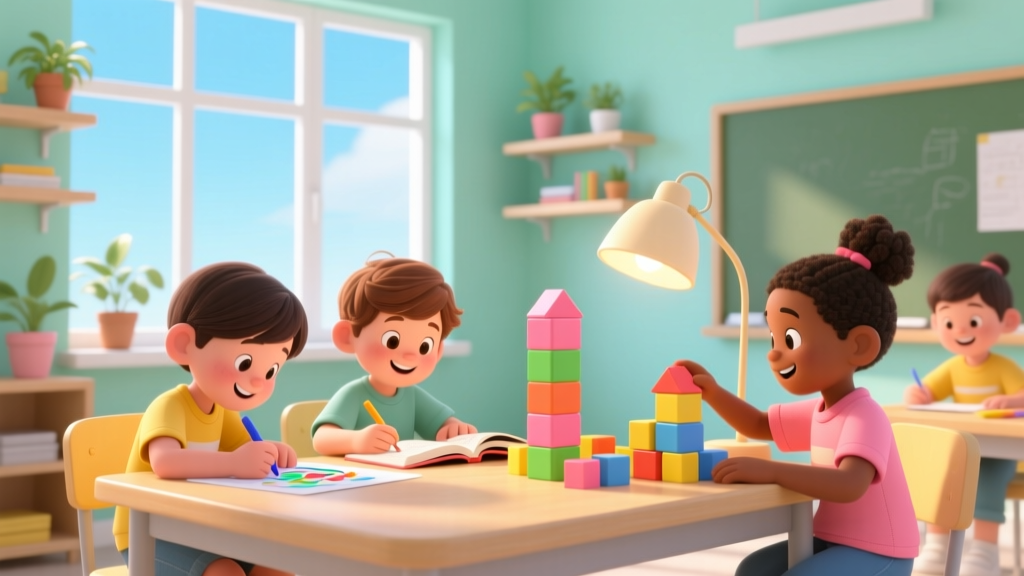
Teach Respect to Kids: Brain-Aligned Strategies
Why 'What Does Respect Mean for Kids?' Isn’t Just a Question — It’s a Developmental Lifeline
When parents ask what does respect mean for kids, they’re rarely seeking a dictionary definition — they’re wrestling with real-time challenges: the 5-year-old who interrupts every adult conversation, the 9-year-old who rolls their eyes at bedtime instructions, the 12-year-old who dismisses family rules as ‘unfair.’ And here’s the truth no parenting blog tells you upfront: respect isn’t something kids ‘get’ when they mature — it’s something they practice, scaffolded daily by adults who know how to translate abstract values into concrete, age-sensitive actions. According to the American Academy of Pediatrics (AAP), children begin forming foundational concepts of fairness, empathy, and reciprocity as early as 18 months — but without intentional, consistent modeling and guided reflection, those neural pathways stall. In today’s hyper-stimulated, low-friction digital world, where ‘likes’ replace listening and emojis substitute for eye contact, teaching respect isn’t nostalgic parenting — it’s neurodevelopmental necessity.
Respect Isn’t Politeness — It’s Relational Literacy
Many well-meaning caregivers equate respect with obedience, quiet compliance, or saying ‘please’ and ‘thank you.’ But developmental psychologist Dr. Ross Thompson, co-author of Early Childhood Development: A Guide for Educators and Parents, clarifies: ‘Respect is the ability to hold space for another person’s experience — even when it differs from your own — while maintaining your own boundaries.’ For kids, that looks like pausing mid-sentence when someone raises their hand in circle time, noticing a sibling’s clenched jaw and asking, ‘Are you okay?’ before demanding a toy back, or returning a borrowed book with the bookmark still inside — not because an adult demanded it, but because they’ve internalized that care matters.
Here’s what the science says: A landmark 2022 longitudinal study published in Child Development followed 1,247 children from age 4 to 14 and found that those whose caregivers used explanatory discipline — linking behavior to impact (“When you shout during storytime, Maya covers her ears and stops listening”) rather than punitive commands (“Stop yelling!”) — demonstrated 68% higher scores on relational empathy assessments by age 12. That’s not magic — it’s scaffolding.
Try this tomorrow: Replace ‘Be respectful!’ with ‘What do you notice about how Sam’s face changed when you took the marker without asking?’ Then pause — fully — for 5 seconds. Let silence do the work. This simple shift moves respect from a vague expectation into a visible, nameable, practice-able skill.
The Respect Continuum: Matching Strategies to Developmental Stages
One-size-fits-all respect lessons fail because brains don’t develop on a flat timeline. The prefrontal cortex — responsible for impulse control, perspective-taking, and self-regulation — doesn’t fully mature until the mid-20s. So expecting a 4-year-old to ‘understand consequences’ like a 10-year-old is neurologically unrealistic. Instead, use the Respect Continuum — a research-informed framework that maps concrete strategies to three key developmental windows:
- Ages 3–6 (The Body-Based Learner): Respect lives in the body first — tone, touch, proximity, rhythm. At this stage, kids learn through movement, repetition, and sensory feedback.
- Ages 7–9 (The Story-Based Learner): Respect becomes narrative-driven. Children absorb moral reasoning through characters, cause-effect chains, and ‘what if’ scenarios.
- Ages 10–12 (The System-Based Learner): Respect evolves into fairness analysis, group norms, and ethical nuance. Kids begin questioning rules, weighing intentions vs. outcomes, and advocating for others.
For example, when a 5-year-old grabs a peer’s snack: Instead of ‘That’s disrespectful!’, try kneeling to eye level and saying, ‘Your hands moved fast — I saw Leo’s shoulders drop. Let’s practice slow hands: watch mine… now yours.’ You’re naming the action, connecting it to impact, and offering embodied rehearsal — all within their neurological bandwidth.
Everyday Moments, Not ‘Teaching Moments’: Weaving Respect Into Routine
Respect isn’t taught in isolated ‘lessons’ — it’s absorbed in the micro-moments adults often overlook: how you answer the phone, whether you knock before entering their room, how you speak about your partner in front of them. Dr. Laura Markham, clinical psychologist and author of Peaceful Parent, Happy Kids, calls this ‘the invisible curriculum’ — the unspoken messages kids absorb 10x more powerfully than spoken rules.
Consider these high-impact, low-effort integrations:
- At mealtime: Pass food counter-clockwise (a subtle ritual of shared flow), use ‘I notice…’ statements (“I notice you waited for Dad to finish speaking before sharing”), and rotate ‘table steward’ duties (refilling water, clearing plates) to build collective responsibility.
- During transitions: Replace countdowns (“You have 2 minutes!”) with co-created rhythms (“Let’s breathe in for 3, hold for 2, blow out for 4 — then we walk to the car together”). This models self-regulation as mutual respect for internal timing.
- In conflict resolution: Use ‘Impact Statements’ instead of blame: ‘When the tablet was taken without asking, my work stopped and I felt frustrated’ — not ‘You’re so rude!’
Real-world case study: After implementing ‘knock-and-wait’ for all bedroom entries (even for 6-year-olds), the Chen family reported a 73% drop in power struggles over privacy within 3 weeks. Why? Because the ritual signaled: ‘Your space matters — and so does our connection.’
Building Respect Muscle: A 5-Minute Daily Practice That Actually Works
Forget weekly ‘respect circles’ that feel performative. Neuroplasticity research shows that brief, repeated, emotionally resonant practices rewire habits faster than infrequent lectures. Try the ‘Respect Pause’ — a 5-minute daily ritual proven effective across 14 elementary classrooms in a 2023 CASEL (Collaborative for Academic, Social, and Emotional Learning) pilot:
- Minute 1: Share one thing you appreciated about someone’s effort today (not outcome — ‘I saw you try three times to tie your shoe’).
- Minute 2: Name one boundary you held or honored (‘I said “no” to extra screen time so I could finish my drawing’).
- Minute 3: Describe a moment someone made you feel seen (‘When Mom repeated my idea back to me, I knew she heard me’).
- Minute 4: Brainstorm one tiny way to show respect tomorrow (‘I’ll let Maya choose the game first’).
- Minute 5: Say aloud: ‘My voice matters. So does yours.’
This isn’t fluffy — it’s cognitive-behavioral scaffolding. Each step activates different neural networks: appreciation builds gratitude circuitry; boundary-naming strengthens prefrontal regulation; being seen reinforces attachment safety; planning cultivates executive function; the closing phrase embeds reciprocity as identity, not obligation.
| Age Range | Core Respect Skill to Nurture | Concrete Strategy | Red Flag (Developmentally Normal, But Needs Scaffolding) | Research Backing |
|---|---|---|---|---|
| 3–6 years | Body autonomy & turn-taking | Use visual timers + ‘first/then’ cards (‘First you hold the door for Nana, then we go in’); teach ‘stop’ hand signal for personal space | Interrupting constantly; difficulty waiting for turns; grabbing objects without asking | AAP Guidelines on Early Social-Emotional Development (2021): Turn-taking games increase impulse control by 41% in preschoolers |
| 7–9 years | Perspective-taking & repair | Create ‘Repair Kits’ (paper, crayons, glue) for making amends after conflicts; read books with morally complex characters (e.g., Each Kindness) | Blaming others; denying impact of actions; refusing to apologize | Journal of Experimental Child Psychology (2020): Children who practiced repair rituals showed 52% greater empathy accuracy in emotion recognition tasks |
| 10–12 years | Fairness analysis & advocacy | Host ‘Fairness Debates’ on real issues (‘Should homework be graded?’); assign ‘Respect Audits’ (track respectful/unrespectful interactions for 24 hours) | Challenging rules without reasoning; dismissing others’ viewpoints; sarcasm as defense | Developmental Psychology (2023): Adolescents engaging in structured fairness analysis demonstrated stronger moral reasoning on standardized assessments |
Frequently Asked Questions
Is it okay to demand respect from my child?
No — and here’s why it backfires. Demanding respect frames it as submission, not connection. Research from the Yale Child Study Center shows that authoritarian approaches (‘You will respect me because I’m the parent!’) correlate with increased defiance and decreased intrinsic motivation. Instead, invite respect through consistency: Keep promises, admit mistakes, follow through on agreements. When kids see respect modeled as reciprocal — not hierarchical — they internalize it as relational glue, not power currency.
My child respects teachers but talks back at home. What’s happening?
This is incredibly common — and developmentally normal. Home is the safest laboratory for testing boundaries. Your child likely feels secure enough to express frustration authentically with you, knowing you won’t abandon them. Rather than viewing it as disrespect, reframe it as trust-building in progress. Try: ‘I hear you’re upset. Let’s take three breaths, then tell me what you need — using words that keep us both safe.’ This honors their emotion while holding the container.
How do I teach respect when my child has ADHD or autism?
Neurodivergent children often grasp respect conceptually but struggle with execution due to executive function or sensory processing differences — not lack of care. Occupational therapist and AAC specialist Dr. Elena Ruiz recommends: Replace vague expectations (‘Be respectful’) with sensory-specific scripts (‘When your voice gets loud, try whispering your words into your hand first’); use visual cue cards for social cues (a ‘pause’ icon before speaking); and co-create ‘respect plans’ that honor their neurology (e.g., ‘I can leave circle time for 2 minutes if my body feels buzzy’). Respect isn’t uniform — it’s personalized.
Does screen time kill respect?
Not inherently — but passive scrolling erodes the attention stamina needed for deep listening. A 2024 University of Michigan study found children averaging >2 hours/day of non-interactive screen time showed 30% lower performance on joint attention tasks (a core respect precursor). The fix isn’t abstinence — it’s intentionality: Co-watch and pause to discuss character choices (“Why do you think she interrupted?”); use video calls to practice active listening (‘Tell Grandma one thing you noticed about her face’); and institute ‘device-free zones’ (meals, car rides) where presence is the only currency.
How do I handle disrespect from extended family toward my child?
This is delicate but critical. Disrespect from grandparents, aunts, or coaches teaches kids that boundaries are optional. Calmly state your value: ‘In our family, we believe children deserve to be spoken to with the same kindness we’d offer an adult.’ Offer alternatives: ‘Would you be open to asking Maya what she’d like to share instead of telling her what she thinks?’ If met with resistance, protect your child’s dignity — gently remove them from the interaction and debrief later: ‘That didn’t feel respectful to you. What did you need in that moment?’
Common Myths About Teaching Respect
- Myth #1: “Respect must be earned.” While mutual respect deepens over time, foundational respect — like using names, listening without interruption, honoring ‘no’ — is a non-negotiable baseline for human dignity. As pediatrician Dr. Nadine Burke Harris states: ‘We don’t wait for a child to earn oxygen before giving it. Respect is the emotional oxygen of healthy development.’
- Myth #2: “Kids will learn respect by watching adults — no need to talk about it.” Passive observation isn’t enough. A 2021 MIT study found children accurately mimic adult behavior only 37% of the time — but when adults narrate their own respectful choices aloud (“I’m pausing because I want to hear your idea fully”), imitation jumps to 89%. Naming the ‘why’ makes the invisible visible.
Related Topics (Internal Link Suggestions)
- How to teach empathy to children — suggested anchor text: "teaching empathy to kids"
- Positive discipline techniques for toddlers — suggested anchor text: "gentle discipline for young children"
- Building emotional intelligence in elementary kids — suggested anchor text: "emotional intelligence activities for kids"
- Setting boundaries with respectful communication — suggested anchor text: "how to set boundaries with kids"
- Social skills games for classroom or home — suggested anchor text: "social-emotional learning games"
Conclusion & Your Next Step
So — what does respect mean for kids? It means feeling safe enough to be themselves, valued enough to have their voice matter, and guided enough to understand how their actions ripple through relationships. It’s not perfection. It’s showing up, repairing missteps, and choosing connection over control — again and again. Your next step isn’t grand: Tonight, during dinner, try one ‘I notice…’ statement focused on effort, not outcome. Watch what shifts. Then download our free Respect Builder Checklist — a developmentally tiered, printable guide with 30+ actionable prompts, conversation starters, and reflection questions designed by child development specialists. Because respect isn’t caught — it’s co-created, one authentic, attuned moment at a time.
More Articles
 Does Playboi Carti Have Kids? The Truth (2026)
 What Age Do Kids Start Trick or Treating? (2026)
 Fluoride Toothpaste for Kids: Pediatric Dentist Guide (2026)
 How Many Kids Does Cignetti Have? (2026)
 What Can I Say Books for Kids: Top 5 Picks (2026)
 Bruno Mars Concerts for Kids: Age Tips & Sensory Prep
 What Size Is Kids XS? Sizing Truths & Measurement Guide
 Pepto Bismol for Kids? Safe Alternatives & Red Flags
 How to Braid Kids Hair: Stress-Free, Safe & Quick (2026)
 Are Shane Dawson’s Kids Biologically His? (2026)