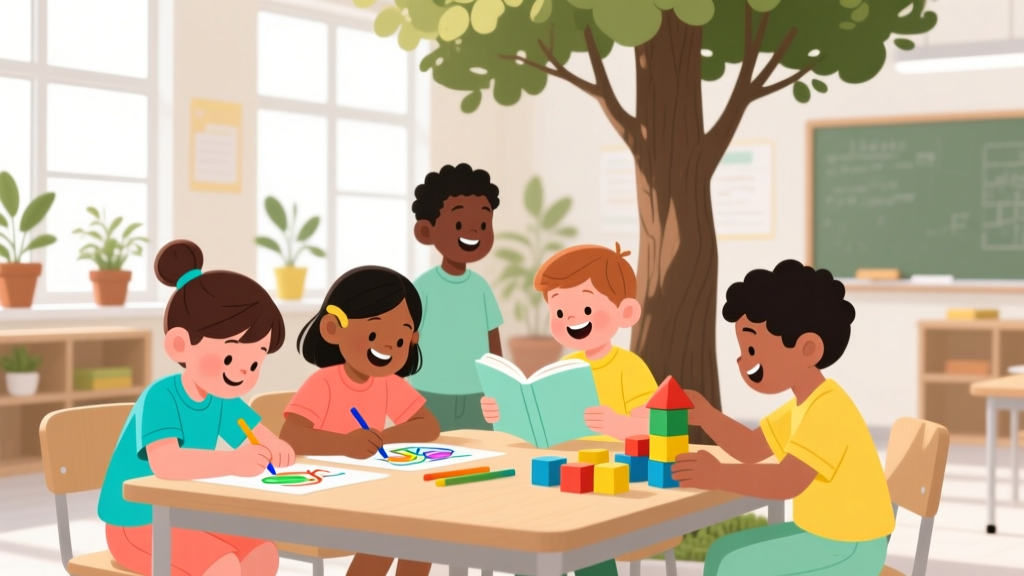
What Do Kids Learn in 2nd Grade (2026)
Why Understanding What Kids Learn in 2nd Grade Matters More Than Ever
If you’re asking what do kids learn in 2nd grade, you’re not just checking a box—you’re preparing to be your child’s most important learning partner. Second grade is the pivotal ‘bridge year’: it’s when foundational skills from 1st grade solidify into fluent reading, abstract math reasoning begins, and children start navigating complex peer dynamics independently. Yet research from the National Center for Education Statistics shows that nearly 42% of parents underestimate the depth of 2nd grade expectations—especially in writing stamina, multi-step problem solving, and self-regulation. Misalignment between home and school expectations can lead to avoidable frustration, confidence dips, or missed intervention windows. This guide cuts through curriculum jargon to deliver actionable, developmentally grounded insights—backed by classroom teachers, child psychologists, and AAP-recommended practices.
Literacy: From Decoding to Deep Comprehension
Second graders move far beyond sounding out words. According to the Common Core State Standards—and reinforced by the International Literacy Association—this year focuses on reading fluency, inferential comprehension, and structured writing. Children are expected to read aloud with accuracy, appropriate pacing, and expression (not just speed), while also answering ‘why’ and ‘how’ questions about texts—not just ‘who’ and ‘what’. A typical 2nd grader reads 90–120 words per minute with >95% accuracy and begins identifying themes like kindness, courage, or fairness across stories.
In writing, they shift from sentence-level work to multi-paragraph pieces: opinion essays with reasons and examples, informative reports with headings and facts, and narrative stories with sequenced events and dialogue. Teachers use the ‘RAFT’ strategy (Role, Audience, Format, Topic) to scaffold purposeful writing—and many now integrate digital tools like voice-to-text for students still building fine motor stamina.
At-home tip: Try the ‘3-2-1 Summary’ after reading together: ‘3 things you learned, 2 questions you have, 1 connection to your life.’ This builds metacognition without pressure. Avoid correcting every spelling error—focus first on idea generation and organization. As Dr. Sarah Chen, a developmental psychologist and former elementary literacy coach, advises: ‘Spelling is a skill; ideas are the engine. Let the engine run first.’
Math: Building Conceptual Bridges, Not Just Facts
Forget rote memorization—2nd grade math centers on place value mastery, flexible addition/subtraction strategies, and early measurement reasoning. Students learn that 347 means 3 hundreds, 4 tens, and 7 ones—not just ‘three hundred forty-seven.’ They solve two-digit problems using multiple methods: base-ten blocks, number lines, partial sums, and mental math—because the goal isn’t one right answer, but understanding *why* a strategy works.
They also explore arrays (early multiplication foundations), tell time to the nearest five minutes, count money up to $5, and measure lengths in inches/centimeters using rulers—not just estimation. Crucially, they begin interpreting data: creating and reading picture graphs, bar graphs, and line plots with up to four categories. A 2023 study in Teaching Children Mathematics found classrooms emphasizing visual models and real-world context (e.g., ‘How many more pencils does our class need to reach 100?’) saw 37% higher retention than those relying on worksheets alone.
Real-world case: Maya, a 2nd grader in Austin, struggled with regrouping until her teacher used ‘shopping cart math’: she ‘bought’ items with play money, physically exchanging ten $1 bills for one $10 bill. Within three weeks, her accuracy jumped from 58% to 92%. You can replicate this with grocery receipts or a pretend lemonade stand.
Science & Social Studies: Curiosity Meets Critical Thinking
While not standardized nationally, most states align 2nd grade science with NGSS (Next Generation Science Standards), focusing on patterns in life cycles, properties of matter, and Earth’s systems. Kids observe plant growth over weeks, classify animals by habitat and diet, compare solids/liquids/gases using everyday materials (ice, water, steam), and track weather patterns—not just naming clouds, but predicting changes based on humidity or wind direction.
Social studies emphasizes community roles, map literacy, and historical empathy. Children create neighborhood maps with symbols, interview family members about ‘their childhood,’ and discuss fairness through scenarios like sharing classroom resources. Importantly, this is where cultural responsiveness becomes essential: high-quality curricula include diverse perspectives—not just ‘Pilgrims and Native Americans,’ but Indigenous stewardship of land, immigrant contributions to local infrastructure, or civil rights figures from varied backgrounds.
A key insight from the National Council for the Social Studies: 2nd graders are developmentally ready to grasp ‘multiple viewpoints’ but not yet ‘moral relativism.’ So instead of ‘Was Columbus good or bad?,’ ask ‘What did different people experience when ships arrived—and why might their stories differ?’
Social-Emotional Learning: The Hidden Curriculum
This is where many parents feel most unprepared—and where the stakes are highest. Second grade is when executive function skills rapidly mature: working memory expands, impulse control strengthens (though not consistently!), and children begin recognizing others’ emotions with greater nuance. But it’s also when social comparison intensifies, perfectionism emerges, and anxiety about ‘being smart’ takes root.
According to the American Academy of Pediatrics’ 2022 School Readiness Guidelines, 2nd graders benefit most from explicit instruction in: (1) self-advocacy (“I don’t understand—can you show me another way?”), (2) conflict resolution scripts (“I feel ___ when ___, and I need ___”), and (3) growth mindset language (replacing “I’m bad at math” with “My brain is growing when I try hard problems”).
Teachers embed SEL in daily routines: morning meetings with emotion check-ins, ‘kindness journals,’ and collaborative projects requiring role negotiation. At home, model vulnerability—share your own learning struggles (“I kept mixing up these knitting stitches—what helped me was watching a slow-mo video”). And crucially: limit screen time before homework. A longitudinal study published in Pediatrics linked >1 hour of pre-academic screen use to 23% lower task persistence in 2nd graders.
| Skill Domain | Typical 2nd Grade Expectation | Red Flag Indicators (When to Discuss with Teacher) | Simple Home Reinforcement Strategy |
|---|---|---|---|
| Literacy | Reads 90–120 wpm with expression; writes 3–5 sentence paragraphs with topic sentences and details | Consistently avoids reading aloud; writes only single sentences with no connecting words; cannot retell a story’s sequence | Use audiobooks + physical text: pause every 2 pages to predict ‘What might happen next?’ |
| Math | Solves 2-digit +/- with regrouping; measures objects to nearest inch/cm; interprets simple bar graphs | Cannot identify place value beyond tens; counts on fingers for all problems; confuses AM/PM or coin values | Play ‘Storekeeper’: assign prices under $2, give exact change practice with real coins |
| Social-Emotional | Names 3+ emotions; uses ‘I statements’ during conflicts; completes multi-step tasks with minimal reminders | Frequent meltdowns over minor transitions; inability to name feelings beyond ‘happy/sad/angry’; requires constant adult prompting for routines | Create an ‘emotion thermometer’ chart: draw a scale 1–5, label each level, and practice rating feelings daily |
| Executive Function | Holds 3–4 step directions; organizes backpack independently; estimates time needed for small tasks | Forgets materials daily despite checklists; loses track mid-task; cannot estimate how long ‘clean up’ will take | Use visual timers + photo checklists: take pictures of ‘ready-for-school’ backpack, desk, and lunchbox |
Frequently Asked Questions
Is it normal for my 2nd grader to reverse letters like ‘b’ and ‘d’?
Yes—letter reversals are common through age 7 and often resolve naturally as visual processing matures. However, if reversals persist *with* other signs—like confusing left/right, trouble copying from the board, or difficulty rhyming—it’s worth discussing with your school’s reading specialist. Per the International Dyslexia Association, isolated reversals aren’t diagnostic, but patterns matter more than single errors.
How much homework should a 2nd grader have—and what if they cry doing it?
The National Education Association recommends 20 minutes maximum per night for 2nd grade. If tears occur regularly, first rule out fatigue, hunger, or unclear instructions. Then, break work into 5-minute chunks with movement breaks (jumping jacks, wall push-ups). Never let homework become a power struggle—contact the teacher to co-create a plan. As Dr. Elena Torres, a pediatric neuropsychologist, states: ‘Tears signal overwhelm, not defiance. Your job is to help them feel safe enough to try again tomorrow.’
My child reads well but hates writing. Is that okay?
It’s very common—and often stems from fine motor fatigue or fear of imperfection, not lack of ideas. Encourage low-stakes writing: texting emojis to describe feelings, labeling drawings, or recording voice notes they transcribe later. Occupational therapists note that grip strength and shoulder stability (built through climbing, swimming, or even carrying groceries) directly impact writing endurance. Prioritize movement before writing tasks.
Should I teach my child cursive in 2nd grade?
Most states introduce cursive formally in 2nd or 3rd grade—but handwriting research (per the Journal of School Psychology, 2021) shows that legibility and consistency matter far more than script type. If your child struggles with print, cursive may actually help—its continuous strokes reduce lifting and improve flow. Focus on proper pencil grip and paper positioning first. Skip cursive if it causes stress; keyboarding fluency is equally vital today.
What’s the biggest mistake parents make supporting 2nd grade learning?
Assuming ‘more practice = better results.’ Neuroscience confirms that spaced repetition and sleep consolidation are more effective than marathon drills. One 15-minute focused session with reflection beats 45 minutes of distracted repetition. Also, avoid comparing your child to peers—2nd grade developmental windows vary widely. As AAP guidelines emphasize: ‘Variability is the norm, not the exception.’
Common Myths About 2nd Grade Learning
- Myth #1: “If they’re reading chapter books, they’ve ‘mastered’ reading.” Reality: Fluency ≠ comprehension. Many 2nd graders decode well but miss inference, cause-effect, or character motivation. Ask open-ended questions: ‘What do you think the character is feeling—and what in the text tells you that?’
- Myth #2: “Homework builds responsibility, so it must be done nightly.” Reality: Research shows no academic benefit to routine homework before middle school. Responsibility is built through meaningful chores, self-care routines, and collaborative projects—not worksheets. Focus on consistency in *habits*, not hours logged.
Related Topics (Internal Link Suggestions)
- 2nd Grade Reading Milestones — suggested anchor text: "2nd grade reading benchmarks by month"
- Best Math Games for 2nd Graders — suggested anchor text: "hands-on math activities for second grade"
- Executive Function Skills in Elementary — suggested anchor text: "how to build focus and working memory in kids"
- IEP vs. 504 Plan for Elementary Students — suggested anchor text: "when to request school support for learning differences"
- Screen Time Guidelines for 7-Year-Olds — suggested anchor text: "healthy tech balance for second graders"
Your Next Step: Partner, Don’t Pressure
Understanding what do kids learn in 2nd grade isn’t about turning your kitchen into a classroom—it’s about becoming a calm, curious co-pilot. Start this week by choosing just *one* area from the table above where your child shows interest or mild frustration. Observe for 3 days: what sparks their focus? Where do they pause, sigh, or ask for help? Then, collaborate with their teacher using specific observations (“Liam loves measuring things—he measured our dog’s paws in cm yesterday!”) rather than general concerns. That specificity builds trust and unlocks targeted support. Download our free 2nd Grade Skill Tracker to monitor progress without pressure—and remember: the goal isn’t perfection. It’s presence.
More Articles
 Why Are Video Games Good for Kids? Evidence-Backed Benefits
 Kim Porter’s Kids: How Many Children Did She Have?
 Trump Kids Accounts Eligibility (2026)
 Booster Seat Age: Height, Law & Readiness (2026)
 Do Kids Only Go to School 6 Months? The Truth
 Custody Privacy Guide for Co-Parents (2026)
 Pugs With Kids: Temperament, Safety & Compatibility (2026)
 Blake Griffin Kids: How Many & Why So Private (2026)
 Bruno Mars Kids: Truth About His Private Family Life
 How Many Kids Does Allen Iverson Have? (2026)