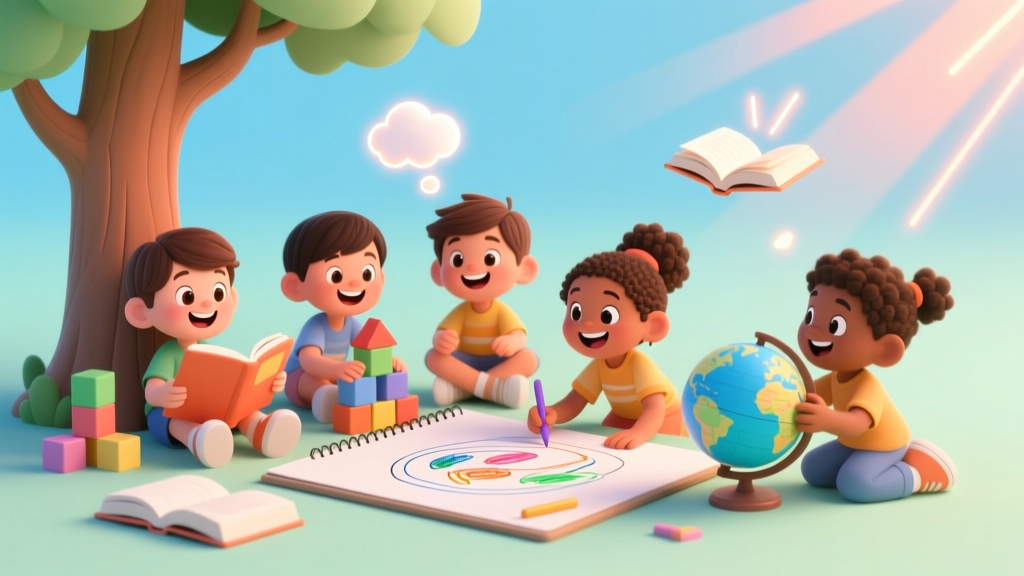
What Age Do Kids Learn to Talk? (2026)
Why This Question Keeps Parents Up at Night (and Why It Matters More Than Ever)
If you’ve ever found yourself staring at your 15-month-old while they babble happily but haven’t said "mama," "dada," or any recognizable word yet — you’re not alone. What age do kids learn to talk is one of the most searched developmental questions online, and for good reason: language is the bedrock of learning, social connection, emotional regulation, and school readiness. Yet misinformation abounds — from well-meaning but outdated advice like 'boys always talk later' to viral TikTok trends promising '3-day talking fixes.' In reality, speech development isn’t a race — but it *is* highly responsive to environment, interaction quality, and timely support. And thanks to advances in early brain plasticity research, we now know the first three years aren’t just important — they’re irreplaceable. Missing subtle cues during this window can delay intervention by months or years, impacting literacy, behavior, and confidence long after preschool.
How Speech Development *Actually* Unfolds (Spoiler: It Starts Way Before First Words)
Speech doesn’t magically appear at 12 months. It’s built on a cascade of pre-verbal foundations — many of which begin in utero and accelerate dramatically between birth and age 2. According to the American Academy of Pediatrics (AAP), infants recognize their mother’s voice by 32 weeks gestation and distinguish phonemes (speech sounds) by 6 months old. What follows isn’t linear, but layered — like building blocks stacked in overlapping phases.
Here’s what the science says about the typical progression:
- 0–3 months: Cooing, vowel-like sounds (“oo,” “ah”), eye contact, responding to voices with smiles or quieting.
- 4–6 months: Babbling with consonant-vowel combos (“ba-ba,” “da-da”), taking turns vocalizing (‘conversational’ back-and-forth), showing interest in faces and sounds.
- 7–12 months: Using gestures (waving, pointing), understanding simple words (“no,” “bye-bye”), imitating sounds, and often saying 1–2 meaningful words (e.g., “mama” used intentionally, not just as babble).
- 12–18 months: Vocabulary of 3–20 words, following simple directions (“give me the ball”), using gestures + words together, and attempting to imitate new words.
- 18–24 months: Combining 2 words (“more milk,” “go park”), vocabulary of 50+ words, understanding 2-step instructions, and using words to express needs, protest, or comment.
Crucially, these ranges reflect population averages — not strict deadlines. As Dr. Nina S. Fink, a board-certified pediatric speech-language pathologist and clinical faculty at Boston Children’s Hospital, explains: “We track trajectories, not timestamps. A child who says their first word at 16 months but then adds 10 new words per week is progressing more robustly than one who hits ‘first word’ at 12 months but stalls for months afterward.”
The 7 Evidence-Based Strategies That Move the Needle (Backed by RCTs & Real Families)
Forget flashcards and screen-based ‘talking apps.’ Decades of peer-reviewed research — including randomized controlled trials published in Pediatrics and the Journal of Speech, Language, and Hearing Research — confirm that the most powerful speech accelerators are human-centered, low-tech, and woven into daily life. Here’s what works — and exactly how to apply it:
- Follow Their Lead (Not Your Agenda): Instead of drilling labels (“Say ‘dog!’”), notice what your child is looking at or reaching for — then narrate it simply and warmly: “You see the dog! Big brown dog!” This builds joint attention, the #1 predictor of language growth. One 2022 longitudinal study followed 127 toddlers and found those whose parents consistently followed their gaze and labeled objects had 32% larger vocabularies at age 2 than peers whose parents initiated 80% of interactions.
- Slow Down & Stretch Out Sounds: When your child babbles “ba-ba,” respond with “BAH-bah! BAH-NA-NA!” — elongating vowels and exaggerating mouth movements. This gives their developing auditory cortex time to process and mimic. Speech therapists call this ‘auditory scaffolding,’ and fMRI studies show it activates mirror neuron networks more intensely than normal-speed speech.
- Pause With Purpose (The 5-Second Rule): After you speak, wait — count silently to 5. Most parents wait less than 1 second before jumping in. But research shows toddlers need 3–5 seconds to formulate a response. In a landmark Vanderbilt University trial, parents trained in strategic pausing saw 2.3x more spontaneous word attempts in their 18-month-olds within just 3 weeks.
- Label Actions, Not Just Objects: Instead of “That’s a spoon,” try “You’re stirring!” or “I’m pouring water.” Verbs drive sentence-building. A 2023 meta-analysis of 17 studies confirmed verb-rich input correlates more strongly with later grammar skills than noun-heavy input.
- Use ‘Expansion,’ Not Correction: If your child says “ball,” respond with “Yes! Big red ball!” — adding 1–2 words without saying “No, say ‘big red ball.’” Correction shuts down attempts; expansion models richer language gently.
- Turn Off Background Noise: TVs, podcasts, and even constant radio reduce language processing efficiency. A University of Washington study found infants exposed to >3 hours/day of background TV had significantly lower expressive language scores at 24 months — even when parents were present and interacting.
- Read the Same Book — Over and Over: Repetition builds neural predictability. When children anticipate “and the cow says…” they’re priming motor planning for speech. Pediatrician Dr. Alan Greene notes: “Rereading builds vocabulary faster than introducing new books weekly — because familiarity frees cognitive space for sound production.”
When to Pause, Observe… and When to Pick Up the Phone
Developmental variation is real — and healthy. But certain patterns warrant professional evaluation *before* age 2. The AAP and ASHA (American Speech-Language-Hearing Association) emphasize that early intervention yields dramatically better outcomes: children who begin therapy before age 2.5 show 2–3x greater gains in language comprehension and expression than those starting after age 3.
Trust your instinct — and cross-check with these evidence-based red flags:
- No babbling or cooing by 6 months
- No back-and-forth sharing of sounds, smiles, or facial expressions by 9 months
- No response to their name by 12 months
- No gestures (waving, pointing, reaching) by 12 months
- No single meaningful word by 16 months
- No two-word phrases (not just echoing) by 24 months
- Loss of previously acquired words or social skills at any age
Importantly, bilingual households should *not* be delayed for evaluation. While bilingual children may say their first word slightly later (by ~1–2 months on average), they should still meet all other milestones — and code-switching or mixing languages is a sign of cognitive strength, not confusion. As Dr. Elena Rodriguez, a bilingual SLP and researcher at NYU, states: “Bilingualism doesn’t cause delay — but it can mask a true disorder if professionals aren’t trained to assess both languages.”
Speech Development Timeline & Milestone Guide
| Age Range | Typical Expressive Language Milestones | Typical Receptive Language Milestones | Red Flag Indicators |
|---|---|---|---|
| 0–6 months | Cooing, smiling when spoken to, making eye contact | Startles to loud sounds, quiets or smiles when hearing familiar voice | No reaction to sounds; doesn’t smile or coo by 4 months |
| 6–12 months | Babbling with consonants (“ba-ba,” “ma-ma”), takes turns vocalizing, says 1–2 words meaningfully by 12 mo | Responds to own name, understands “no” and simple requests (“give me”), looks at objects when named | No babbling by 9 months; no response to name by 12 months |
| 12–18 months | Vocabulary of 3–20 words, uses gestures + words, imitates words | Follows simple 1-step directions (“get the ball”), points to body parts when asked | Fewer than 3 words by 15 months; no consistent word use by 18 months |
| 18–24 months | 50+ words, combines 2 words (“more juice”), uses pronouns (“me,” “mine”) inconsistently | Understands 2-step directions (“get your shoes and put them on”), identifies pictures in books | No 2-word combinations by 24 months; difficulty understanding simple questions |
| 24–36 months | 200–300+ words, uses 3–4 word sentences, tells simple stories, asks “what?” and “where?” | Understands concepts (big/small, in/on), follows 3-step directions, understands basic prepositions | Hard to understand >50% of the time by age 3; frustration due to inability to communicate |
Frequently Asked Questions
My child is 18 months and only says “mama” and “dada” — should I be worried?
Not necessarily — but it’s an ideal time to consult a pediatrician or SLP for screening. At 18 months, many children have 10–20 words, but the range is wide. What matters more than quantity is *how* they use language: Do they point to request? Respond to questions? Try to imitate new sounds? If yes, continue enriching their environment with the strategies above. If not, early evaluation is low-risk and high-reward. Remember: Early Intervention programs (often free or low-cost under IDEA Part C) can provide home-based support with zero diagnosis required.
Does screen time delay speech? What about educational apps?
Passive screen exposure (TV, videos) is linked to expressive language delays — especially before age 2. A landmark JAMA Pediatrics study of 2,400 toddlers found each additional 30 minutes of daily screen time at 24 months correlated with a 49% increased risk of expressive language delay at 36 months. Interactive apps *don’t* compensate: the American Academy of Pediatrics states there’s no evidence that apps teach language better than live interaction. Why? Because babies learn speech through reciprocal turn-taking, reading facial cues, and feeling vocal vibration — none of which screens provide. Save screens for shared viewing *with commentary*, not solo use.
My pediatrician says ‘wait and see’ — but I’m still concerned. What should I do?
Trust your gut — and get a second opinion. Pediatricians are generalists; only ~15% receive formal training in early speech milestones. Request a referral to a certified speech-language pathologist (CCC-SLP) for a comprehensive evaluation — or contact your state’s Early Intervention program directly (search “[Your State] Early Intervention”). No doctor’s referral is needed for EI screening, and evaluations are free. As Dr. Fink emphasizes: “‘Wait and see’ is the most common missed opportunity in early childhood. We’d never wait to evaluate a heart murmur — why wait on language, the foundation of everything else?”
Do boys really talk later than girls? Is that normal?
On average, yes — boys produce their first words ~1–2 months later than girls, and have ~10–20 fewer words at 24 months. But this small gap doesn’t justify ignoring red flags. A 2021 analysis in Child Development confirmed that while sex differences exist, they don’t change clinical thresholds: a boy with no words at 18 months needs the same evaluation as a girl. Attributing delay to ‘just being a boy’ risks missing underlying issues like hearing loss or language disorders that affect both sexes equally.
Can late talkers catch up on their own? What’s the ‘late bloomer’ rate?
About 50–70% of late talkers (those with <10 words at 18 months and no 2-word phrases at 24 months) catch up by age 3–4 without intervention — but this group is hard to predict. Risk factors for persistent delay include: family history of language disorders, limited babbling, poor eye contact, no response to name, or regression. Even ‘bloomers’ often struggle with reading, spelling, or social pragmatics later. A 2020 longitudinal study tracking 187 late talkers found that 38% had clinically significant language impairments by age 5 — and 62% scored below average on kindergarten literacy assessments. Early support doesn’t prevent ‘bloomers’ — it ensures *all* children bloom fully.
Debunking Common Myths
Myth #1: “If they understand everything, their speech will come naturally.”
Understanding (receptive language) and speaking (expressive language) rely on different neural pathways. A child can comprehend complex instructions yet struggle to coordinate mouth muscles, retrieve words, or sequence sounds — especially if they have a specific language impairment (SLI). In fact, 30% of children with SLI have strong receptive skills but severe expressive deficits.
Myth #2: “More words = better language.”
Quantity matters less than *how* words are used. A child who says “cookie” only when demanding food has limited functional communication. But one who uses “cookie” to label, request, protest (“no cookie!”), or comment (“cookie yummy!”) is building flexible, rule-governed language — the precursor to grammar and narrative. Focus on communicative *intent*, not just output.
Related Topics (Internal Link Suggestions)
- Signs of Autism in Toddlers — suggested anchor text: "early autism signs to watch for before age 2"
- Best Books for Language Development — suggested anchor text: "top 10 interactive board books for speech growth"
- How to Choose a Speech Therapist — suggested anchor text: "what to look for in a pediatric SLP"
- Bilingual Language Development Guide — suggested anchor text: "raising bilingual kids without delay"
- Free Early Intervention Resources by State — suggested anchor text: "how to access free speech therapy for toddlers"
Your Next Step Starts Today — Not Tomorrow
You don’t need a diagnosis, a prescription, or a fancy app to support your child’s speech journey. You already have the most powerful tool: your voice, your presence, and your attuned attention. Start tonight — pause longer after you speak, follow their gaze to name what fascinates them, and read that favorite book one more time. Small, consistent actions compound. If your gut whispers ‘something’s off,’ act with kindness — toward your child *and* yourself. Reach out to your pediatrician, call Early Intervention, or find a certified SLP. Because every day of rich, responsive interaction builds neural architecture — and every day of waiting closes a window that won’t reopen. Your child’s first word isn’t just a milestone. It’s the first sentence in the story they’ll tell the world. Make sure they have all the tools — and all the time — to tell it well.
More Articles
 How to Size Kids Shoes: Pediatric Podiatrist Method
 No Sabo Kid: A Compassionate Guide for Parents
 When Can Kids Tie Shoes? Evidence-Based Timeline & Tips
 Normal Heart Rate for Kids: When to Worry (2026)
 Should You Keep Baby Teeth? Dentist Advice 2026
 529 Plan for Multiple Kids: IRS Rules & Tax Traps (2026)
 How Are Kids Tested for Autism? A Parent’s Guide (2026)
 Is Grown Ups Appropriate for Kids? (2026)
 Can Kids Drink Liquid IV? Pediatrician Advice (2026)
 Does Olivia Ray Have Kids? Privacy in Modern Parenting