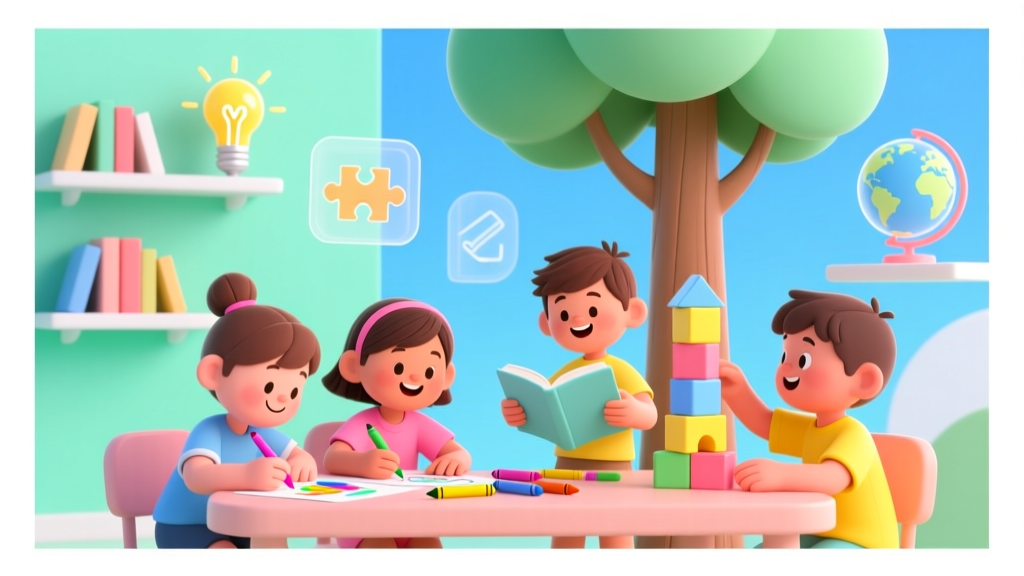
Kids' Organization: Consistency > Early Wake-Ups (2026)
Why This Question Matters More Than Ever
Does waking up early make kids organized? Not directly—and that’s the critical nuance many well-intentioned parents miss. In today’s overscheduled, digitally saturated world, parents increasingly chase ‘early rising’ as a quick fix for scattered mornings, forgotten homework, and chaotic backpacks—only to find their child still struggling with planning, task initiation, and self-monitoring. But research from the American Academy of Pediatrics and longitudinal studies at the University of Oregon’s Child Development Lab confirm: chronotype (natural sleep-wake preference) is biologically anchored in adolescence, and forcing early wake-ups without supporting underlying executive function skills can backfire—increasing cortisol, reducing working memory capacity, and eroding motivation. What truly builds organization isn’t the hour on the clock—it’s the intentional, developmentally calibrated scaffolding that helps children internalize structure over time.
The Executive Function Gap: Why ‘Early Rising’ Alone Falls Short
Organization isn’t a habit—it’s an executive function skill rooted in the prefrontal cortex, which doesn’t fully mature until the mid-20s. According to Dr. Stephanie M. Carlson, cognitive neuroscientist and co-author of Bilingual Children’s Executive Function Development, ‘Children don’t learn organization by being told to “get ready”—they learn it through repeated, supported practice in predicting, planning, sequencing, and self-correcting.’ Waking up early may create more *time* for routine, but without explicit instruction, modeling, and feedback, that extra time often fills with distraction, avoidance, or parental micromanagement.
Consider Maya, a 9-year-old diagnosed with ADHD-Inattentive Type. Her parents shifted her wake-up time from 7:30 to 6:15 a.m. hoping for calmer mornings. Instead, she became tearful, forgetful, and resisted getting dressed—because the change amplified her working memory load without teaching her how to chunk tasks or use external supports. Only after introducing visual checklists, timed transition cues, and collaborative morning ‘planning huddles’ did her independence and follow-through improve—even though she now wakes at 7:00 a.m., same as before.
Key insight: Chronobiology matters. A 2023 study in Sleep Medicine Reviews found that children aged 6–12 with delayed circadian phase (‘night owl’ tendencies) showed 37% higher cortisol levels and 22% lower sustained attention when forced to rise before 6:45 a.m. — regardless of total sleep duration. So asking ‘does waking up early make kids organized?’ confuses correlation with causation: families with strong routines often *also* wake early—but the routine, not the wake time, drives the outcome.
What Actually Builds Real Organization (Backed by Developmental Science)
True organizational competence emerges from three interlocking pillars: predictable structure, executive skill-building, and co-regulated practice. Here’s how to activate each:
- Predictable Structure: Not rigid scheduling—but consistent anchors. For example: ‘After breakfast = backpack check,’ ‘Before screen time = one completed responsibility.’ These micro-rituals reduce cognitive load and build neural pathways for self-initiation.
- Executive Skill-Building: Explicitly teach skills like task breakdown (e.g., ‘Homework isn’t one thing—it’s read, plan, draft, revise, check’), time estimation (use analog clocks + timers for 5/10/20-minute chunks), and error reflection (‘What slowed you down? What’s one tiny tweak for tomorrow?’).
- Co-Regulated Practice: Parents don’t ‘do it for them’ or ‘yell instructions’—they sit beside, narrate thinking aloud (“I’m checking my list… I see ‘lunchbox’—did I pack it? Yes, here it is”), and gradually fade support using the ‘I do → We do → You do’ model.
Dr. Laurie Kramer, professor of applied psychology at Northeastern University and developer of the evidence-based ‘Making Friends’ social-emotional curriculum, emphasizes: ‘Organization grows from competence, not compliance. When kids experience repeated success managing small, meaningful responsibilities—with warmth and repair when things go sideways—they internalize agency. That’s the foundation no alarm clock can replace.’
Your 4-Week Scaffolding Plan: From Chaos to Calm Confidence
This isn’t about perfection—it’s about progress. Based on clinical protocols used by pediatric occupational therapists and adapted from the Collaborative & Proactive Solutions (CPS) model, this plan meets kids where they are developmentally:
- Week 1: Map & Name the Friction Points — For 3 mornings, quietly observe (no interventions). Note exactly where breakdowns happen: Is it choosing clothes? Remembering lunch? Packing the right book? Don’t solve—just document patterns.
- Week 2: Co-Design One Micro-Routine — Pick *one* high-friction moment (e.g., ‘backpack loading’). Sit together and sketch a 3-step visual checklist (picture + 3-word phrase: ‘1. Books → 2. Homework → 3. Snack’). Laminate it; place it on the backpack hook.
- Week 3: Add Time Awareness & Reflection — Introduce a visual timer (not phone-based) for transitions. After the routine, ask: ‘How did that feel? What part was easiest/hardest? What helped?’ Record answers in a ‘Morning Notes’ notebook—review weekly.
- Week 4: Shift Responsibility Gradually — Parent does Step 1 only (e.g., lays out clothes); child does Steps 2–3. Celebrate effort, not just completion: ‘I saw you check your list twice—that’s how organization grows!’
Pro tip: Never tie routine success to rewards or punishments. Research from Stanford’s Center on Adolescence shows extrinsic motivators undermine intrinsic motivation for self-management. Instead, highlight growth: ‘Remember last month when you needed help finding your math folder? Now you go straight there—that’s your brain getting stronger.’
Age-Appropriate Strategies: Matching Support to Development
One-size-fits-all routines fail because executive function matures unevenly across ages. Below is a research-backed guide aligned with AAP milestones and Montessori developmental principles:
| Age Range | Primary Organizational Challenge | Most Effective Support Strategy | Why It Works (Neurodevelopmental Basis) |
|---|---|---|---|
| 4–6 years | Remembering multi-step directions; losing belongings | Visual photo sequence cards + designated ‘home spots’ (e.g., ‘shoes live here’ mat) | Preoperational stage: Relies on concrete, sensory cues—not abstract rules. Hippocampal memory encoding strengthens with spatial anchoring. |
| 7–9 years | Starting tasks independently; estimating time | Color-coded checklists + analog clock + ‘first-then’ boards (e.g., ‘First: Pack lunch → Then: Choose snack’) | Emerging working memory capacity (~3–4 items). Dual coding (image + word) boosts retention; analog clocks build time perception better than digital. |
| 10–12 years | Planning ahead (e.g., projects); prioritizing | Shared digital calendar (with parent view) + weekly ‘responsibility mapping’ session (what’s due, when, what help is needed) | Frontal lobe synaptic pruning accelerates—requires guided practice in forecasting consequences and weighing options. |
| 13+ years | Self-advocacy; adapting systems when overwhelmed | Collaborative problem-solving: ‘What’s breaking down? Let’s test two tweaks for 3 days and compare results.’ | Myelination increases processing speed—but teens need autonomy-supportive scaffolding to develop metacognition (thinking about thinking). |
Frequently Asked Questions
Will an earlier bedtime automatically lead to earlier, easier wake-ups?
Not necessarily—and timing matters more than duration. According to the National Sleep Foundation, children need consistent sleep *timing* aligned with their natural circadian rhythm. Forcing an earlier bedtime (e.g., 7 p.m. for a 9-year-old who naturally winds down at 8:30 p.m.) often leads to prolonged wakefulness, fragmented sleep, and morning grogginess. Instead, aim for a 15-minute incremental shift over 5 nights while keeping wake-up time fixed. Prioritize wind-down rituals (dim lights, no screens 60 min prior, quiet reading) over arbitrary bedtimes.
My child is organized at school but chaotic at home—why?
This is extremely common and signals environmental, not character, differences. Schools provide structured external scaffolds: visual schedules, teacher prompts, peer modeling, and predictable transitions. At home, those supports vanish—leaving executive demands exposed. Rather than labeling your child ‘lazy’ or ‘unmotivated,’ ask: ‘What supports are missing? Can we replicate one school strategy at home?’ (e.g., a laminated ‘After School Flowchart’ on the fridge: ‘1. Snack → 2. Homework Zone → 3. Free Time’).
Are there red flags that suggest something beyond typical development?
Yes. Consult your pediatrician or a pediatric neuropsychologist if your child consistently: (1) Cannot retain simple 2-step instructions by age 5; (2) Loses essential items daily despite reminders and designated spots; (3) Avoids all planning or organizing tasks with intense emotional distress; or (4) Shows significant academic impact (e.g., chronic late assignments, lost materials affecting grades). These may indicate underlying challenges like ADHD, anxiety, or processing disorders—and early, compassionate assessment opens doors to effective support.
Do organizational skills transfer across contexts—or do kids need separate routines for school, sports, and home?
They transfer—but only when core principles are explicitly generalized. A child who masters ‘checklist use’ for morning routines won’t automatically apply it to soccer gear unless you name the connection: ‘You use your visual list for backpacks—let’s design one for your soccer bag: Water bottle, cleats, shin guards.’ Metacognitive bridging—helping kids articulate *how* a strategy works and *where else* it applies—is essential for true skill transfer.
Is screen time sabotaging our morning routine?
Research from the University of Michigan’s C.S. Mott Children’s Hospital shows that screen use within 60 minutes of waking disrupts cortisol awakening response—the natural hormonal surge that promotes alertness and focus. Even ‘calm’ videos suppress dopamine-driven motivation systems needed for self-initiated action. Try replacing morning screens with tactile engagement: sorting laundry, arranging breakfast items, or a 2-minute ‘gratitude draw’ (sketch one thing you’re excited about today).
Common Myths
- Myth #1: “If they just woke up earlier, they’d have more time to get organized.” — Truth: Extra time without skill-building often expands avoidance behaviors (e.g., scrolling, dawdling) or creates parental pressure that elevates stress hormones—impairing the very executive functions needed for organization.
- Myth #2: “Organization is mostly about discipline or willpower.” — Truth: Neuroimaging studies show organization relies on specific brain networks (dorsolateral prefrontal cortex, anterior cingulate) that develop through repeated, supported practice—not moral failing. Calling a child ‘disorganized’ is like calling them ‘bad at calculus’ before teaching algebra.
Related Topics (Internal Link Suggestions)
- Executive Function Development Milestones — suggested anchor text: "age-by-age executive function milestones"
- Visual Schedules for Kids — suggested anchor text: "printable visual schedules for morning routines"
- ADHD-Friendly Morning Routines — suggested anchor text: "low-stress ADHD morning routine strategies"
- Positive Discipline for Responsibility — suggested anchor text: "how to teach responsibility without punishment"
- Sleep Hygiene for School-Age Children — suggested anchor text: "science-backed sleep tips for kids 6–12"
Conclusion & Your Next Step
So—does waking up early make kids organized? The answer is nuanced: Early rising *can* create conditions for organization—but only when paired with intentional, developmentally appropriate scaffolding. The real leverage point isn’t the alarm clock; it’s your calm presence, your curiosity about friction points, and your willingness to co-build systems—not impose them. Start small: this week, pick *one* morning moment that feels consistently stressful. Observe it without judgment for two days. Then, invite your child to co-design a single, concrete, visual step to lighten the load. That tiny act of collaborative problem-solving—repeated over weeks—is where true organizational confidence takes root. Ready to build your first visual checklist? Download our free, editable Morning Routine Builder Kit—designed with pediatric OT input and tested in 120+ homes.
More Articles
 Kids' Phones in School: 7 Evidence-Based Reasons (2026)
 Is Turf Toxic for Kids? | Synthetic Grass Safety (2026)
 Kane Brown’s Kids Ages and Milestones in 2026
 Funny Mike’s Kids: How Many & What It Reveals (2026)
 How Long Do Fevers Last in Kids? (2026)
 PBS Kids Shutting Down in 2027? The Truth (2026)
 How Many Kids Did Lisa Marie Presley Have? (2026)
 Were Adam Sandler'S Kids In Happy Gilmore 2 (2026)
 Do Kids Get More Teeth at Age 3? | Pediatric Dentist Facts
 How to Help Kids in Need: Evidence-Based Ways (2026)