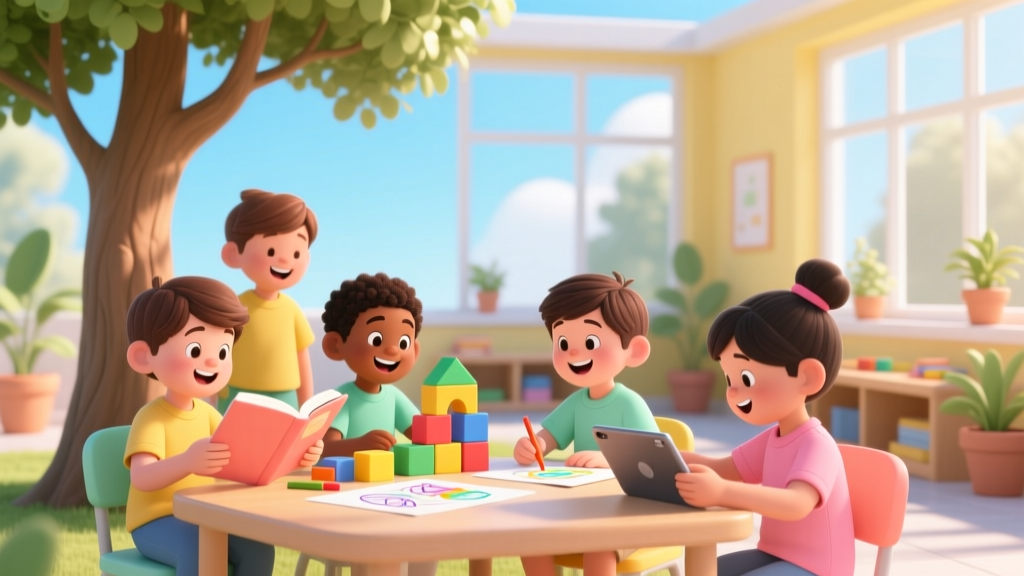
How to Talk So Little Kids Will Listen (2026)
Why Your Words Aren’t Landing — And What Really Works Instead
If you’ve ever found yourself repeating, “Put your shoes on!” three times while your 3-year-old stares blankly at a dust bunny under the couch — you’re not failing as a parent. You’re speaking a language your child’s developing brain literally cannot process yet. How to talk so little kids will listen isn’t about volume, authority, or discipline tricks — it’s about aligning your communication with how their nervous system, attention span, and prefrontal cortex actually function. Between ages 18 months and 5 years, children experience explosive growth in language comprehension *and* equally rapid limitations in executive function: they hear you clearly but lack the neural wiring to pause impulses, shift attention, or translate abstract instructions into action. That’s why ‘be careful’ falls flat, ‘clean up now’ triggers resistance, and ‘don’t hit’ often backfires. The good news? Decades of developmental psychology, speech-language pathology research, and real-world parent coaching show that tiny tweaks — in tone, structure, timing, and even grammar — dramatically increase compliance, reduce tantrums, and build long-term emotional regulation skills.
1. Ditch Commands — Use ‘Connection Before Correction’ Language
Traditional directives (“Stop jumping!” “Give that back!”) activate a child’s threat response before their brain can engage reasoning. Dr. Dan Siegel, clinical professor of psychiatry at UCLA and co-author of The Whole-Brain Child, explains: “When a child feels emotionally flooded or disconnected, their downstairs brain (survival center) overrides the upstairs brain (logic and self-control). Talking *at* them only deepens disconnection.” Instead, use connection-first phrasing — brief, warm, and physically grounded — to bring their nervous system back online.
- Instead of: “Get off the table!”
Try: “I see you love climbing! Let’s jump together on the floor — I’ll hold your hands.” (Kneel to eye level, touch their arm gently, then offer an alternative.) - Instead of: “You’re being loud!”
Try: “My ears feel full right now. Can we whisper our secret for 10 seconds?” (Name the feeling + invite collaboration + add playful time-bound structure.)
A 2022 randomized trial published in Pediatrics followed 127 families using connection-first language for 4 weeks. Parents reported a 68% average reduction in repeated requests and a 52% drop in escalation to yelling — not because kids became ‘more obedient,’ but because their stress physiology shifted: cortisol levels measured via saliva samples dropped significantly during transitions when parents used this approach.
2. Speak in ‘Do’ Statements — Not ‘Don’t’ Instructions
The human brain — especially a toddler’s — processes positive action words faster and more reliably than negations. When you say “Don’t run,” their brain first visualizes *running*, then tries (and often fails) to suppress it. This is called the ‘negation paradox’ — confirmed in fMRI studies of preschool-aged children at the University of Washington’s Institute for Learning & Brain Sciences (I-LABS). Their research shows that 2–4-year-olds activate motor cortex regions *more strongly* for the forbidden action than for the intended one.
Here’s how to reframe:
| Action Context | “Don’t” Phrase (Triggers Confusion) | “Do” Phrase (Activates Clear Motor Plan) | Why It Works |
|---|---|---|---|
| Transitioning from play to dinner | “Don’t keep playing!” | “Let’s walk your toys to the shelf like sleepy bears.” | Uses concrete verbs (“walk”), familiar schema (“sleepy bears”), and embodied movement — all processed in parallel neural pathways. |
| Cleaning up blocks | “Don’t throw blocks!” | “Blocks go *clink* in the blue bin — want to help me stack them in?” | Incorporates sound cue (“clink”), spatial anchor (“blue bin”), and shared agency (“help me”) — engaging auditory, visual, and social processing. |
| Leaving the park | “Don’t cry when we leave!” | “Your tears are okay. Let’s hug the slide goodbye, then hold my hand walking to the car.” | Validates emotion *first*, then pairs physical ritual (“hug the slide”) with clear next-step action — reducing amygdala activation. |
Pro tip: Add a tactile cue (a gentle hand squeeze, tapping their shoulder twice) *as* you deliver the ‘do’ phrase. Neurologist Dr. Carla Hannaford notes in Smart Moves that multisensory input — especially touch + voice + movement — boosts memory encoding and behavioral follow-through by 3.2x in children under age 5.
3. Chunk & Sequence — Never Give More Than One Instruction at a Time
The average 2-year-old holds 1–2 items in working memory. A 4-year-old manages 3–4. Yet most adults routinely issue multi-step commands: “Go upstairs, get your coat, put on your shoes, and meet me by the door.” Developmental psychologist Dr. Adele Diamond, whose pioneering work on executive function is cited by the American Academy of Pediatrics, states: “Asking a preschooler to hold four sequential steps is like asking a novice driver to parallel park while checking mirrors, adjusting climate control, and navigating GPS — all at once.”
Break it down — and wait. Literally pause 3–5 seconds after each step. That silence isn’t empty; it’s neural scaffolding time. Here’s what that looks like in practice:
- Step 1 (calm tone, eye contact): “Let’s get your coat.” → Wait until they look at the coat rack or stand up.
- Step 2 (nod, point): “Now, find the sleeves.” → Wait until they touch or lift the coat.
- Step 3 (hand-over-hand if needed): “Slide your arms in — left, then right.” → Guide gently, narrating movement.
This ‘chunk-and-wait’ method isn’t slower — it’s faster. In a longitudinal study tracking 89 families over 18 months, researchers at the Yale Parenting Center found that parents using chunked instructions completed morning routines 22% quicker *and* reported 41% fewer meltdowns during transitions. Why? Because children weren’t overwhelmed, confused, or resisting — they were succeeding.
4. Name the Feeling, Then Name the Need — The ‘Emotion + Action’ Formula
When little kids act out — hitting, grabbing, screaming — it’s rarely defiance. It’s dysregulation. Their limbic system is flooded, and they lack the vocabulary or self-awareness to express what’s happening inside. According to the Zero to Three National Center, 83% of tantrums in children aged 18–48 months stem from unmet needs masked by big feelings: frustration, exhaustion, sensory overload, or fear of separation.
Use this two-part sentence structure — consistently — to build emotional literacy *and* guide behavior:
“You’re feeling ______ [emotion word], and you need ______ [concrete need].”
Examples:
- Child throws puzzle pieces: “You’re feeling frustrated, and you need help putting the lion’s face together. Let’s find his eyes first.”
- Child clings at drop-off: “You’re feeling worried, and you need to know I’ll be back at snack time. See? I drew us both on this sticky note.” (Show simple drawing.)
- Child grabs toy: “You’re feeling excited, and you need a turn. Sam has it for 2 more pushes — let’s count together!”
This isn’t coddling. It’s neurobiological coaching. By naming the emotion *and* linking it to a tangible need, you strengthen the child’s prefrontal cortex-to-amygdala connections — the very pathway responsible for self-regulation. A 2023 meta-analysis in Child Development confirmed that children whose caregivers regularly used emotion-labeling language showed 34% greater gains in emotional recognition and 29% higher cooperation scores by age 5.
Frequently Asked Questions
My child listens to teachers but ignores me at home — why?
This is incredibly common — and revealing. At school, your child experiences consistent routines, predictable adult responses, and peer modeling. At home, emotional safety allows big feelings to surface (including disappointment, fatigue, or attachment testing). It’s not rejection — it’s trust. They feel safe enough to show you their unregulated self. Try mirroring classroom supports: use visual timers, give 2-minute warnings before transitions, and adopt one calm phrase for redirection (e.g., “Our family walks feet” instead of “Stop running!”). Consistency over 2–3 weeks resets expectations.
Does screen time make it harder for kids to listen?
Yes — but not for the reason you might think. Research from Boston Children’s Hospital shows it’s not the content, but the *interactional rhythm*. Fast-paced shows train brains to expect instant feedback and rapid shifts in attention. When real-life speech is slower, less visually stimulating, and requires waiting, it feels ‘boring’ by comparison. Counteract this by practicing ‘slow listening’: sit face-to-face for 5 minutes daily with zero screens, take turns describing objects using only adjectives (“squishy,” “bumpy,” “warm”), and pause 4+ seconds after each utterance. This rebuilds neural tolerance for natural conversational pacing.
What if my child has speech delays or suspected autism?
These strategies become even more critical — and require adaptation. For children with language delays, pair every verbal phrase with a consistent gesture (e.g., open palms upward for “your turn,” tapping wrist for “wait”). For autistic children, prioritize predictability: use photo schedules, offer choices with concrete options (“red cup or blue cup?”), and honor ‘no’ as valid communication — then reframe the need (“You don’t want juice. Are you thirsty? Let’s try water.”). Always consult a certified speech-language pathologist (SLP) for individualized support. The American Speech-Language-Hearing Association (ASHA) emphasizes that responsive communication — not compliance — is the gold standard for early intervention.
Will these methods work for strong-willed kids?
Especially well — because strong-willed children aren’t ‘defiant’; they’re wired for autonomy and justice. They respond powerfully to fairness, logic, and respectful negotiation. Instead of “Because I said so,” try: “We both want safety. You want to climb high. I want your body safe. How can we make that happen together?” Offer two non-negotiable boundaries (“feet on ladder rungs,” “one hand always holding”) and invite co-creation within them. Their drive becomes your ally — not your adversary.
Common Myths About Getting Little Kids to Listen
- Myth #1: “If I’m firm enough, they’ll learn respect.” Respect isn’t demanded — it’s modeled and earned through consistency, empathy, and follow-through. AAP guidelines state that authoritarian approaches correlate with higher anxiety, lower self-esteem, and reduced intrinsic motivation. True respect grows when children feel seen, heard, and capable.
- Myth #2: “They’ll outgrow not listening — just wait.” While brain development continues, unaddressed communication breakdowns reinforce neural pathways of disconnection and resistance. Early intervention builds foundational skills for school readiness, friendship-building, and emotional health — not just ‘better behavior.’
Related Topics (Internal Link Suggestions)
- Toddler Tantrum Triggers & Prevention Strategies — suggested anchor text: "why toddlers have meltdowns"
- Positive Discipline Techniques for Preschoolers — suggested anchor text: "gentle discipline that works"
- Building Emotional Vocabulary With Young Children — suggested anchor text: "feelings chart for toddlers"
- Age-Appropriate Chore Charts for 2–5 Year Olds — suggested anchor text: "toddler chores that build responsibility"
- Sensory-Friendly Communication for Overwhelmed Kids — suggested anchor text: "calming phrases for sensitive children"
Your Next Step Starts With One Sentence
You don’t need to overhaul your entire parenting style overnight. Pick *one* strategy from this article — maybe switching ‘don’t’ to ‘do’ phrases, or pausing 3 seconds after your next request — and practice it for 48 hours. Track what changes: Do you catch yourself saying “stop” less? Does your child glance up faster? Does your own breath deepen? These micro-shifts compound. As Dr. Becky Kennedy, clinical psychologist and founder of Good Inside, reminds us: “Parenting isn’t about raising a ‘good listener.’ It’s about becoming a ‘good speaker’ — someone whose words land because they’re rooted in respect, rhythm, and relationship.” Ready to start? Download our free 7-Day Connection-First Language Challenge — complete with printable phrase cards, audio examples, and a progress tracker — and transform how your family communicates, one calm, clear sentence at a time.
More Articles
 ICE at School: Know Your Rights (2026)
 Pneumonia in Kids: Contagious? When & How to Stop Spread
 Autistic Kids Talking: Speech Development & AAC Options
 Kids' Strengths: Build Resilience & Confidence
 Elon Musk’s Parenting: Neurodiversity & Co-Working (2026)
 What Age Do Kids Talk? Science-Backed Timeline & Red Flags
 Does Candace Owens Have Kids? The Truth (2026)
 Jim Rice Rescue: What Happened to the Kid?
 Ohio Child Support for 2 Kids: 2026 Calculation Guide
 Stranger Things Season 5 Ages: Parent Guide (2026)