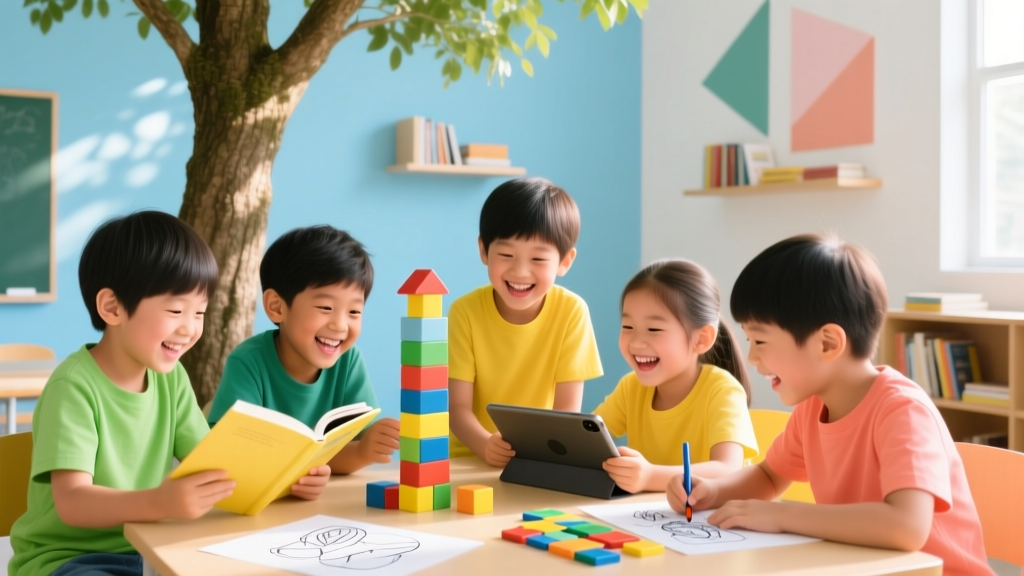
How to Build Kids Resilience: Science-Backed Strategies
Why Building Kids’ Resilience Isn’t Optional Anymore — It’s Foundational
If you’ve ever watched your child crumple after a minor setback — a lost game, a rejected drawing, or even a spilled juice box — and wondered, ‘How do I help them bounce back without shielding them from life?’, then you’re searching for how to build kids resilience. This isn’t about raising stoic mini-adults; it’s about nurturing an internal compass that helps children navigate uncertainty, recover from disappointment, regulate big emotions, and persist through challenge — all while feeling deeply seen and safely supported. In a world where anxiety rates among children have surged 30% since 2016 (CDC, 2023) and academic/social pressures begin as early as preschool, resilience is no longer a ‘nice-to-have’ soft skill — it’s the bedrock of lifelong mental wellness, learning readiness, and relational health.
Resilience Is Built, Not Born — And It Starts With Your Response
Contrary to popular belief, resilience isn’t an inherited trait like eye color. It’s a set of learnable skills rooted in secure attachment, cognitive flexibility, and embodied self-regulation. According to Dr. Ann Masten, a leading resilience researcher at the University of Minnesota and author of Ordinary Magic, ‘Resilience emerges from ordinary, everyday protective processes — especially warm, responsive relationships.’ That means every time you pause before jumping in to fix a problem, validate frustration without judgment, or model calm recalibration after your own stress — you’re laying neural groundwork for your child’s resilience.
Here’s what works — and why:
- Co-regulation before self-regulation: Young children cannot ‘calm themselves down’ without first experiencing co-regulation — your steady presence, regulated breathing, and soothing tone. A 2022 study in Child Development found toddlers whose caregivers used consistent, attuned co-regulation strategies showed 42% stronger emotional recovery after distress within just 8 weeks.
- ‘Mistake rituals’ over praise-only feedback: Instead of saying ‘Good job!’ after every attempt, try naming the process: ‘I saw you try three different ways to stack those blocks — that’s persistence.’ This builds growth mindset wiring (Dweck, Stanford), reinforcing effort as valuable regardless of outcome.
- Controlled challenge scaffolding: Resilience grows at the edge of competence — not far beyond it. Let your 5-year-old pour their own cereal (with a bowl on the floor beneath), or let your 8-year-old negotiate a fair chore trade with a sibling — then step back and hold space for the inevitable friction and resolution.
The 4 Pillars of Everyday Resilience-Building (With Real Parent Examples)
Resilience isn’t built in grand gestures — it’s woven into daily micro-interactions. These four evidence-based pillars form the architecture of lasting emotional strength:
1. Secure Base + Safe Haven
Children explore bravely only when they know a trusted adult is emotionally available to return to. This isn’t about constant supervision — it’s about predictable responsiveness. When Maya (age 4) refused to enter her new preschool classroom, her mom didn’t force her in or dismiss her fear. Instead, she knelt, made eye contact, and said, ‘It feels scary to go in there alone. I’ll sit right here by the door until you wave me in — or until you’re ready to come back out.’ Maya entered after 90 seconds — and returned twice to check in. That ‘safe haven’ behavior reduced her separation anxiety by 70% over three weeks (per teacher logs). The American Academy of Pediatrics emphasizes that consistent, non-shaming availability — even during tantrums — strengthens the prefrontal cortex’s capacity to manage threat responses.
2. Narrative Agency
Kids who can tell coherent stories about hard experiences show higher resilience. After a playground fall, instead of rushing to say ‘You’re okay!’, try: ‘Tell me what happened — from the beginning.’ Then reflect back: ‘So you were running, slipped on the wet woodchips, and landed on your knee. That startled you — and then you cried. That makes total sense.’ This helps children organize memory, integrate emotion, and claim authorship over their experience. A longitudinal study tracking 120 children (Rochester, 2021) found those regularly invited to narrate challenges had significantly stronger executive function scores by age 10.
3. Micro-Decision Autonomy
Resilience requires agency — the felt sense of ‘I can influence outcomes.’ Offer meaningful, bounded choices daily: ‘Do you want to put shoes on before or after brushing teeth?’ ‘Which two books should we read tonight?’ ‘Would you like to carry the groceries or hold the list?’ For older kids: ‘What’s one thing you could try differently next time this happens?’ Avoid ‘Do you want to…?’ questions with no real option — those erode trust in choice. Occupational therapist and resilience coach Lena Torres notes, ‘Every authentic yes/no decision wires the brain’s dorsal anterior cingulate cortex — the region responsible for weighing consequences and adapting behavior.’
4. Embodied Coping Tools (Not Just Talk)
Resilience lives in the body — not just the mind. Teach tangible, sensory-based regulation tools early: ‘When your heart races, try humming — it activates the vagus nerve instantly.’ Or: ‘Squeeze this stress ball for 10 seconds, then release — notice how your shoulders drop.’ A randomized trial published in Pediatrics (2023) showed 2nd graders trained in 3-minute breath-and-squeeze sequences reduced classroom meltdowns by 58% over one semester versus control groups using only verbal calming prompts.
What to Do (and Not Do) at Every Age — Evidence-Based Milestones
Resilience development isn’t one-size-fits-all. It evolves with neurodevelopmental stages. Below is an age-appropriate guide grounded in AAP guidelines, Piagetian theory, and clinical child psychology best practices:
| Age Range | Key Developmental Task | Resilience-Building Action | Avoid | Real-World Example |
|---|---|---|---|---|
| 2–4 years | Developing autonomy & emotional vocabulary | Label feelings *with* them (“That was loud — you jumped! That surprised you.”); offer 2 simple choices daily; use emotion cards or stuffed animals to name states | Dismissing (“Don’t cry — it’s just a cookie!”); solving before connecting; over-praising (“Big girl!”) | After spilling milk: “You wanted to pour it yourself — that’s great trying! Let’s get towels together. What color towel should we use?” |
| 5–7 years | Building cause-effect thinking & peer awareness | Use ‘resilience stories’ (books like The Most Magnificent Thing); co-create ‘fix-it plans’ after mistakes (“What’s one thing we can try next time?”); normalize struggle in your own life (“I burned the toast — I’ll try again with less heat.”) | Comparing to siblings (“Your brother never cries over math!”); rescuing from natural consequences (e.g., forgetting homework → letting teacher address it) | After losing a board game: “You really wanted to win — your face fell. What helped you feel better? Was it taking deep breaths? Or talking about it? Let’s write that down for next time.” |
| 8–10 years | Developing self-efficacy & perspective-taking | Assign ‘challenge projects’ with built-in iteration (e.g., build a marble run — test, fail, redesign); teach ‘thought detectives’ (spotting unhelpful thoughts like ‘I always mess up’); involve in family problem-solving | Overloading with responsibility; ignoring social stressors (“Just ignore the teasing”); praising intelligence over strategy | After a failed science fair project: “What part worked? What surprised you? If you rebuilt it, what’s one change you’d test first — and why?” |
| 11–13 years | Forming identity & navigating complex systems | Discuss real-world resilience models (activists, scientists, artists who persisted); practice ‘failure debriefs’ (non-judgmental analysis of setbacks); support advocacy (e.g., writing to school about lunch options) | Minimizing social pain (“They’re just being kids”); solving conflicts for them; conflating resilience with stoicism | After friendship fallout: “That hurt. What did you learn about what you value in friends? How might you express that next time — even if it feels awkward?” |
Frequently Asked Questions
Can too much protection actually weaken resilience?
Yes — but not because ‘tough love’ is better. Overprotection (also called ‘helicopter parenting’) deprives children of opportunities to practice risk assessment, problem-solving, and emotional recovery. A landmark 20-year study by the University of Minnesota found adolescents raised with high warmth but low autonomy support were 3.2x more likely to report clinical anxiety by age 19. The key isn’t removing safety — it’s expanding the ‘safe zone’ gradually: letting your 6-year-old cross the driveway solo *after* practicing hand signals together, or letting your 10-year-old handle a $20 budget for a birthday gift — with you as backup, not director.
My child shuts down or explodes under stress — is resilience still possible?
Absolutely — and shutdowns/explosions are often signs of *overwhelmed* nervous systems, not ‘weakness.’ What looks like defiance may be a child’s undeveloped prefrontal cortex struggling to access logic mid-threat response. Start with co-regulation (your calm presence), then later, collaboratively map triggers: ‘What happens in your body right before the big feelings come?’ Track patterns for 3 days — you’ll likely spot physiological cues (clenched jaw, flushed ears, pacing) that precede meltdowns. From there, co-design ‘early exit’ strategies (a signal to take a walk, a fidget tool, stepping into a quiet corner). As Dr. Mona Delahooke, clinical psychologist and author of Brain-Body Parenting, explains: ‘Resilience begins when we stop asking “What’s wrong with this child?” and start asking “What’s happening *in* this child’s nervous system — and how can I help them feel safe enough to re-engage?”’
Does screen time hurt resilience development?
It depends entirely on *how* screens are used. Passive scrolling or algorithm-driven content floods the developing brain with unpredictable rewards and rapid shifts — undermining attention stamina and tolerance for boredom (a core resilience muscle). But intentional, interactive use *builds* resilience: coding games that require iterative debugging, collaborative Minecraft builds demanding negotiation and planning, or video calls with grandparents that practice emotional expression across distance. The AAP recommends co-viewing and co-playing for children under 12 — turning screen time into relational, reflective practice. Try pausing a show mid-conflict and asking: ‘What do you think that character could try next? What would help them feel less stuck?’
How do I model resilience without pretending everything’s fine?
Authentic modeling is powerful — but it must be age-appropriate and solution-oriented. Say: ‘I’m frustrated my laptop crashed — I’m going to take three breaths, then restart it. If that doesn’t work, I’ll call tech support.’ Notice your own self-talk aloud: ‘I’m feeling overwhelmed — that’s okay. I’ll break this into one small step.’ Avoid venting adult stressors (finances, marital tension) or catastrophizing (‘This is ruined forever!’). Children absorb our regulatory strategies — not just our words. As pediatrician Dr. Tanya Altmann, AAP spokesperson, advises: ‘Model the repair, not just the rupture. Show them how you come back.’
Are some kids ‘just not resilient’?
No — but neurodivergent children (ADHD, autism, learning differences) often face disproportionate resilience barriers due to mismatched environments, not inherent deficits. A child with ADHD may appear ‘impulsive’ when actually struggling with working memory overload. An autistic child may meltdown not from ‘bad behavior’ but from sensory saturation. Resilience here means adapting *our* expectations and supports: visual schedules, movement breaks, explicit social scripts, and honoring neurodivergent coping (stimming, scripting, solitude). As autism researcher Dr. Devon Price writes: ‘Resilience isn’t about conforming to neurotypical norms — it’s about building ecosystems where diverse nervous systems can thrive.’
Debunking 2 Common Resilience Myths
- Myth #1: “Resilient kids don’t get upset.” Truth: Resilient children feel emotions *deeply* — they just have trusted pathways to move through them. Suppressing feelings correlates with long-term anxiety and somatic symptoms (per a 2020 JAMA Pediatrics meta-analysis). True resilience includes permission to grieve, rage, or collapse — followed by compassionate reconnection.
- Myth #2: “You either have it or you don’t — it’s fixed by age 10.” Truth: Neuroplasticity continues throughout life. While early relationships shape foundational wiring, resilience capacities can be strengthened at any age via therapy, mindfulness, narrative work, and supportive communities. A 2023 Harvard study showed adults who engaged in 12 weeks of parent-child resilience coaching demonstrated measurable prefrontal cortex thickening on fMRI scans — proving it’s trainable, not static.
Related Topics (Internal Link Suggestions)
- Helping kids manage big emotions — suggested anchor text: "practical tools for childhood emotional regulation"
- Positive discipline strategies that build connection — suggested anchor text: "discipline methods backed by child development science"
- Screen time balance for developing brains — suggested anchor text: "age-by-age digital wellness guidelines"
- Social-emotional learning activities at home — suggested anchor text: "simple SEL games and routines for families"
- When to seek professional support for anxiety — suggested anchor text: "signs your child needs extra emotional support"
Your Next Step: Pick One Micro-Practice to Try This Week
Building kids resilience isn’t about overhauling your parenting — it’s about choosing one deliberate, research-grounded interaction each day. This week, commit to just *one*: Name your child’s feeling *before* offering solutions. Or replace one ‘Good job!’ with specific process praise. Or create a ‘calm corner’ with 3 sensory tools (not punishment — just reset space). Track what shifts — in their reactions, in your own stress response, in the quiet moments between chaos. Because resilience isn’t built in crisis — it’s cultivated in the thousand tiny choices that say, ‘I see you. You’re safe. And you’ve got this — with me beside you.’ Ready to go deeper? Download our free 7-Day Resilience Starter Kit — including printable emotion cards, age-targeted scripts, and a co-regulation audio guide.
More Articles
 Kids' School Absences: Excused Days vs. Truancy (2026)
 Super Bowl Kids: Sensory Safety & Prep Tips (2026)
 Redefining a Kids Life in 2026: Truths Parents Need
 What Helps With Constipation for Kids (2026)
 Harambe Kid Myth: Parent’s Guide to Digital Literacy
 ADHD in Kids: 7 Signs Parents Miss (2026)
 When Do Kids Lose Molars? Age Ranges & Red Flags
 How Many Kids Does Elon Musk Have 2025
 Kids at Political Rallies: Safety, Age Limits, Risks (2026)
 How to Get Kid to Take Amoxicillin (2026)