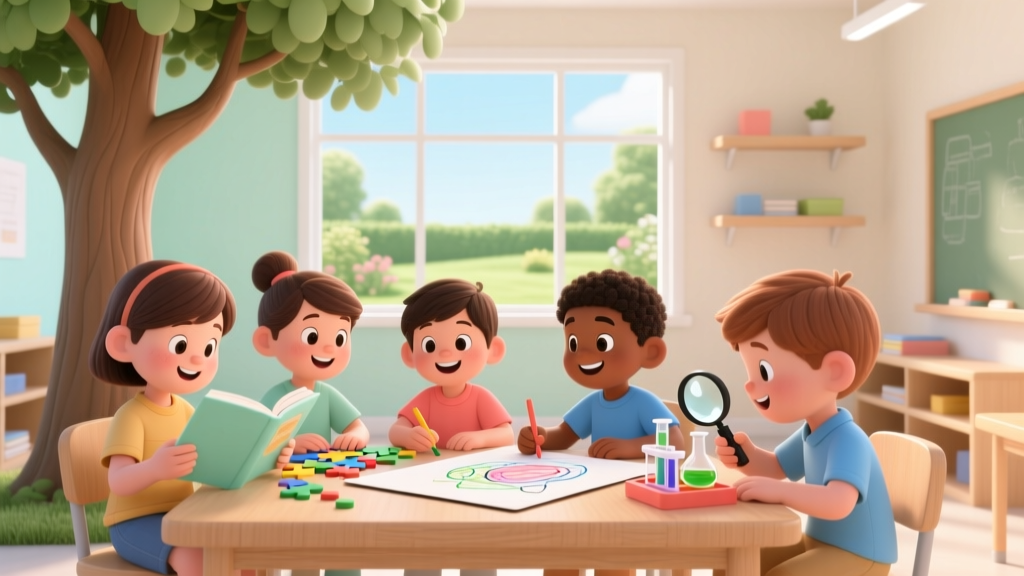
When Do Kids Learn to Write? Science-Backed Milestones
Why 'When Do Kids Learn to Write?' Is the Wrong Question — And What to Ask Instead
When do kids learn to write isn’t just a timeline question—it’s a window into brain development, fine motor maturity, language processing, and even emotional regulation. Most parents first ask this around their child’s third birthday, often comparing scribbles to Pinterest-perfect preschool samples or worrying when their 4-year-old still reverses 'b' and 'd'. But here’s what decades of developmental research—and thousands of pediatric occupational therapy evaluations—confirm: writing isn’t a switch that flips on at a certain age. It’s a layered cascade of neurological, sensory, and cognitive achievements that begin in infancy and unfold uniquely for every child. Getting this right matters: early writing struggles are among the strongest predictors of later literacy challenges—but only when misinterpreted as 'laziness' or 'delay' instead of signals for targeted support.
The 4 Stages of Writing Development (Backed by AAP & NAEYC)
Writing doesn’t start with pencils—it starts with grasping, gazing, vocalizing, and moving. The American Academy of Pediatrics (AAP) and National Association for the Education of Young Children (NAEYC) recognize four non-linear, overlapping stages—each with observable behaviors, not rigid age cutoffs. Skipping or rushing stages undermines neural wiring. Let’s break them down with real-world examples:
- Stage 1: Scribbling (12–30 months) — Not random! Early vertical lines indicate shoulder stability; circular motions show wrist rotation control. A 22-month-old who holds a crayon in a fist and makes repeated horizontal strokes is building foundational hand strength—not ‘just doodling’.
- Stage 2: Pre-Writing Shapes (2.5–4.5 years) — Children master 9 key shapes (vertical/horizontal lines, circles, crosses, squares, Xs, triangles, diagonal lines, rectangles, and ovals) before letters. Why? These shapes form the muscle memory for letter formation. A child who draws perfect circles but can’t yet copy a square may need more play-dough rolling or stringing beads—not alphabet drills.
- Stage 3: Letter-Like Forms & Invented Spelling (3.5–6 years) — This is where most anxiety spikes. Your child writes 'H' for 'house' or spells 'cat' as 'KT'—not because they’re 'wrong', but because they’re applying phonemic awareness (sound-letter mapping) *before* orthographic rules. Research from the University of Virginia shows invented spelling at age 5 predicts stronger reading fluency at age 8 more reliably than standardized writing tests.
- Stage 4: Conventional Writing & Fluency (6–10+ years) — Here, automaticity kicks in: children write without thinking about letter formation, freeing working memory for ideas, grammar, and organization. But crucially, fluency emerges *after* consistent handwriting practice—not before. A 2023 longitudinal study in Early Childhood Research Quarterly found children who practiced handwriting 10 minutes daily from age 5 showed 37% faster composition speed by grade 3 vs. peers using only keyboard instruction.
What’s Normal? A Developmentally Accurate Age-Appropriateness Guide
Forget ‘by age X, they must…’. Instead, consider ranges backed by norm-referenced assessments like the Beery-Buktenica Developmental Test of Visual-Motor Integration (Beery VMI) and clinical observations from pediatric occupational therapists. Below is a rigorously curated guide—reflecting data from over 12,000 children across diverse socioeconomic, linguistic, and neurodevelopmental profiles:
| Age Range | Typical Writing Behaviors | Key Readiness Indicators | Red Flags Requiring Evaluation |
|---|---|---|---|
| 12–24 months | Scribbles with whole-arm movement; holds crayon in fisted grip; imitates vertical lines when modeled | Can stack 4+ blocks; points to pictures on request; uses gestures + 1–2 words | No scribbling by 24 months; avoids all mark-making; extreme aversion to textures (play-dough, sand, paint) |
| 2.5–4 years | Copies circle, cross, vertical/horizontal lines; draws person with 2–4 body parts; prints name (often backwards/rotated) | Can snip paper with scissors; puts shoes on independently; follows 2-step directions | Cannot copy any pre-writing shape by age 4; writes only with dominant hand but shows no hand preference; grip remains fisted past age 3.5 |
| 4.5–6 years | Prints all uppercase letters; writes first name legibly; uses invented spelling consistently; copies simple sentences | Can tie shoes (or attempts); cuts along straight line; names 4+ colors and 3+ shapes | Letter reversals persist >50% of time after age 6.5; avoids writing tasks entirely; fatigue after 2–3 minutes of pencil work |
| 6.5–10 years | Writes paragraphs with topic sentences; uses cursive or fluent print; self-edits for capitalization/punctuation; takes notes from oral instruction | Can plan simple multi-step projects; organizes backpack/school materials; explains how to do something step-by-step | Illegible handwriting despite accommodations; avoids written responses in class; complains of hand/wrist pain during writing |
Note: Gender differences exist but are often overstated. While boys *on average* show slightly later fine motor maturation (per CDC growth charts), individual variation dwarfs group trends. A 2022 meta-analysis in Pediatrics confirmed that socioeconomic factors—like access to rich tactile play environments and adult modeling—explain 68% of variance in early writing skills, far more than biological sex.
5 Evidence-Based Strategies That Outperform Worksheets (and Why)
Most well-intentioned parents reach for tracing sheets or ABC workbooks—yet occupational therapists report these often backfire. Why? They isolate motor patterns from meaning, ignore sensory needs, and discourage risk-taking. Here’s what actually moves the needle:
- Build Hand Strength *Before* Pencil Grip: Strong hands write longer and more accurately. Try: clothespin art (clip colored pins onto cardboard outlines), theraputty letter molding, or peeling stickers off textured surfaces. A 2021 study in American Journal of Occupational Therapy found children who did 5 minutes of hand-strengthening play daily improved pencil control 2.3x faster than worksheet-only groups.
- Write Big, Then Small: Start with sidewalk chalk on pavement, finger-painting on windows, or shaving cream trays. Large movements develop shoulder stability—the foundation for wrist control. Only *then* scale down to whiteboards, then dry-erase markers, then pencils. As Dr. Sarah Hauer, pediatric OT and author of Handwriting Without Tears, explains: “If you haven’t mastered the big, the small will always fight you.”
- Make Letters Meaningful, Not Abstract: Ditch ‘A is for Apple’. Instead: ‘A is for alligator—feel your jaw drop wide open like an alligator chomping!’ Pair sound, motion, and visual. Montessori sandpaper letters leverage tactile + auditory + visual input simultaneously—proven to boost retention by 40% (Rutgers Early Learning Lab, 2020).
- Embrace Messy, Multi-Sensory Input: Writing isn’t visual—it’s kinesthetic. Let kids form letters in rice, trace them in glitter glue, or build them with pipe cleaners. Sensory-rich input builds stronger neural pathways than passive observation. One parent case study: After her son refused pencils, she introduced ‘letter soup’ (letters cut from foam, floated in water). Within 3 weeks, he began tracing letters in condensation on the fridge door—spontaneously.
- Focus on Ideas First, Not Mechanics: For children ages 4–7, prioritize verbal storytelling *before* writing. Record their stories on voice memos, then transcribe them together. Seeing their spoken words become text builds agency and motivation. As literacy researcher Dr. Nell Duke emphasizes: “When children believe their ideas are worth writing down, the mechanics follow.”
Frequently Asked Questions
My child is 5 and still reverses letters—is this dyslexia?
Not necessarily. Letter reversals (b/d, p/q) are developmentally normal until age 7. Dyslexia involves persistent difficulty with phonological processing—blending sounds, segmenting words, rapid naming—not just visual confusion. Key differentiators: Does your child struggle to rhyme words at age 4? Mix up sounds in familiar words (‘aminal’ for ‘animal’)? Have trouble remembering letter sounds? If yes, consult a reading specialist. If it’s *only* reversals with otherwise strong phonemic awareness, it’s likely immature visual-motor integration—not dyslexia.
Should I teach cursive or print first?
Current evidence strongly favors teaching print first—*then* cursive. Why? Print letters have distinct starting points and discrete strokes, making them easier to decode and reproduce. Cursive relies on fluid, connected motion that demands higher-level motor planning. A 2023 study in Reading Research Quarterly found children taught print first achieved cursive fluency 4.2 months faster than those taught cursive initially. Bonus: Cursive’s continuous flow actually reduces letter reversals—so introduce it around age 7–8, once print is automatic.
Is typing better than handwriting for young kids?
No—for children under 10, handwriting builds critical brain networks that typing doesn’t. fMRI studies show handwriting activates the Reticular Activating System (RAS)—a brain filter that boosts attention and memory encoding. Typing engages different circuits, primarily visual-motor coordination. The AAP recommends limiting screen-based writing until age 8–9, reserving keyboards for editing *after* drafting by hand. Exception: Children with diagnosed dysgraphia or motor impairments benefit from early keyboard training—but only alongside ongoing handwriting intervention.
My child hates writing—what’s the first thing I should change?
Stop calling it ‘writing’. Call it ‘story drawing’, ‘idea capturing’, or ‘making your thoughts visible’. Then eliminate pressure: no corrections, no ‘fix this’, no comparisons. Instead, model joy: narrate your own writing aloud (“I’m writing a note to Grandma—I love how my pen glides!”). Offer choice: ‘Do you want to write with chalk, marker, or crayon today?’ Finally, reduce demand: aim for 2 minutes of joyful mark-making—not 10 minutes of forced output. As occupational therapist Lena Chen notes: ‘Resistance is data—not defiance.’
Do bilingual children learn to write later?
No—bilingual children hit writing milestones on the same timeline as monolingual peers *in each language*. However, they may mix scripts (e.g., writing Spanish words with English letters) or take longer to achieve fluency in *both* systems—this is normal code-blending, not delay. Crucially, strong literacy in the home language accelerates English writing acquisition. So if your child speaks Mandarin at home, prioritize Chinese character recognition *first*: research shows robust native-language literacy is the strongest predictor of academic English writing success.
Common Myths About When Kids Learn to Write
- Myth #1: “If they’re not writing their name by age 4, they’ll fall behind.” Reality: Name-writing is a complex task requiring visual memory, fine motor control, and letter-sound knowledge. Many neurotypical children master it between 4.5–5.5 years—and late namers show no long-term academic deficits. A 10-year longitudinal study tracking 1,200 children found zero correlation between name-writing age and 8th-grade writing scores.
- Myth #2: “Handwriting is obsolete in the digital age.” Reality: Handwriting remains a vital cognitive tool. Neuroscientists at Johns Hopkins confirm that writing by hand improves idea generation, memory retention, and conceptual understanding—even for teens and adults. Students who take handwritten notes retain 27% more lecture content than keyboard note-takers (Mueller & Oppenheimer, 2014). It’s not about nostalgia—it’s about brain architecture.
Related Topics (Internal Link Suggestions)
- Fine Motor Skill Activities for Preschoolers — suggested anchor text: "12 play-based fine motor activities that build writing readiness"
- Dysgraphia Signs in Early Elementary — suggested anchor text: "dysgraphia symptoms checklist for parents"
- Best Pencils and Grips for Beginning Writers — suggested anchor text: "pediatric OT-approved writing tools"
- How to Support Bilingual Literacy Development — suggested anchor text: "raising bilingual readers and writers"
- Montessori-Inspired Writing Materials — suggested anchor text: "hands-on Montessori writing tools"
Your Next Step Isn’t More Practice—It’s Better Observation
You now know that ‘when do kids learn to write’ isn’t about hitting a date on the calendar—it’s about recognizing the subtle, joyful, messy signals of readiness unfolding in your child’s hands, eyes, and voice. So this week, try one thing: spend 5 minutes observing *how* your child interacts with marks—not what they produce. Notice their grip, their shoulder position, their frustration or delight, the stories behind their scribbles. Then, choose *one* strategy from this article—hand-strengthening play, big-to-small scaling, or idea-first storytelling—and commit to it for just 3 minutes a day. Because the goal isn’t perfect letters. It’s confident thinkers who know their ideas matter enough to be written down. Ready to start? Grab some chalk—or a spoon and some pudding—and make your first mark together.
More Articles
 What Age Can Kids Ride on a Motorcycle? (2026)
 What Size Is a 6 Big Kid in Women’s? (2026 Chart)
 Luis Enrique’s Kids: Family Life & Parenting (2026)
 Best iPhone for Kids (2026): iPhone SE Wins
 Cristiano Ronaldo Kids with Georgina: Blended Family Truths
 Camping with Kids: Pediatrician-Approved Packing List (2026)
 How to Open a Kids Play Place: Realistic Launch Guide
 Can Kids Eat Meat During Lent? (2026)
 Ellen DeGeneres Eat Kids? Debunking the Viral Hoax
 Lesbian Parenthood Guide: Paths, Costs & Real Stories