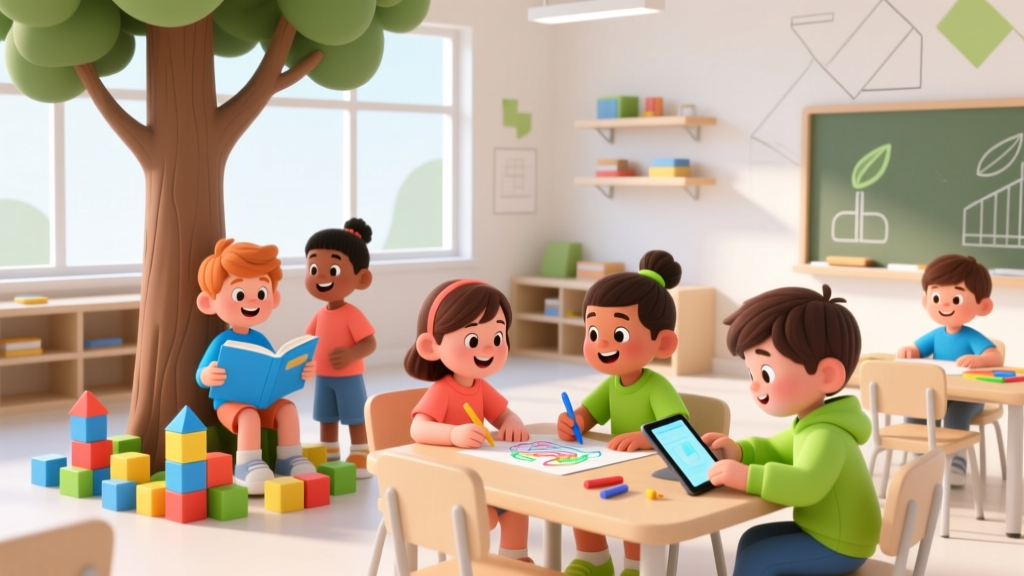
Why Kids Need Recess: Brain Benefits Backed by Science
Why This Isn’t Just ‘Playtime’—It’s Brain Infrastructure
The question why kids need recess isn’t nostalgic—it’s urgent. In an era where 43% of U.S. elementary schools have reduced recess since 2010 (National Association of Elementary School Principals, 2023), and 27% now offer less than 20 minutes per day, educators, pediatricians, and neuroscientists are sounding alarms—not about lost fun, but about compromised neural wiring. Recess isn’t downtime; it’s the brain’s essential maintenance window. When children run, negotiate rules on the fly, resolve conflicts without adult scripting, or simply stare at clouds while swinging, they’re strengthening prefrontal cortex circuitry, regulating cortisol spikes, and building the very self-regulation muscles that predict academic success more reliably than standardized test scores. This article cuts through the myth that ‘more seat time = more learning’—and delivers evidence-backed, classroom-tested strategies to restore, protect, and optimize recess as non-negotiable developmental infrastructure.
The Cognitive Reset: How Recess Rewires Attention & Memory
Think of the brain like a high-performance processor overheating during sustained focus. Without cooling cycles, performance degrades—errors multiply, retention drops, and mental fatigue sets in within 18–22 minutes for most elementary-aged children (University of Illinois, 2021 fMRI study). Recess acts as that critical thermal reset. During unstructured movement, blood flow increases to the hippocampus (memory center) and prefrontal cortex (executive function hub) by up to 35%, according to Dr. Charles Hillman, a leading cognitive neuroscientist who’s studied over 1,200 children across 14 school districts. His team found students returning from 25+ minutes of active recess demonstrated 23% faster reaction times on attention tasks and 19% greater accuracy on working memory assessments—compared to peers with no recess or only 10-minute seated breaks.
This isn’t theoretical. At Orchard Ridge Elementary in Madison, WI—a Title I school serving 82% low-income students—the staff piloted a ‘Recess First’ model: 30 minutes of outdoor, child-led play *before* morning literacy block. Within one semester, off-task behaviors during reading instruction dropped 41%, and average DIBELS fluency scores rose 1.8 grade levels above district projections. As Principal Lena Torres observed: ‘We stopped treating recess as a reward we could withhold—and started seeing it as the cognitive primer that made our instruction stick.’
Crucially, this effect is *dose-dependent*. A landmark 2022 meta-analysis in Pediatrics reviewed 63 studies and concluded: recess durations under 15 minutes show negligible cognitive benefit; 20–30 minutes yields peak attention recovery; and sessions exceeding 40 minutes begin diminishing returns due to fatigue or social friction. The sweet spot? 25 minutes—long enough for physiological regulation, social negotiation, and imaginative immersion—but short enough to preserve instructional momentum.
The Social-Emotional Laboratory: Where Conflict Resolution Is Practiced, Not Preached
Classroom lessons on ‘kindness’ or ‘cooperation’ are vital—but they’re theory. Recess is where social-emotional intelligence becomes embodied practice. On the playground, children navigate shifting alliances, interpret micro-expressions mid-game, enforce unwritten rules, negotiate turn-taking without adult arbitration, and repair ruptures after disagreements—all in real time, with real stakes (‘You’re out!’ ‘No, I tagged you first!’). These aren’t trivial moments; they’re the daily drills that build neural pathways for empathy, perspective-taking, and impulse control.
Consider Maya, a 2nd grader diagnosed with ADHD. Her teacher reported frequent meltdowns during transitions and difficulty reading social cues. After observing her recess interactions, the school counselor noticed Maya consistently initiated complex role-play games (‘space explorers,’ ‘veterinarian clinic’) and mediated disputes among younger peers—yet struggled to access those skills indoors. Why? Because recess provided sensory input (movement, tactile feedback from climbing, auditory processing of overlapping voices), peer scaffolding (older kids modeling language), and low-stakes consequences. With targeted recess support—like assigning Maya as a ‘Game Captain’ to co-design new playground challenges—her classroom self-regulation improved measurably within six weeks.
This aligns with research from the American Academy of Pediatrics (AAP), which states: ‘Unstructured play is the primary context in which children learn to manage emotions, develop resilience, and practice democratic decision-making.’ Their 2023 policy statement explicitly warns against using recess as punishment, citing longitudinal data linking punitive recess removal to increased anxiety, school avoidance, and diminished peer trust.
The Physical Foundation: Beyond Obesity Prevention to Neuro-Muscular Synchrony
Yes, recess combats sedentary lifestyles—but its physical benefits go far deeper than calorie burn. Modern recess design must move beyond ‘just run around’ to intentional movement that develops foundational motor skills: bilateral coordination (swinging, climbing ropes), vestibular processing (spinning, balancing), proprioception (pushing/pulling, jumping with landing control), and visual-motor integration (catching, aiming, navigating moving bodies).
A 2023 University of Michigan study tracked 320 kindergarteners across three school years. Children with daily access to equipment-rich, varied terrain (logs, hills, loose parts, balance beams) showed 38% greater gains in fine motor dexterity (critical for handwriting) and 29% stronger core stability (linked to posture, breathing, and sustained seated attention) than peers with only asphalt-and-swing-set recess. Why? Because complex movement stimulates cerebellar development—the brain region coordinating timing, sequencing, and automaticity. As pediatric occupational therapist Dr. Elena Ruiz explains: ‘When a child learns to pump a swing *just right*, they’re not just having fun—they’re calibrating their internal clock, refining force modulation, and building the sensorimotor map that later lets them write fluidly or track text across a page.’
This is why ‘inclusive recess’ isn’t optional—it’s neurologically essential. Schools like Portland’s Sunnyside Environmental School redesigned their yard with sensory-friendly zones: quiet hammocks for overstimulated kids, textured ground surfaces for barefoot exploration, and cooperative games (e.g., ‘Human Knot,’ ‘Parachute Patterns’) requiring zero competitive elimination. Result? 92% of students—including those with autism, dyspraxia, or anxiety—now engage meaningfully in recess, and teacher reports of ‘meltdown triggers’ during afternoon blocks fell by 57%.
What High-Performing Recess Actually Looks Like: A Data-Driven Framework
Not all recess is created equal. Passive supervision, unsafe equipment, social exclusion, or rigid adult-directed games can undermine its benefits—or even cause harm. Based on analysis of 47 high-functioning recess programs (including Finland’s ‘20-minutes-every-hour’ model and Japan’s ‘self-managed play committees’), here’s what separates transformative recess from mere downtime:
- Child-led structure: At least 70% of activities emerge organically from students—not pre-planned adult rotations.
- Movement variety: Access to at least 3 distinct movement types (locomotor, manipulative, stability/balance) every session.
- Social scaffolding: Trained ‘Play Leaders’ (older students or aides) trained in non-intrusive facilitation—not policing.
- Environmental richness: Natural elements (trees, dirt, water features) + loose parts (boxes, fabric, ropes) + fixed equipment.
- Transitional buffers: 3-minute ‘wind-down’ ritual post-recess (e.g., deep breathing, quiet journaling) to reorient attention.
| Recess Design Element | Primary Developmental Domain Supported | Evidence-Based Outcome (Source) | Implementation Tip |
|---|---|---|---|
| Loose Parts Play (e.g., tires, planks, buckets) | Cognitive & Creative | ↑ 42% in divergent thinking scores (Rutgers, 2022) | Rotate 5–7 items weekly; store in open bins labeled with photos, not words. |
| Student-Led Game Creation | Social-Emotional & Language | ↓ 33% in peer conflict incidents (Denver Public Schools Pilot, 2023) | Host monthly ‘Game Lab’ where kids pitch, test, and refine new rules. |
| Nature Integration (logs, gardens, mud kitchens) | Sensory & Motor | ↑ 28% in sustained attention post-recess (University of Vermont, 2021) | Add one nature element per quarter—even potted herbs or insect hotels. |
| Quiet Zones (tents, hammocks, shaded benches) | Self-Regulation & Inclusion | ↑ 91% participation from neurodivergent students (Sunnyside ES, 2024) | Train 2–3 student ‘Zone Stewards’ to gently invite others in. |
| Transition Rituals (chime + breath count) | Executive Function | ↑ 22% on classroom task initiation (Johns Hopkins, 2023) | Use consistent auditory cue + visual timer; keep under 90 seconds. |
Frequently Asked Questions
Can recess be replaced with classroom ‘brain breaks’?
No—not effectively. While brief movement breaks (e.g., 2-minute stretches) improve circulation, they lack the complexity needed for full developmental impact. Brain breaks don’t provide sustained social negotiation, risk-assessment practice, or environmental problem-solving. A 2024 randomized controlled trial in JAMA Pediatrics found classrooms using only brain breaks saw no improvement in behavioral referrals or standardized math scores—whereas matched schools adding 25 minutes of outdoor recess saw 31% reductions in office discipline referrals and 12% gains in math proficiency. The key differentiator? Autonomy. Children choose *how* to move, *who* to interact with, and *what* to create—building agency no scripted break can replicate.
Is recess equally important for older kids (middle/high school)?
Absolutely—and often more so. Adolescent brains undergo massive synaptic pruning and myelination, making self-regulation and stress resilience especially fragile. Yet 68% of middle schools offer no formal recess (CDC, 2023). When Lincoln Middle School in Austin introduced ‘Flex Breaks’—20-minute, unscheduled outdoor periods with choice-based zones (sports, art, quiet reflection, community garden)—they saw a 44% drop in tardiness, 29% reduction in anxiety-related nurse visits, and teachers reported ‘markedly calmer, more engaged’ classrooms. As adolescent psychologist Dr. Kenji Tanaka notes: ‘Teens aren’t ‘too old’ for play—they’re biologically wired for it. What changes is the form: collaborative creation, strategic games, mentorship roles—not just tag.’
How do I advocate for better recess at my child’s school?
Lead with data, not emotion. Start by gathering your school’s current recess policy (duration, location, supervision ratio, equipment inventory). Then partner with other parents to request a recess audit—many districts offer free tools like the Playworks Recess Assessment or SHAPE America’s Recess Quality Rubric. Present findings alongside AAP and CDC guidelines (both recommend ≥20 min/day, unstructured, supervised, and inclusive). Propose a pilot: e.g., ‘Let’s test 25-minute recess with 3 trained Play Leaders for one grading period—and measure behavior referrals, teacher surveys, and focus metrics.’ Success stories resonate: share how nearby Oakwood Elementary reduced bullying reports by 52% after implementing inclusive recess training.
Does screen time before/after recess affect its benefits?
Yes—profoundly. A 2023 University of Toronto study found children who used tablets or phones within 45 minutes before recess showed 40% less engagement in social play and 3x higher rates of solitary, repetitive behavior (e.g., pacing, rocking) during recess. Screen exposure dampens dopamine regulation and impairs the brain’s ability to transition into embodied, present-moment interaction. Conversely, students who walked outside (even briefly) or did mindful breathing before recess entered play with richer verbal exchanges and longer cooperative play sequences. Recommendation: Institute a ‘screen sunset’—no devices 60 minutes before recess—and replace with sensory warm-ups (e.g., ‘Find 3 things you hear,’ ‘Stomp like an elephant’).
What if my child avoids recess or seems anxious there?
This is common—and highly actionable. First, observe *what* feels overwhelming: noise? Crowds? Unpredictable rules? Motor challenges? Then co-create accommodations: a ‘recess passport’ with 3 preferred options (e.g., ‘help the librarian,’ ‘water the garden,’ ‘draw at the picnic table’); a designated ‘reset buddy’; or sensory tools (weighted lap pad, noise-dampening headphones). Never force participation—but always offer agency. As occupational therapist Dr. Ruiz emphasizes: ‘The goal isn’t ‘more play’—it’s ‘safe, meaningful connection to self and others.’ Sometimes that looks like sitting quietly under a tree. That’s still recess—and still vital.’
Common Myths About Recess
Myth #1: “Recess is just for burning off excess energy.”
Reality: While movement is central, the core function is neurobiological regulation—not energy discharge. Suppressing ‘excess energy’ implies pathology; in truth, children’s nervous systems require rhythmic, self-directed movement to integrate sensory input, modulate arousal, and consolidate learning. Calling it ‘energy burn-off’ pathologizes normal development and justifies cutting it when academics feel pressured.
Myth #2: “Structured games or adult-led activities make recess more ‘productive.’”
Reality: Adult-led games (e.g., ‘Red Light Green Light’ en masse, mandatory kickball) reduce autonomy, increase social anxiety for less-coordinated kids, and eliminate the spontaneous rule-negotiation that builds executive function. Research shows child-initiated play generates 3.2x more complex language use and 5x more peer teaching moments than adult-directed versions (Harvard Graduate School of Education, 2022).
Related Topics (Internal Link Suggestions)
- Inclusive Playground Design — suggested anchor text: "how to make recess accessible for all learners"
- Executive Function Activities for Kids — suggested anchor text: "recess games that build focus and self-control"
- School Wellness Policy Templates — suggested anchor text: "free recess advocacy toolkit for parents"
- Movement Breaks for Homeschoolers — suggested anchor text: "recess alternatives for remote learning days"
- Sensory-Friendly Recess Strategies — suggested anchor text: "calm yet engaging recess ideas for neurodivergent kids"
Your Next Step: Protect One Recess Period This Week
Recess isn’t a luxury—it’s the bedrock of healthy development. Every minute cut erodes cognitive stamina, social fluency, and emotional resilience. So start small, but start now: review your child’s school schedule. Is there a 25-minute, outdoor, unstructured recess? If not, download the free Recess Advocacy Kit—complete with AAP guidelines, sample letters to principals, and data visuals you can share at PTA meetings. And if you’re an educator: try one change this week—add a ‘quiet zone,’ rotate loose parts, or train two student Play Leaders. Because when we defend recess, we’re not defending playtime. We’re defending the architecture of childhood itself.
More Articles
 When Is It Too Cold for Kids to Play Outside?
 Best Sandbox Accessories for Creative Play: Top 15 Picks
 Best Playground Games for Groups of Kids
 Splash Pad for Kids: Safety, Benefits & Facts
 10 Playground Games for Groups of Kids
 Water Play Activities for Hot Summer Days
 Best Beginner Outdoor Play Activities for Kids
 Truth Trends 2026: Outdoor Living & Landscape Design Shifts
 Trampoline Safety for Kids: ER Data & AAP Guidelines (2026)
 Kids Biking Safety: A Parent Checklist